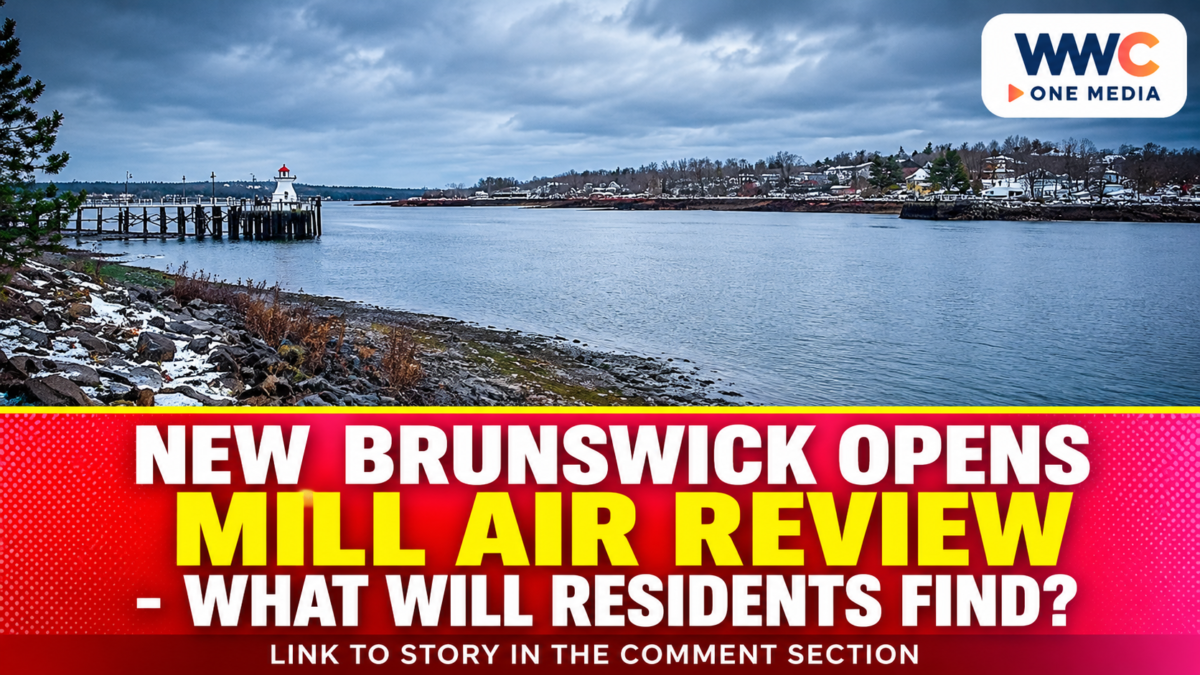
ST. STEPHEN, New Brunswick — November 26, 2026 — Residents of St. Stephen are being invited to weigh in on the air-quality approval for a major wood-products mill, reopening public scrutiny of an industrial site that was previously the subject of an air-monitoring investigation following community complaints.
The Government of New Brunswick began a 180-day public participation process on November 25 for the renewal of Arauco Canada Limited’s Class 1 air-quality approval. The facility produces medium-density fibreboard and particleboard using hardwood chips, softwood shavings and other residual wood fibre.
Its current operating approval expires on June 30, 2027.
The review does not mean the mill has been found to violate its existing permit. Government documents show that the facility has reported compliance with its principal emissions limits and that a separate monitoring project found no exceedances of regulated provincial air-quality objectives.
But the public record also identifies emissions that require oversight, including particulate matter, formaldehyde and volatile organic compounds. A previous monitoring exercise recorded one period when particulate readings exceeded an Ontario guideline.
The question now is whether the renewal process will provide residents with enough information to assess the mill’s emissions, monitoring arrangements and proposed future operating conditions.
Why the Arauco mill is under review
Arauco Canada operates a wood-composite manufacturing complex in St. Stephen, in southwestern New Brunswick.
The facility’s industrial history stretches back to 1960, when operations began with a stationary particleboard press. It expanded its particleboard production in subsequent decades and began producing medium-density fibreboard in 1991.
The government’s November 2026 facility profile says the plant can produce approximately 360 tonnes of medium-density fibreboard per day.
The manufacturing process involves storing wood fibre, screening and drying raw materials, mixing them with resin, refining the material and transferring it to production lines. Finishing operations include sanding and painting.
The facility also operates a urea-formaldehyde resin plant. Its equipment includes systems for converting methanol into formaldehyde and scrubbing emissions from resin reactors and product storage.
These processes explain why the approval covers more than visible dust. The government identifies particulate matter, sulphur dioxide, nitrogen oxides and carbon monoxide from the heat-energy system; formaldehyde from refining and finishing; and volatile organic compounds from finishing operations.
Fugitive dust, odours and operational noise are also listed as potential environmental impacts.
What earlier air monitoring found
The renewed review comes against the background of a separate government air-quality evaluation initiated in 2023 after residents raised complaints about emissions from the mill.
Monitoring in St. Stephen ran from April 27, 2023, to April 26, 2024. A mobile monitoring unit measured sulphur dioxide, nitrogen dioxide, ground-level ozone, fine particulate matter, respirable particulate matter and carbon monoxide. Formaldehyde was also sampled, while wind speed and direction were monitored.
The published results were mixed but did not establish a breach of provincial air-quality objectives.
For most monitored pollutants—including sulphur dioxide, nitrogen dioxide, fine particulate matter, ozone, carbon monoxide and formaldehyde—concentrations were reported to be well within applicable standards and guidelines.
There was, however, one exception involving PM10. On February 9, 2024, readings exceeded an Ontario 24-hour average guideline during a nine-hour period.
The monitoring report said video surveillance and wind analysis suggested that road dust generated by trucks servicing the plant was the primary issue. The dust was associated with dried winter road salt and sand being raised into the air.
The report concluded that none of the monitored contaminants exceeded regulated New Brunswick provincial air-quality objectives. It also described the potential for formaldehyde guideline exceedances in the area as negligible.
That distinction is important: the PM10 event was an exceedance of an Ontario guideline, not a finding that the mill breached a New Brunswick provincial air-quality objective.
The report also noted that permanent off-site ambient air monitoring was not in place for the area during the evaluation. That makes the design and transparency of future monitoring an important subject for public discussion.
What the mill’s current emissions records show
The province’s November 2026 facility profile provides a separate account of the mill’s compliance with its existing approval.
The document lists annual emissions limits of 115 tonnes for formaldehyde, 50 tonnes for sulphur dioxide, 450 tonnes for particulate matter and 480 tonnes for nitrogen oxides.
For 2025, the reported emissions were:
- Formaldehyde: 41.9 tonnes
- Sulphur dioxide: 12.5 tonnes
- Particulate matter: 48 tonnes
- Nitrogen oxides: 70.44 tonnes
The government profile describes the facility as having remained in compliance with these annual limits over the life of the current approval.
It also says the mill’s required particulate monitoring results since 2021 showed zero exceedances of the approval’s 120-microgram-per-cubic-metre limit for 24-hour ground-level concentrations.
The facility profile further states that no air-quality warnings or orders had been issued to Arauco Canada during the current approval period and that the department had not initiated prosecutions against the company during that period.
These records are relevant, but they should not be mistaken for proof that no emissions or community concerns exist. Compliance with specified limits and the absence of enforcement action do not eliminate the need to examine monitoring data, operational changes and the conditions proposed for a renewed approval.
How residents can take part
The review is governed by New Brunswick’s public participation rules for Class 1 industrial air-quality approvals.
The province says the process for Arauco’s renewal began on November 25, 2026, and will run for 180 days. The formal public comment period is 120 days, from November 25, 2026, to April 1, 2027.
The government’s notice says comments received by January 6, 2027, will be included in the interim summary prepared around the midpoint of the process. That date is an early milestone for inclusion in the interim summary, not the end of the full public comment period.
Residents can request information about the approval and submit comments or questions to the Department of Environment and Local Government. The department says comments may be submitted anonymously, although written submissions are preferred so there is a clear record.
The review is also intended to make technical information available, including a facility profile, the existing approval, an interim summary of issues and responses, and a draft approval with proposed conditions.
After the public comment period, the process provides for a final summary of issues and responses and an intended approval to be made public before the minister’s decision.
Residents can find the official process and documents through the provincial government’s air-quality public participation portal.
Why the approval matters beyond St. Stephen
The Arauco review raises a wider environmental-governance question: how can communities assess industrial air pollution when emissions limits, facility monitoring and off-site ambient measurements provide different pieces of the picture?
A facility can report compliance with its permitted emissions limits while residents still seek clearer information about what is measured outside its property, how often measurements are taken and how complaints are investigated.
That is why public access to monitoring data and clear responses to community submissions matter.
Other regions have faced similar questions about industrial pollution and the reliability of environmental oversight. WWC has examined air-quality deterioration in Metro Cebu linked to transboundary haze, as well as Taiwan’s proposal to regulate additional hazardous air pollutants.
The issue is not limited to air emissions. Industrial operations can also raise questions about water contamination and environmental monitoring, as explored in WWC’s coverage of arsenic concerns in a river along the Thailand-Myanmar border.
In Canada, the latest Greater Toronto and Hamilton Area emissions assessment also illustrates why industrial pollution figures need to be interpreted alongside the methods and data used to produce them.
What happens next?
The immediate milestones are the January 6, 2027, interim-summary cutoff and the end of the 120-day public comment period on April 1, 2027.
The department will then need to publish the required review documents and consider the issues raised before the minister makes a decision on the renewed approval.
For residents, the most consequential questions are likely to concern the pollutants monitored, the frequency and location of measurements, the handling of truck-related dust, and whether the next approval should strengthen any operating or reporting conditions.
The existing records show that the mill has reported compliance with its current emissions limits. They also show why residents have reason to examine the details rather than rely on a simple assurance that the facility is compliant.
The renewal is not yet a decision to approve or reject the mill’s future operations. It is the stage at which the public can ask whether the next approval will provide adequate protection and enough transparency for the community.
The key test will be what changes, if anything, when the next air-quality approval is issued.