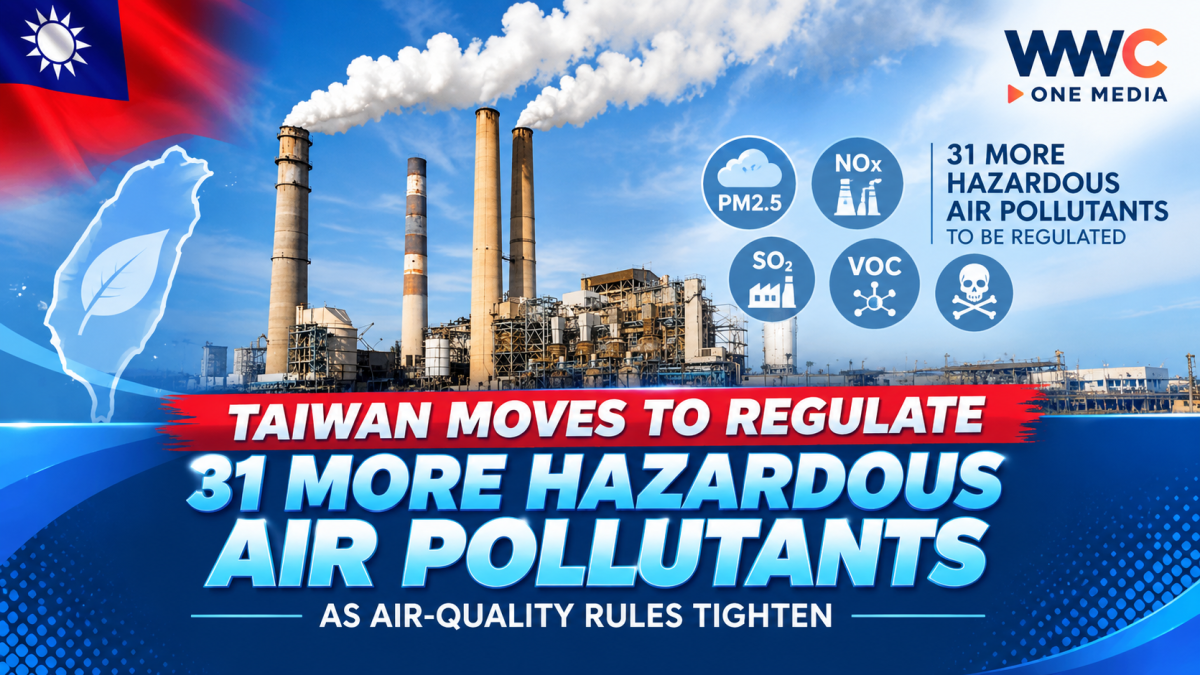
TAIPEI — Taiwan is moving to significantly expand its regulation of hazardous air pollutants, with the Ministry of Environment proposing 31 additional substances for control and bringing the regulated list to 104.
The proposed expansion includes chemicals used in precision manufacturing and other industrial processes, particularly substances identified as having carcinogenic, mutagenic, reproductive-toxic or highly bioaccumulative properties. The ministry announced the plan on Wednesday, September 23.
Among the newly listed substances is benzo[a]pyrene (BaP), a known carcinogen that has recently drawn attention in Taiwan following a food-safety controversy involving contaminated cooking oil.
31 New Pollutants Targeted
The Environment Ministry said it reviewed regulatory approaches in the United States, Germany, Japan and South Korea, alongside hazard assessments from international organizations including the World Health Organization, the International Agency for Research on Cancer and the European Union.
The review considered characteristics such as carcinogenicity, mutagenicity, reproductive toxicity and persistence or bioaccumulation before the ministry selected the additional 31 substances.
The proposed changes would expand the pollutants covered by Taiwan’s fixed-source air-pollution regulations.
The ministry plans to establish emission standards for the newly regulated substances and is also considering pollution fees based on their environmental impact.
Benzo[a]pyrene Draws Particular Attention
Benzo[a]pyrene has become especially prominent in Taiwan’s recent environmental and food-safety discussions.
Taiwan’s health authorities describe BaP as a carcinogenic polycyclic aromatic hydrocarbon that can occur through incomplete combustion and can also contaminate foods, particularly products exposed to high-temperature processing. Taiwan’s existing food standards already establish a maximum BaP level for edible oils.
Its inclusion on the expanded air-pollution control list therefore connects two separate areas of regulation: industrial emissions and food-safety exposure.
The proposed air-pollution rules, however, concern emissions from pollution sources and should not be interpreted as meaning that the new list itself represents a finding that ordinary consumers are currently facing dangerous exposure.
Taiwan Also Tightening Indoor-Air Rules
The move comes as Taiwan separately reviews its Indoor Air Quality Management Act.
The Environment Ministry has been working on amendments that could tighten indoor-air standards for facilities serving vulnerable groups such as young children and older adults. Proposed changes also include more standardized monitoring requirements and adjustments to requirements for dedicated indoor-air-quality personnel based on facility size and characteristics.
Officials have emphasized that the issue extends beyond outdoor pollution.
Taiwan’s environment authorities say people spend more than 80% of their time indoors, while the country’s widespread use of air conditioning can mean windows remain closed for long periods, making indoor-air management an important consideration.
What Happens Next?
The 31-pollutant expansion is a proposed regulatory change, not an indication that all 31 substances are already subject to the new standards.
Taiwan’s Environment Ministry will need to proceed with the regulatory process, including establishing the relevant emission limits and determining how the expanded controls will be implemented.
The broader direction is clear: Taiwan is moving toward a wider framework for monitoring and controlling hazardous air pollutants, particularly those associated with industrial activity and long-term health or environmental risks.
The development also reflects a broader shift toward using international toxicology and emissions standards when determining which pollutants should receive regulatory attention.
WWC ONE MEDIA G,A