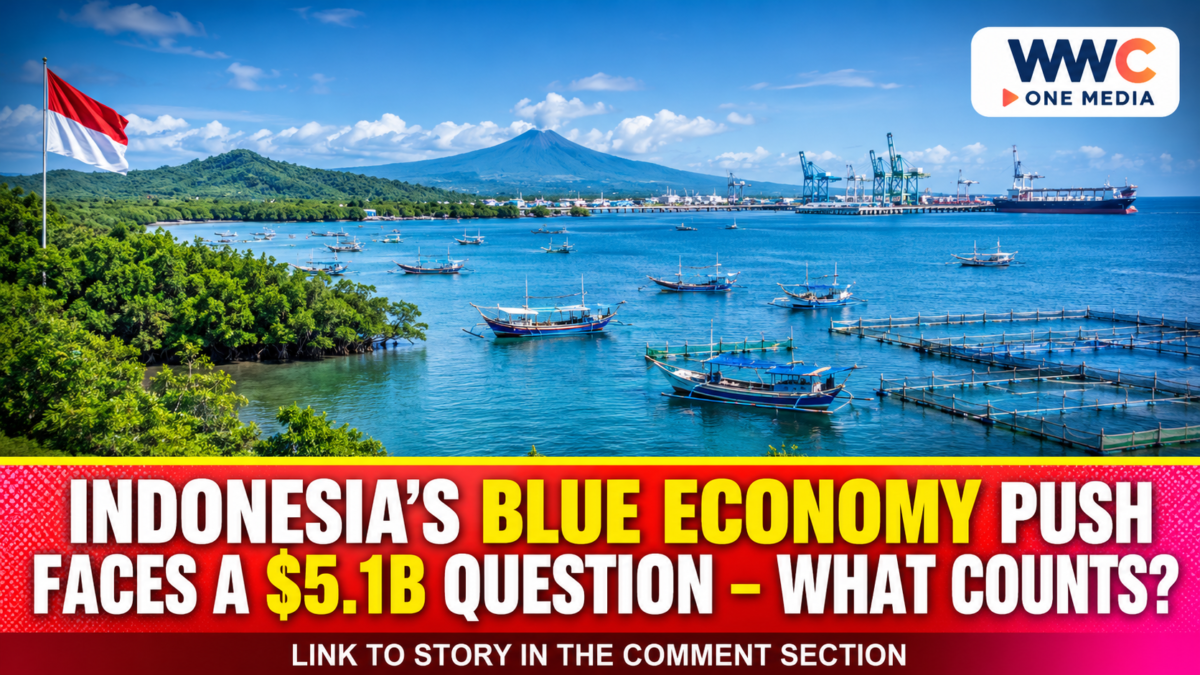
BADUNG, Bali, Indonesia — November 26, 2026 — Indonesia is stepping up efforts to attract investment into ocean-related industries, from fisheries and aquaculture to ports, maritime logistics and blue-carbon projects. But a headline figure of US$5.1 billion in blue-economy investment for January to September 2026 raises an important question: how much of that money is going directly into marine industries, and how much is being counted through supporting sectors?
The figure was publicly attributed to Deputy Minister of Investment and Downstreaming Todotua Pasaribu during the Global Marine Spatial Planning Conference and Expo 2026 in Nusa Dua, Bali.
However, the underlying statistical breakdown for the US$5.1-billion figure was not available in the official records reviewed for this report. The number therefore needs a clearer public methodology before it can be treated as a fully verified measure of investment directly entering Indonesia’s marine economy.
What official government records do establish is that Indonesia recorded Rp1,539.2 trillion in total investment during January–September 2026. Within its downstreaming programme, investment in fisheries and marine activities reached Rp7.3 trillion over the same period.
Those figures offer a more concrete starting point for assessing Indonesia’s ocean investment ambitions.
The $5.1-billion figure needs a clearer breakdown
The reported US$5.1-billion figure is significant, but its composition matters as much as its size.
The reported breakdown identifies transportation, warehousing and telecommunications as the largest contributing subsector, with US$2.5 billion, or approximately 49% of the total. Jakarta was identified as the leading provincial location, with US$1.6 billion.
That raises a question about the scope of the blue-economy classification.
Ports, shipping, storage and telecommunications infrastructure can support ocean-related businesses. Cold-chain facilities, port connections and digital communications are important to fisheries, aquaculture and maritime trade.
But investment in these supporting industries is not necessarily the same as direct investment in fish production, marine conservation, aquaculture facilities or coastal restoration.
A transparent breakdown would help investors, policymakers and coastal communities understand which activities are receiving capital and how much is reaching the industries that depend directly on healthy marine resources.
The distinction is particularly important because Indonesia’s wider investment figures use different categories. The government reported Rp1,539.2 trillion in total investment for the first nine months of 2026, while its downstreaming investment breakdown identified Rp7.3 trillion for fisheries and marine activities.
These numbers should not be added together or treated as interchangeable. They describe different investment classifications.
Indonesia’s wider investment figures show where capital is flowing
Indonesia’s overall investment performance provides important context.
The Ministry of Investment and Downstreaming reported Rp1,539.2 trillion in investment realization from January to September 2026, an increase of 7.3% from the same period in 2025.
The amount represented 75.4% of the government’s annual investment target of Rp2,041.3 trillion.
Foreign investment contributed Rp777.8 trillion, or 50.5% of the total, while domestic investment accounted for Rp761.4 trillion, or 49.5%.
The government also reported that investment outside Java reached Rp779.4 trillion, equivalent to 50.6% of the national total. This is relevant to the blue economy because many fisheries, coastal tourism and marine-resource industries operate outside the country’s principal industrial and commercial centres.
Within downstreaming, total investment reached Rp480 trillion during the first nine months of 2026, up 11.3% year-on-year. Fisheries and marine activities contributed Rp7.3 trillion, while plantation and forestry activities accounted for Rp83.6 trillion and oil and gas for Rp54 trillion.
The figures show that marine and fisheries investment is part of a much larger industrial transformation programme. They also underline why a more detailed breakdown of the US$5.1-billion blue-economy figure would be useful.
Bali conference puts ports, logistics and blue carbon in focus
The Global Marine Spatial Planning Conference and Expo 2026 is being held at the Bali Nusa Dua Convention Center from November 25 to 27.
Organised by Indonesia’s Ministry of Marine Affairs and Fisheries, the event brings together policymakers, investors, international organisations, researchers, financial institutions and other maritime stakeholders.
Its theme, “Unlocking, Securing, Transforming: From Ocean Planning to Sustainable Blue Investment,” reflects an effort to connect marine spatial planning with investment opportunities and practical projects.
The conference is intended to move discussions beyond mapping and planning. Its stated objectives include developing investment-ready opportunities, strengthening legal and regulatory certainty, and delivering benefits for marine ecosystems, communities and economies.
Indonesia’s Minister of Marine Affairs and Fisheries, Sakti Wahyu Trenggono, has outlined opportunities in fisheries, aquaculture, marine tourism, blue-carbon ecosystems and maritime industries.
The ministry has also identified six national priority programmes for the marine and fisheries sector through 2029. These include establishing 5,000 fishing villages, rehabilitating underproductive aquaculture ponds, developing 2,000 hectares of integrated shrimp farming facilities, expanding inland aquaculture, modernising fishing vessels and building a national salt industrial zone.
These are government programme targets, not completed projects. Their eventual economic contribution will depend on implementation, financing and the ability to attract private-sector participation.
Blue carbon could become another investment frontier
Blue carbon refers to carbon captured and stored by coastal and marine ecosystems, including mangroves, seagrass beds and tidal wetlands.
Indonesia’s extensive coastal ecosystems give the country opportunities to develop conservation-linked financing, restoration projects and potentially carbon-related investment.
The Ministry of Marine Affairs and Fisheries has described a broader blue-economy approach that combines conservation, sustainable production and coastal-community welfare.
Its five policy priorities include expanding marine protected areas, implementing quota-based measured fishing, developing sustainable aquaculture, strengthening coastal and small-island ecosystem management, and increasing public participation in reducing marine plastic waste.
The government has set a target of expanding marine conservation areas to 30% of Indonesia’s waters by 2045.
That target illustrates the balancing act behind the blue economy: attracting investment while ensuring that economic activity does not undermine the ecosystems on which fisheries, tourism and coastal livelihoods depend.
WWC has examined similar questions through its coverage of Indonesia’s Pari Island residents and their fight to protect coastal livelihoods.
Investment must reach communities and productive industries
Large investment totals can signal confidence, but they do not automatically demonstrate that coastal communities are benefiting.
For fishing households, the practical effects of investment are often measured through access to reliable markets, cold storage, improved vessels, processing facilities and stable incomes.
For seaweed producers, the opportunity may lie in moving beyond the sale of raw materials towards higher-value products. WWC’s report on Tawi-Tawi’s effort to expand seaweed processing and product innovation explores why technology, packaging and market access matter to coastal producers.
Aquaculture investment also needs to account for environmental conditions, disease management, feed costs and access to buyers. WWC’s coverage of the growing role of aquaculture in the regional fisheries sector illustrates how production technology and market infrastructure can influence the sector’s growth.
Environmental protection is equally important. Mangroves and other coastal ecosystems support biodiversity and can help protect shorelines, while also sustaining fisheries. A community-based restoration programme in the Philippines, covered in WWC’s report on Alaminos fisherfolk restoring mangroves, demonstrates how ecological work can also create livelihood opportunities.
For Indonesia, the challenge is to make sure that investment supports both productive industries and the natural systems on which they rely.
What happens next?
The immediate priority is to make the reported US$5.1-billion figure easier to examine.
Investors and the public would benefit from a published breakdown showing which sectors are included, how the investment is classified, where projects are located and whether the figures represent realized investment or announced commitments.
The government will also need to demonstrate how the conference’s investment agenda translates into funded projects, stronger maritime infrastructure, sustainable fisheries and measurable benefits for coastal communities.
Indonesia has already established a substantial national investment programme and set ambitious marine conservation and fisheries targets. Its blue-economy agenda could help connect those priorities with international financing and private-sector participation.
But the headline number alone cannot show whether that transformation is happening.
The real test is not simply how much investment Indonesia can count as blue. It is how much capital produces stronger ocean industries, healthier marine ecosystems and lasting economic benefits for the people who depend on the sea.