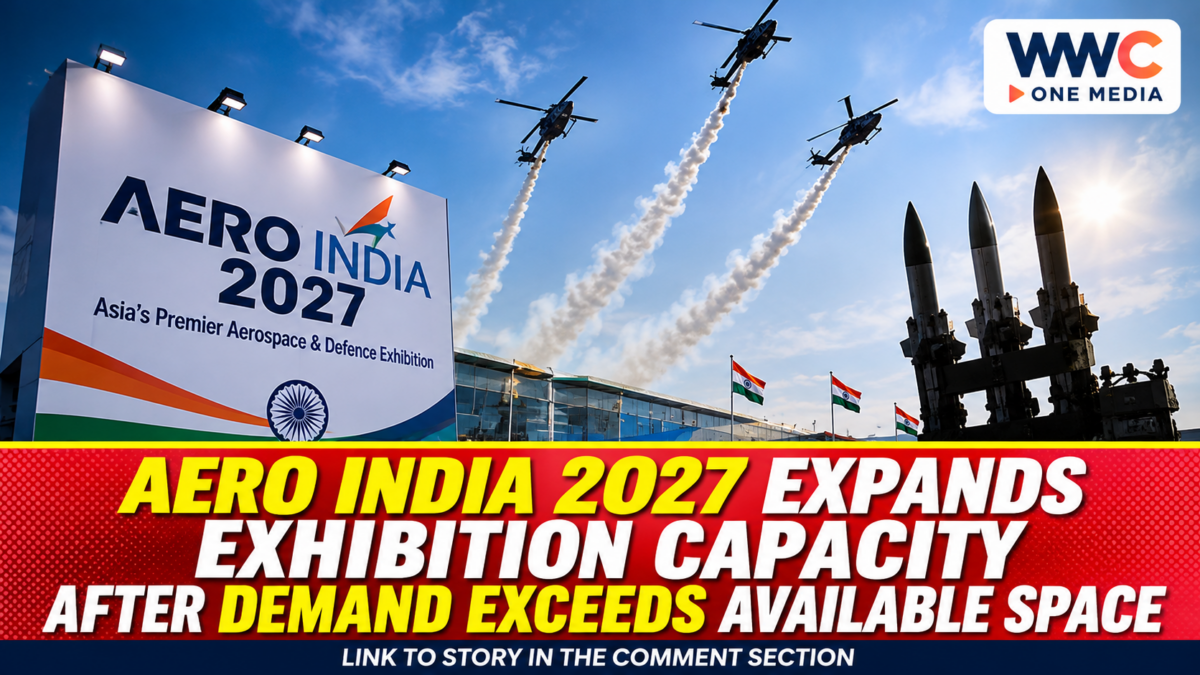
India’s Ministry of Defence has ordered a major expansion of exhibition facilities for Aero India 2027 after requests for space exceeded the venue’s initial capacity by approximately 12,000 square metres. The Department of Defence Production announced on November 25 that two additional hangars are being built and exhibitors will be allowed to construct mezzanine floors inside their allocated stalls for the first time in the event’s history.
The expansion is intended to accommodate more domestic and international aerospace and defence companies at the 16th edition of the show, scheduled for February 8–12, 2027, at Air Force Station Yelahanka in Bengaluru. The decision is more than a venue adjustment: it is an operational response to demand for access to one of India’s principal platforms for defence technology, industrial partnerships and aerospace business development. Press Information Bureau+1
Aero India 2027 faces a space constraint at its Bengaluru venue
The Ministry of Defence says exhibition-space requests have exceeded the initial capacity by approximately 12,000 square metres. It has not published a corresponding total number of exhibitors or a final count of participating companies in the announcement.
The venue creates a particular planning challenge. Air Force Station Yelahanka is an active Indian Air Force training base, and the ministry says aviation safety and operational requirements restrict the possibility of expanding the exhibition horizontally.
Rather than treating the surrounding airfield as ordinary event property, the Department of Defence Production is addressing the shortage through two construction and layout measures. The first is the construction of two additional exhibition hangars. The second is permission for mezzanine floors within exhibitors’ allocated stalls, wherever the height of the hangar allows it. Press Information Bureau
A mezzanine is an intermediate floor built within a larger interior space. For an exhibition, it can provide additional display or meeting space without requiring a larger ground-level footprint. The ministry says the structures will have to comply with prescribed standards for structural stability, load-bearing capacity and safety.
The approach is intended to increase usable exhibition area while respecting the limits of an operating military airfield. It does not mean that every exhibitor will automatically receive a larger stall: mezzanine construction is conditional on available hangar height and the requirements governing each structure.
The exhibition is a business platform, not only an air show
Aero India is organised by the Department of Defence Production under India’s Ministry of Defence. The official event portal describes it as a biennial aerospace exhibition, with its first edition held in 1996. The 2027 gathering will be its 16th edition. Asia’s Premier Aerospace & Defence Exhibition+1
The event’s commercial role is important. The Ministry of Defence says the five-day programme will bring together aerospace and defence companies, policymakers, technology specialists, innovators, industry stakeholders and defence personnel. Its stated objectives include business engagement, technology exchange, government-industry interaction and opportunities for collaboration.
That mix makes exhibition space valuable for more than product displays. Companies can use the event to present equipment and technologies, meet potential partners, engage with government representatives and explore supply-chain relationships. The official event description also identifies business and strategic engagements as part of the programme. Press Information Bureau
For Indian manufacturers, the show offers a public-facing venue to demonstrate domestic capabilities. For overseas suppliers, it creates an opportunity to meet Indian industry and government stakeholders. However, participation in an exhibition should not be confused with winning a defence contract, securing an export order or concluding a technology-transfer agreement.
Domestic manufacturers and smaller firms are part of the strategy
The ministry’s September announcement said Aero India 2027 would provide opportunities for Indian defence industries, including micro, small and medium enterprises and start-ups, to showcase capabilities and pursue partnerships, investment, exports and technology collaboration.
This matters because a defence supply chain is not made up only of aircraft manufacturers or major weapons contractors. It can also include businesses producing components, electronics, software, specialist materials, maintenance services and engineering systems.
The expansion therefore has potential relevance beyond the largest companies. More usable floor area could create additional opportunities for smaller firms seeking visibility alongside established manufacturers. That is a reasonable commercial possibility, not a guarantee that every applicant will receive exhibition space or secure business from attending.
The challenge of developing a domestic supplier base is also tied to workforce readiness. WWC previously examined India’s defence skills gap and the training programmes intended to support manufacturing. The same industrial ecosystem needs trained engineers, technicians and specialists if exhibition interest is to translate into sustainable production capacity. Press Information Bureau
India’s aerospace ambitions extend beyond military hardware
The exhibition’s significance also reflects the breadth of India’s aerospace and technology sectors. Defence manufacturing, aviation systems, electronics, unmanned platforms, space technology and related engineering capabilities can share suppliers, technical expertise and research infrastructure, even though they operate under different regulatory and procurement systems.
India’s private space sector provides one example of how the country is seeking to widen participation in high-technology industries. WWC has reported on the growth of India’s space start-ups and the challenge of turning engineering capability into commercial businesses. Space technology is not the same market as defence procurement, but both sectors depend on specialist engineering, investment and reliable industrial partners.
The government’s wider military modernisation programme is another part of the backdrop. WWC has also covered India’s proposed defence procurement expansion. That procurement story concerns planned acquisitions, not Aero India exhibitor commitments. The connection is that a larger defence industrial base requires both demand for equipment and companies capable of supplying, maintaining and improving it.
The distinction is important: a busy exhibition can indicate strong interest in access to the market, but it does not by itself measure production output, technology independence or the number of contracts that will eventually be signed.
Registration and space allocation remain important milestones
The Ministry of Defence previously announced that online registration and exhibition-space booking for Aero India 2027 would begin on September 3, 2026, through the official event portal. Media registration opened on November 19, with the stated closing date of January 4, 2027. Press Information Bureau+1
As of November 26, the official Aero India website says the exhibition layout is being finalised based on exhibitor requirements. It states that an email offering space will be sent to exhibitors by November 30. This is a key near-term milestone because the new facilities and revised floor arrangements must be reflected in actual space allocations. Asia’s Premier Aerospace & Defence Exhibition
The event is also divided into business and public-facing activities. The official visitor information identifies February 8–10 as business days, with February 11–12 designated as public days for the business zone. A separate Aero India Experience Zone is scheduled to open to the general public from February 9–12. Aero India
What happens next
The immediate test is whether the additional hangars and permitted mezzanine structures can be completed, approved and incorporated into the final exhibition plan before the February event. The ministry has announced the expansion measures but has not published a completion schedule for each hangar or a final exhibitor list in the release reviewed for this report.
The November 30 space-allocation update will help clarify how the organisers intend to accommodate applicants. Further details about participating companies, stall locations and the final exhibition footprint will be important indicators of how much of the excess demand can be addressed.
For now, the confirmed development is a substantial increase in planned exhibition capacity at a venue where safety and operational requirements limit outward expansion. Whether that translates into more business partnerships, technology collaboration or commercial agreements will only become clear as exhibitors are allocated space and the event takes place.
Frequently asked questions
1. When will Aero India 2027 take place?
Aero India 2027 is scheduled for February 8–12, 2027, at Air Force Station Yelahanka in Bengaluru, Karnataka.
2. Why is India expanding the Aero India exhibition site?
The Ministry of Defence says requests for exhibition space exceeded the initial capacity by approximately 12,000 square metres.
3. What new facilities are being added for Aero India 2027?
The Department of Defence Production is building two additional exhibition hangars and allowing mezzanine floors within allocated stalls where hangar height permits.
4. What is a mezzanine floor at an exhibition stall?
It is an intermediate level built within a larger interior space. It can provide additional usable display or meeting space without expanding the stall’s ground footprint, subject to structural and safety requirements.
5. When will exhibitors receive their space offers?
As of November 26, the official Aero India portal says emails offering exhibition space are expected to be sent by November 30, 2026.