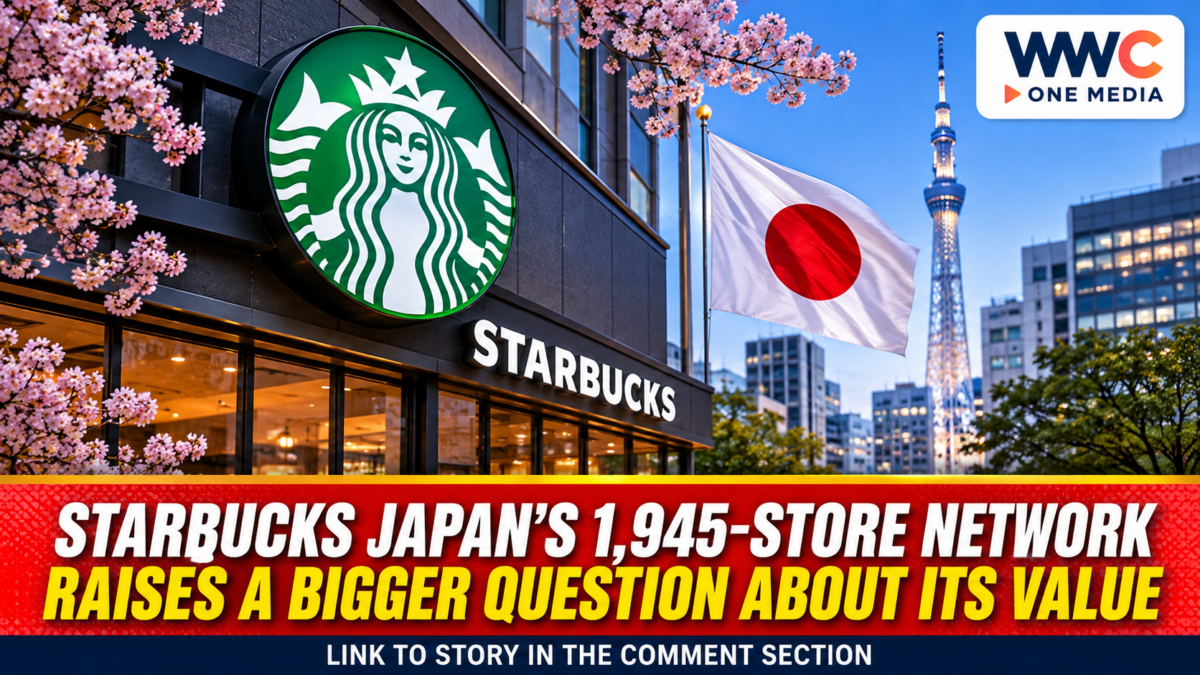
Starbucks Corporation ended its 2026 financial year with 1,945 company-operated coffeehouses in Japan, making the country one of the largest individually identified markets in its international store network. The figure, recorded as of September 27, 2026, appears in the company’s latest annual filing, which also shows that Japan remains a separately identified market for long-lived assets but not for standalone net revenue. SEC+1
That reporting distinction matters when assessing the business. Store numbers show the scale of Starbucks’ physical presence, but they do not reveal how much revenue Japan generates, how profitable its cafés are individually or what an outside buyer might pay for the operation. Without market-specific financial disclosures, any valuation based only on store count would be incomplete.
The public record does, however, provide a useful picture of the Japanese operation: its scale, its position inside Starbucks’ international structure and the corporate model the company has already used in another major Asian market.
Starbucks Japan’s store network remains substantial
Starbucks’ Form 10-K for the financial year ended September 27, 2026, lists 1,883 company-operated coffeehouses in Japan at the beginning of the reporting period. The company opened 78 and closed 16 during the year, ending with 1,945 company-operated locations. SEC
The figures are important because they distinguish company-operated stores from licensed outlets. A company-operated café is run within Starbucks’ own operating structure, while a licensed location is operated by a partner under a commercial arrangement. The distinction affects how revenue, costs and operating responsibilities appear in financial statements.
Starbucks Japan’s corporate profile provides another view of the local business. It identifies Starbucks Coffee Japan Co., Ltd. as a company established on October 26, 1995, and lists its business as operating coffee stores and selling coffee and related products. The profile names Starbucks EMEA Holdings Limited as its shareholder and records 2,155 stores, including 212 licensed locations, as of March 31, 2026. starbucks.co.jp
Those figures come from different reporting dates and store classifications. They should not be combined into a single count or treated as directly comparable without accounting for the reporting periods and definitions.
Why Starbucks Japan revenue is difficult to isolate
The annual filing divides Starbucks’ business into three reportable operating segments: North America, International, and Channel Development. Japan sits within the International segment, alongside China and several other geographic regions. SEC
For fiscal 2026, the International segment represented 18% of Starbucks’ total net revenue. The filing reported consolidated revenue of $37.91 billion for the year, but it did not provide a separate Japan net-revenue figure in its geographic revenue table. SEC+1
Instead, the company reported $7.338 billion in net revenue for “Other countries” in fiscal 2026. It explained that this category includes markets outside the United States and China, and that Japan, Canada and the United Kingdom together accounted for approximately 72% of revenue from those other countries. SEC
That disclosure offers context but not a Japan-specific result. It would be inaccurate to assign the combined figure, or any estimated share of it, to Japan without a separate company disclosure.
The filing does separately report Japan’s long-lived assets at $2.236 billion as of September 27, 2026, down from $2.3837 billion a year earlier. Long-lived assets are not the same as a business’s sale price or market valuation; they are an accounting measure of certain assets held over time. SEC
The China transaction shows one possible operating structure
Starbucks’ recent restructuring in China provides a documented example of how the company can change the ownership and operating model of a major overseas business.
The 2026 annual filing says Boyu Capital acquired a 60% stake in Starbucks’ China retail operations, while Starbucks retained 40% ownership and continued to own and license its brand and intellectual property to the joint venture. The transaction closed during the third quarter of fiscal 2026. SEC+1
The accounting treatment changed as a result. Starbucks stopped consolidating the divested retail operation as a wholly controlled business and began recognising its share of the joint venture’s income under the equity method, alongside product sales and royalty revenue. The company said this model was expected to produce lower reported revenue and higher operating margin than the previous company-operated structure. SEC
That is a useful distinction for understanding international retail strategy. A company can retain a brand, an economic interest and licensing income while transferring majority ownership and day-to-day retail operations to a partner.
WWC has previously examined the Starbucks China ownership restructuring and its implications for the brand’s regional strategy. The China arrangement is a documented transaction, however, not proof that Starbucks will apply the same structure in Japan.
Licensed operations are also reshaping Starbucks in Asia
The wider Asian business is not operated under one uniform ownership model. Starbucks works with licensed partners in several markets, and those arrangements can be reorganised without transferring ownership of the global brand.
A separate transaction involving DFI Retail Group and Maxim’s Caterers concerns Starbucks-licensed operations across seven Asian markets: Thailand, Hong Kong, Singapore, Vietnam, Cambodia, Macau and Laos. WWC has covered DFI Retail’s planned assumption of the Starbucks-licensed network across those markets.
That arrangement is geographically distinct from Japan. It should not be treated as evidence that the Japanese company is included in the same transaction or that a change in its ownership has been agreed.
The distinction is important for customers and business partners. A change in a licensee’s ownership can affect who operates stores in a particular territory, while a change in the ownership of a national subsidiary would involve a different corporate and financial structure.
What the financial picture can — and cannot — tell investors
Starbucks’ 2026 annual results show consolidated net revenue of $37.91 billion, up from $37.18 billion in fiscal 2025. The company also reported that its International segment generated $6.744 billion in net revenue for fiscal 2026. Those are group and segment figures, not Japan-only performance measures. SEC+1
The company’s latest earnings release described progress under its “Back to Starbucks” strategy, including investment in the coffeehouse experience and staffing. WWC has also reviewed the company’s fiscal 2026 sales and earnings disclosures.
For a business as large as Starbucks Japan, the number of cafés is only one part of the assessment. A buyer or investor would also need to understand store-level sales, operating costs, leases, staffing obligations, capital spending, local growth prospects and the terms under which the brand could continue to be used.
Analysis: Japan’s 1,945 company-operated stores make it a significant physical operation in Starbucks’ international portfolio. But the absence of a separate Japan revenue line means the public financial record does not provide enough information to calculate the market’s standalone earnings or establish a defensible transaction value. Store count alone cannot fill that gap.
What happens next
The next meaningful evidence would be a formal Starbucks announcement, a regulatory filing, or a company disclosure identifying a proposed transaction and its terms. Until such a record is available, the company’s latest annual report and Japan corporate profile remain the clearest public documents for assessing the operation.
For now, the verified picture is straightforward: Starbucks has a large company-operated presence in Japan, uses a broader International reporting structure for its financial results and has demonstrated in China that it can separate retail operations from brand ownership through a joint venture.
Whether Japan will undergo any comparable change is not established by the primary records reviewed.
Frequently asked questions
How many Starbucks company-operated stores are in Japan?
Starbucks reported 1,945 company-operated coffeehouses in Japan as of September 27, 2026, in its fiscal 2026 Form 10-K. SEC
Does Starbucks disclose Japan’s standalone revenue?
The fiscal 2026 annual filing does not provide a separate Japan net-revenue figure. Japan is included within the company’s broader International segment and in its geographic revenue disclosures for countries outside the United States and China. SEC+1
Who is listed as the shareholder of Starbucks Coffee Japan?
Starbucks Coffee Japan’s corporate profile lists Starbucks EMEA Holdings Limited as its shareholder, with the profile’s information dated March 31, 2026. starbucks.co.jp
Has Starbucks officially confirmed a sale of its Japan business?
The primary records reviewed for this report do not confirm an agreed sale, a buyer, a transaction value or a formal sale process. Those details should not be treated as established without an official company disclosure or regulatory record.