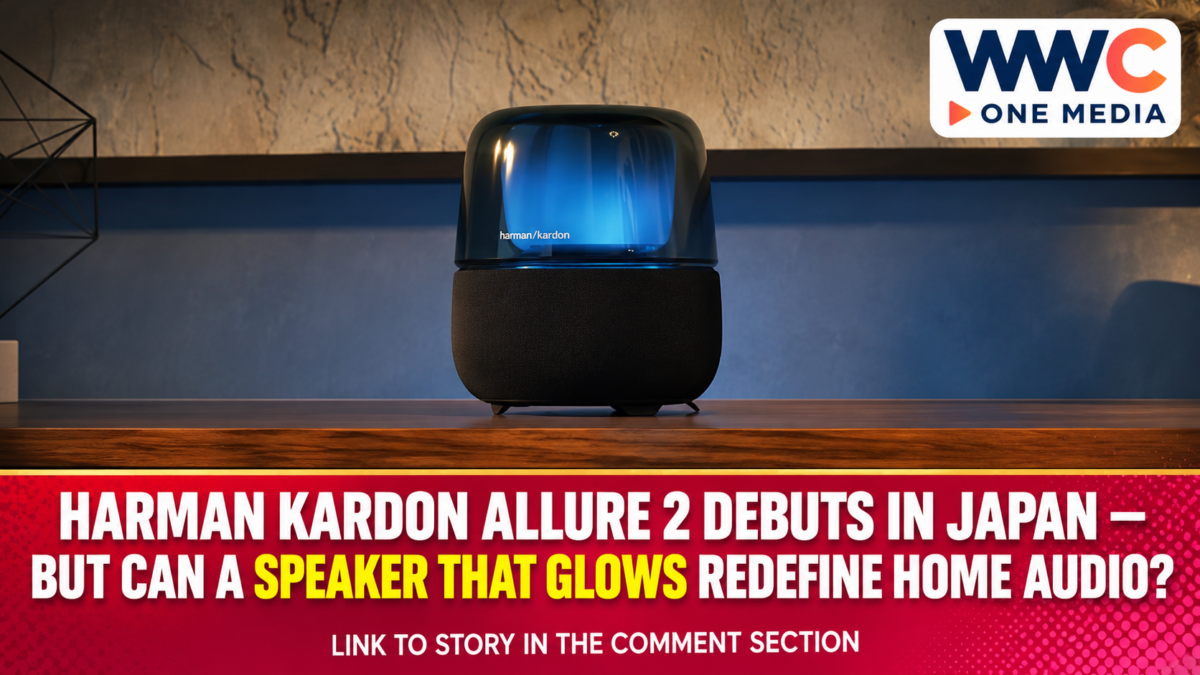
JAPAN — Harman Kardon has introduced its Allure 2 Bluetooth home speaker in Japan, combining a 60-watt audio system with artificial intelligence-assisted sound optimisation and ambient lighting that moves in sync with music.
Released on Nov. 26, 2026, the speaker carries an official Japanese online store price of ¥34,100, including tax, offering consumers a compact entertainment device that doubles as an interior design accessory.
Rather than relying solely on sound quality to attract buyers, Harman Kardon is bringing music, lighting and personalised digital controls together in a single household device.
The launch raises an interesting question for the premium consumer electronics market: could the next generation of home speakers become as much about atmosphere as audio performance?
Harman Kardon Allure 2 Combines Powerful Audio With a Compact Design
The Allure 2 features Harman Kardon’s distinctive transparent dome alongside a fabric-covered enclosure.
Inside the speaker are three 38mm full-range drivers and an 89mm downward-facing subwoofer. The system delivers a combined rated output of 60W RMS, with a frequency response of 40Hz to 20kHz at -6dB.
The speaker measures 166mm wide, 203mm tall and 166mm deep, weighing approximately 2.2 kilograms.
Its compact footprint makes it suitable for placement on desks, shelves, side tables and other household surfaces without requiring the space occupied by larger entertainment systems.
The device operates using a 100–240V AC power supply, positioning it primarily as a stationary home speaker.
Its design reflects a different approach to household entertainment, where electronic equipment can also serve as part of a room’s visual identity.
Similar considerations can be seen in the development of Epson’s home entertainment projector technology, which illustrates how entertainment devices can serve multiple purposes within residential spaces.
AI Sound Boost Brings Intelligent Audio Processing Into the Home
One of the Allure 2’s notable features is Harman Kardon’s AI Sound Boost technology.
The system processes audio in real time and adjusts playback to manage distortion and improve bass performance.
Its intended purpose is to maintain listening quality across different musical genres and volume levels.
This application of artificial intelligence differs from conversational AI platforms. Instead of generating written content or answering questions, it is designed to optimise the speaker’s audio output.
The original Harman Kardon Allure featured Amazon Alexa voice services alongside Bluetooth streaming and multidirectional sound. The Allure 2’s published specifications place greater emphasis on wireless music playback, sound processing and app-based customisation.
The evolving role of artificial intelligence in household audio is also explored in Sonos’ plans to develop AI-powered home entertainment products.
For consumers, however, the practical value of intelligent audio processing will ultimately depend on how effectively it performs during everyday listening.
A Speaker That Changes the Atmosphere of a Room
The Allure 2’s transparent dome contains a 360-degree ambient lighting system that responds to music.
Users can personalise the lighting through the Harman Kardon One mobile application, adjusting its brightness, colours and visual effects.
The same application provides access to equaliser settings and other audio controls.
These features allow owners to create different listening environments, whether they prefer subtle illumination during quiet evenings or more dynamic lighting during social gatherings.
The integration of sound and lighting also gives the device a purpose beyond conventional music playback.
Instead of purchasing separate decorative lighting and audio equipment, consumers may find value in having both functions available through a single product.
Whether this combination justifies its premium price will depend on individual preferences and the quality of the listening experience.
Bluetooth 5.4 and Auracast Expand Wireless Connectivity
Harman Kardon has equipped the Allure 2 with Bluetooth 5.4 connectivity, supporting simultaneous connections with up to two mobile devices.
This allows multiple users to connect compatible smartphones or other audio devices without repeatedly configuring the speaker.
Consumers can also wirelessly pair two Allure 2 units to create a stereo audio arrangement.
For larger listening environments, Auracast connectivity enables synchronised playback across compatible Harman Kardon speakers, with supported functions managed through the Harman Kardon One application.
However, buyers should not assume that every Bluetooth or Auracast-enabled speaker is compatible with all of the Allure 2’s synchronisation features.
Compatibility should be checked before purchasing additional equipment.
The multi-speaker functionality gives Harman Kardon an opportunity to attract customers interested in expanding their home audio arrangements over time rather than replacing an entire system.
Japan’s ¥34,100 Price Sets the Benchmark
The Allure 2 is available in black through Harman Kardon’s Japanese online store at ¥34,100, including tax.
The manufacturer has adopted an open-pricing arrangement in Japan, meaning individual retailers may offer different selling prices.
For buyers, the decision will involve more than comparing the speaker’s wattage against competing devices. Its design, lighting functions, software controls and expansion capabilities are also part of its overall value proposition.
Pricing remains an important consideration across consumer electronics categories, as illustrated by changing smartphone purchasing preferences in Japan.
The Japanese price should not be interpreted as a universal retail price for other Asia-Pacific markets.
Harman Kardon has also incorporated recycled plastic, aluminium and neodymium magnets into the Allure 2’s speaker drivers. Its packaging uses FSC-certified paper printed with soy-based ink.
These material choices represent specific manufacturing and packaging measures, although they do not establish the product’s complete environmental footprint.
What Happens Next for Harman Kardon?
The Allure 2’s introduction creates another option for consumers seeking a compact premium home audio system with integrated decorative lighting.
For audiences across Asia-Pacific economies, the next important developments will include confirmed local pricing, distribution arrangements, warranty coverage and compatibility with other wireless audio products.
Independent listening tests could also provide a clearer understanding of how its AI-assisted processing and multidirectional sound perform in different room sizes.
Harman Kardon has combined several technologies into a single entertainment device. Whether that combination becomes a compelling alternative to conventional home speakers will depend on how much consumers value the relationship between music, lighting and interior design.
The Allure 2 is designed to be heard and seen. Its commercial test will be whether customers consider both experiences worth paying for.