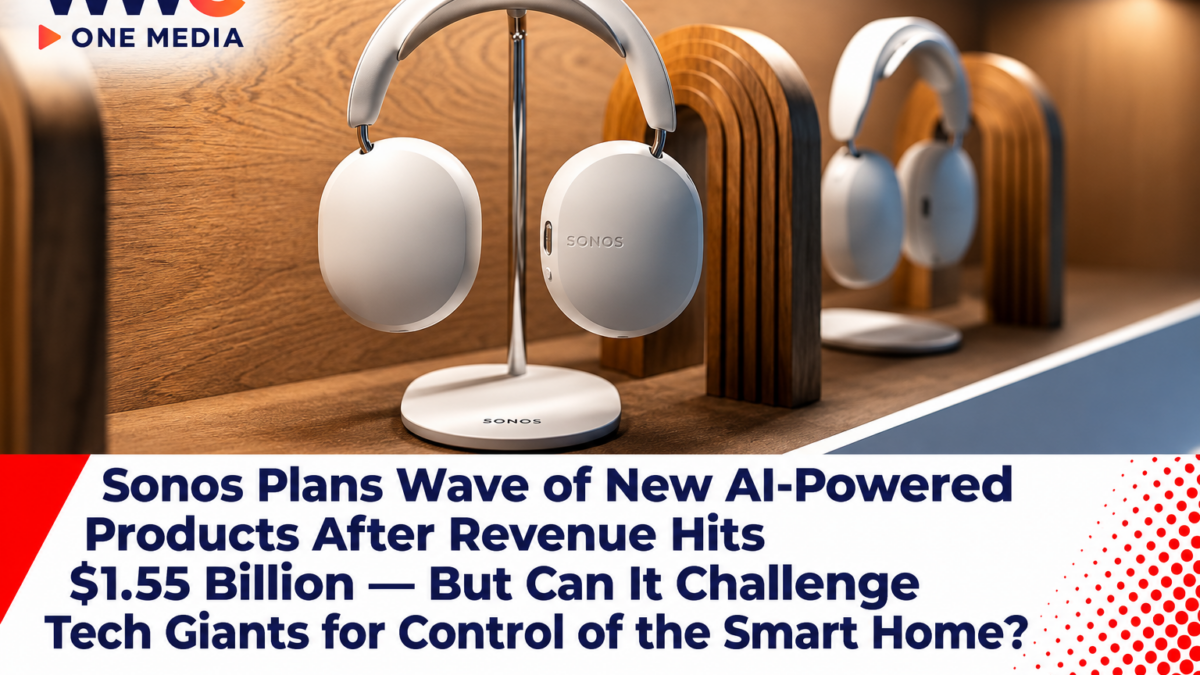
SANTA BARBARA, CALIFORNIA / MANILA, PHILIPPINES — November 11, 2026 — Premium speaker maker Sonos is preparing another major wave of product launches in 2027, betting that artificial intelligence will transform the way people control music, speakers and connected devices throughout their homes.
The announcement comes as the American audio technology company stages a financial recovery following years of operational challenges, including a troubled software redesign that damaged customer confidence.
On November 10, Sonos reported fiscal 2026 revenue of approximately US$1.55 billion, up 7% from the previous year.
Its adjusted earnings before interest, taxes, depreciation and amortization, or EBITDA, increased 39% to nearly $184 million.
The company also introduced five hardware products during the fiscal year, giving CEO Tom Conrad fresh evidence that his turnaround strategy is producing results.
But Conrad believes the next opportunity extends far beyond selling additional wireless speakers.
His ambition is to turn Sonos into an intelligent home-audio platform capable of responding to commands from different artificial intelligence systems.
That could eventually put the company into more direct competition with the connected-home ambitions of Apple, Google, Amazon and emerging AI hardware developers.
Sonos has already demonstrated that it can return to growth. The bigger question is whether AI can turn its premium audio ecosystem into the next major battleground for control of the smart home.
Sonos CEO Promises More Products in 2027
During the company’s November 10 earnings call, Conrad told investors that Sonos has a substantial product roadmap for fiscal 2027.
He described new hardware as one of several growth opportunities alongside better customer relationships, stronger marketing, international expansion and AI integration.
Importantly, the chief executive did not identify every planned device.
He also did not promise that every new Sonos product would contain a separate AI processor or conversational assistant.
Instead, the company is pursuing a broader strategy in which its hardware and software become more useful together.
Sonos wants customers to see its speakers, headphones, soundbars and audio components as parts of one connected system.
That approach can generate additional sales by encouraging existing customers to expand their installations.
A household that already owns a Sonos soundbar might eventually add portable speakers, wireless surrounds or compatible headphones.
For management, this creates a commercial opportunity beyond replacing older devices.
Each new product can potentially increase the usefulness of the customer’s existing Sonos equipment.
Revenue Returns to Growth After a Difficult Period
Sonos’s latest results suggest the company is making progress.
For the fiscal year ended October 3, 2026, revenue increased 7% to approximately $1.547 billion.
Adjusted EBITDA rose 39% to $183.8 million.
Free cash flow increased 14% to approximately $122.9 million.
The company also reported GAAP net income of roughly $89.6 million, compared with a net loss of $61.1 million in the previous fiscal year.
However, fourth-quarter performance requires a more nuanced reading.
Revenue increased 20% to approximately $344.4 million, but the quarter included an additional reporting week.
Excluding that extra week, comparable quarterly revenue growth was approximately 11%.
Sonos also reported a GAAP net loss of approximately $5.2 million for the quarter, considerably smaller than the $37.9 million loss a year earlier.
These results show improving performance without implying that every part of the business is already profitable.
Management believes renewed product innovation and software improvements can help sustain that recovery.
Sonos 27 Becomes the Foundation of Its AI Strategy
One of the company’s biggest changes is the introduction of Sonos 27, its next-generation audio operating system.
Announced in September 2026, Sonos 27 is designed to connect hardware, music services and control interfaces into a more unified home-audio experience.
The operating system adds an open approach to AI control, improved navigation and new ways for speakers to work together.
Rather than focusing exclusively on individual devices, Sonos is attempting to create a platform that becomes more capable as customers expand their systems.
That represents an important change in positioning.
Traditional speaker companies compete heavily on sound quality, design and price.
Sonos still needs to deliver those fundamentals.
But it also wants to differentiate its products through software, interoperability and the ability to connect AI assistants.
For consumers, the proposed advantage is convenience.
Instead of manually navigating several applications or adjusting individual speakers, users could increasingly rely on conversational instructions to control audio across their homes.
Sonos Wants Multiple AI Assistants, Not Just One
A defining feature of Sonos’s strategy is its approach to AI partnerships.
The company has introduced an interface called Sonos 27mcp, designed to allow external AI agents to discover and control compatible Sonos systems.
Sonos says its approach is intended to work with different assistant ecosystems rather than giving one AI provider exclusive control.
That could be a significant distinction from more tightly integrated smart-home platforms.
In a closed ecosystem, the device manufacturer may largely determine which assistant users can access.
Sonos is positioning itself as a hardware and software platform that can accommodate multiple intelligent services.
However, interoperability does not guarantee identical functionality across every assistant.
Actual capabilities will depend on software integrations, user permissions, supported devices and product availability.
The interface is in early access, and the company has not established that every third-party AI agent already supports every Sonos feature.
Still, the approach illustrates how AI competition is expanding beyond chatbot applications into ordinary household electronics.
Sonos 27voice Is Coming Into Early Access
Sonos is also developing its own conversational voice-control system.
Called 27voice, the assistant is designed primarily around music, listening preferences and audio-system control.
Rather than requiring rigid commands, the company wants users to describe the music or atmosphere they want naturally.
For example, a listener could ask for music suitable for a quiet evening or request a playlist that matches a particular mood.
The system is intended to interpret those requests and control compatible Sonos devices.
According to Sonos’s September announcement, 27voice was scheduled for early access during the autumn.
The Verge reported that US users could join a waitlist starting November 6, with early access beginning November 12.
That means general availability should not be assumed as of November 11.
Sonos has also discussed future custom agents that users could configure around different preferences.
Those capabilities are targeted for 2027.
The distinction between announced, early-access and future features is important for consumers considering a purchase today.
Five New Products Lay the Groundwork for the Next Expansion
Sonos introduced five hardware products during fiscal 2026:
- Sonos Play
- Era 100 SL
- Amp Multi
- Beam Ultra
- Ace Ultra
The lineup spans different audio categories, including portable listening, home-theater systems, amplification and headphones.
Each device serves a different customer need.
The Beam Ultra is designed for home cinema and immersive sound.
The Ace Ultra expands the company’s premium headphone offering and supports deeper integration with compatible Sonos systems.
Amp Multi targets more specialized installations requiring multiroom amplification.
Together, the launches illustrate the company’s shift toward selling a broader interconnected audio ecosystem.
Conrad argues that the value of Sonos comes from how different devices work together.
But the approach also creates execution risks.
Customers expect products from different generations to remain compatible, software updates to be reliable and new features to function without unnecessary complexity.
For Sonos, keeping those promises will be just as important as unveiling attractive new hardware.
The Troubled 2024 App Redesign Still Casts a Shadow
Sonos’s current strategy follows one of the most damaging software episodes in its recent history.
In 2024, the company released a redesigned mobile application that triggered widespread criticism from customers.
Users complained about missing features, connectivity problems and a less reliable listening experience.
The controversy weakened confidence in the brand and contributed to a difficult period for the business.
The company subsequently invested in software improvements and changes to its development processes.
Its September 2026 Sonos 27 update introduced a more intuitive app experience, including revised navigation and improved audio controls.
Conrad has emphasized that rebuilding customer trust is central to the turnaround.
But restoring confidence requires more than announcing a major software release.
Customers need continuing evidence that products work reliably across multiple updates.
That makes Sonos’s AI strategy a potential opportunity and a risk.
Sophisticated conversational features could improve the experience.
But additional software complexity could also create new problems if reliability is compromised.
AI Memory Costs Create a $56 Million Earnings Headwind
One of the most surprising parts of the earnings report involves the cost of computer memory.
The AI infrastructure boom has increased demand for high-performance semiconductor products.
That demand has contributed to tighter supply and higher prices for some components used across the electronics industry.
Sonos said increased memory costs reduced fiscal 2026 adjusted EBITDA by approximately $56 million.
Despite that impact, the company still increased its adjusted EBITDA by 39%.
However, management warned that the pressure will continue into fiscal 2027.
For the first quarter, Sonos expects memory and other component costs to create approximately 1,200 basis points of year-over-year gross-margin pressure.
That is equivalent to about 12 percentage points of margin pressure, not a 12% increase in the company’s total expenses.
The difference matters because gross-margin percentages and absolute dollar costs measure different things.
For Sonos, AI has created an unusual contradiction.
The company is pursuing AI-enabled consumer products while simultaneously paying more for hardware components partly because of the global AI investment boom.
Smaller Electronics Companies Face the Same Chip Shortage
Sonos is not alone in confronting higher component costs.
The global memory shortage has affected manufacturers of smartphones, laptops and other electronic devices.
Larger companies may have advantages in negotiating long-term contracts and securing production capacity.
Smaller businesses may face more limited supplies and greater pricing uncertainty.
As WWC ONE MEDIA reported in its investigation of memory shortages affecting smaller electronics manufacturers, some companies have been forced to reconsider product specifications and purchasing strategies.
The direct effects differ by device category.
A smart speaker does not use the same quantity or type of memory as an advanced AI server.
Nevertheless, the industries share parts of the semiconductor supply chain.
Strong demand in one segment can influence availability and prices elsewhere.
For Sonos, the challenge will be ensuring that more expensive components do not undermine the profitability of its new products.
Can Sonos Protect Margins While Launching More Devices?
The company says it has a plan to manage the cost pressure.
Management expects its mitigation efforts to produce approximately 500 basis points of annualized gross-margin improvement by the end of fiscal 2027.
That would represent a five-percentage-point improvement on the relevant annualized basis if achieved.
Potential measures include changes to sourcing, product design and other operating arrangements.
However, the company has not guaranteed that every anticipated saving will be realized.
Sonos expects fiscal first-quarter 2027 revenue of $570 million to $630 million.
That implies year-over-year growth of approximately 4% to 15%.
The midpoint of the forecast is $600 million.
Management is counting on the holiday season, recently launched hardware and improved marketing to support sales.
But the forecast remains subject to consumer demand, component costs, currency movements and competitive conditions.
The coming quarters will test whether Sonos can sustain revenue growth without sacrificing too much profitability.
Apple, Google and OpenAI Are Expanding the AI Hardware Battle
Sonos’s decision to embrace open AI integration comes as larger technology companies pursue more intelligent personal devices.
Apple has been expanding Siri and its broader AI ecosystem.
Google is developing Gemini-based experiences that can extend across connected devices and services.
OpenAI has also explored new consumer hardware designed to make AI accessible beyond conventional computer and smartphone interfaces.
In related reporting, WWC ONE MEDIA examined Apple’s legal dispute with OpenAI and the emerging competition to develop a new generation of AI-powered consumer devices.
That dispute is separate from Sonos’s business strategy.
But it illustrates why the market for AI-enabled hardware has become more competitive.
Sonos does not have the same resources as the largest technology platforms.
Its potential advantage lies in established audio technology, an installed customer base and software that coordinates speakers across the home.
Whether those strengths will be sufficient against much larger competitors remains uncertain.
Apple’s AI Strategy Shows Why Consumer Devices Are Changing
The broader electronics industry is increasingly attempting to make AI a useful part of everyday device operation.
Instead of treating AI as a standalone chatbot, companies are integrating language understanding into phones, computers and connected-home products.
Apple provides an example of the commercial challenge.
The company has expanded AI-related software capabilities while facing questions about the cost of computing infrastructure and ongoing model operation.
As WWC ONE MEDIA examined in its report on Apple’s record quarterly revenue and rising AI-related costs, advanced features must eventually deliver enough value to justify their development and operating expenses.
Sonos faces a similar question on a smaller scale.
AI voice control may make its products more convenient.
But consumers must find those capabilities useful enough to support device purchases, repeat engagement or stronger loyalty.
Adding AI does not automatically guarantee higher sales.
The technology must improve the everyday experience.
Why Sonos Is Betting on an Open Smart-Home Platform
The company’s open approach could offer flexibility in a fast-changing market.
AI assistants are evolving rapidly.
A single provider may lead in one area, while another performs better on particular tasks.
By supporting multiple assistants, Sonos aims to reduce reliance on the success of any one AI model.
The approach may also appeal to households using different technology ecosystems.
A family might use one company’s assistant for productivity, another for information retrieval and Sonos’s own technology for music playback.
But openness introduces technical requirements.
Devices must recognize authorized requests, maintain reliable connections and protect user privacy.
The company must also manage integrations as outside AI services change.
For Sonos, the strategic advantage will depend on execution.
An open platform that works consistently could strengthen customer loyalty.
One that creates confusion or connectivity problems could undermine the trust the company has worked to rebuild.
AI’s Rising Cost Is a Problem Across Consumer Electronics
The memory-cost challenge confronting Sonos reflects a larger industry trend.
Technology companies are investing heavily in AI servers, storage and data centers.
That creates significant demand for advanced components.
It also raises questions about whether some consumer-electronics manufacturers will need to increase retail prices or redesign products to protect margins.
As WWC ONE MEDIA reported on higher computer component prices in Singapore, demand from AI infrastructure has affected the availability and pricing of consumer computing hardware.
The situation is not identical for every device manufacturer.
But the broader lesson applies to Sonos.
A company can benefit strategically from AI while experiencing financial pressure from the same technology trend.
The winners may be those able to develop useful AI capabilities while maintaining disciplined hardware costs.
Why the Philippine Market Matters to the Smart-Home Industry
For consumers in the Philippines, Sonos’s strategy illustrates how premium home entertainment is changing.
Connected speakers are no longer limited to playing music wirelessly.
The industry is moving toward coordinated home-audio systems, conversational interfaces and integration with other digital services.
These changes could appeal to households interested in home theaters, multiroom audio and connected entertainment.
However, product availability, retail pricing and AI feature support can vary by country.
Not every early-access feature announced in the United States will necessarily become available in the Philippines on the same date.
Consumers also need to consider whether a product supports their preferred streaming services, home network and existing devices.
For Sonos, international expansion could create growth opportunities.
But success will require reliable distribution, appropriate pricing and customer support.
A premium product must deliver enough value to justify its price, especially in markets where consumers have less expensive alternatives.
Will Sonos’s AI Expansion Translate Into Real Profits?
The latest earnings report provides reasons for optimism.
Revenue has returned to growth.
Adjusted EBITDA has increased sharply.
Free cash flow remains positive.
The company has also restored momentum in product development.
But several important questions remain.
Will customers adopt the new AI features?
Can Sonos maintain software reliability?
Will planned 2027 products generate additional purchases rather than merely replace older models?
Can the company protect gross margins while semiconductor costs remain elevated?
And can Sonos differentiate itself from much larger technology companies?
The answers will determine whether the AI strategy delivers sustainable financial returns.
Investors should also distinguish between completed 2026 product launches and management’s expectations for 2027.
The company has promised more innovation, but future products and revenue remain subject to development and market uncertainty.
What Happens Next?
Sonos’s immediate priorities include its holiday-quarter sales performance and the early-access rollout of new AI features.
The company expects strong seasonal demand supported by its expanded hardware lineup.
During fiscal 2027, investors will monitor additional product announcements and the broader introduction of AI capabilities.
Management will also be assessed on its progress in offsetting memory and component costs.
The annual release cycle for Sonos 27’s successors could provide further opportunities to improve the experience of existing customers.
But new devices alone will not determine the outcome.
Sonos must demonstrate that its system approach improves customer satisfaction, increases device ownership and generates profitable growth.
The Bigger Picture: Sonos Wants to Become More Than a Speaker Company
Sonos is entering a new phase.
After a difficult software controversy and a prolonged business recovery, it has returned to annual revenue growth and stronger profitability.
The company reported $1.55 billion in fiscal 2026 sales, introduced five hardware products and launched a new audio operating system.
Now it wants to bring artificial intelligence into the home through a platform capable of working with different assistants and connected devices.
The vision is ambitious.
Instead of competing only on speaker specifications, Sonos wants to provide an adaptable audio ecosystem that grows more useful over time.
But the plan carries significant challenges.
Large technology companies are pursuing their own AI hardware ambitions.
Memory costs are rising.
Consumers remain sensitive to premium device prices.
And Sonos must rebuild trust through dependable software.
Sonos is promising another wave of products in 2027 as it transforms its speaker ecosystem into an AI-ready home platform. But with major technology companies racing into intelligent hardware and rising component costs threatening margins, can Tom Conrad turn the company’s comeback into a lasting competitive advantage—or will the next smart-home revolution leave Sonos struggling to keep up?