
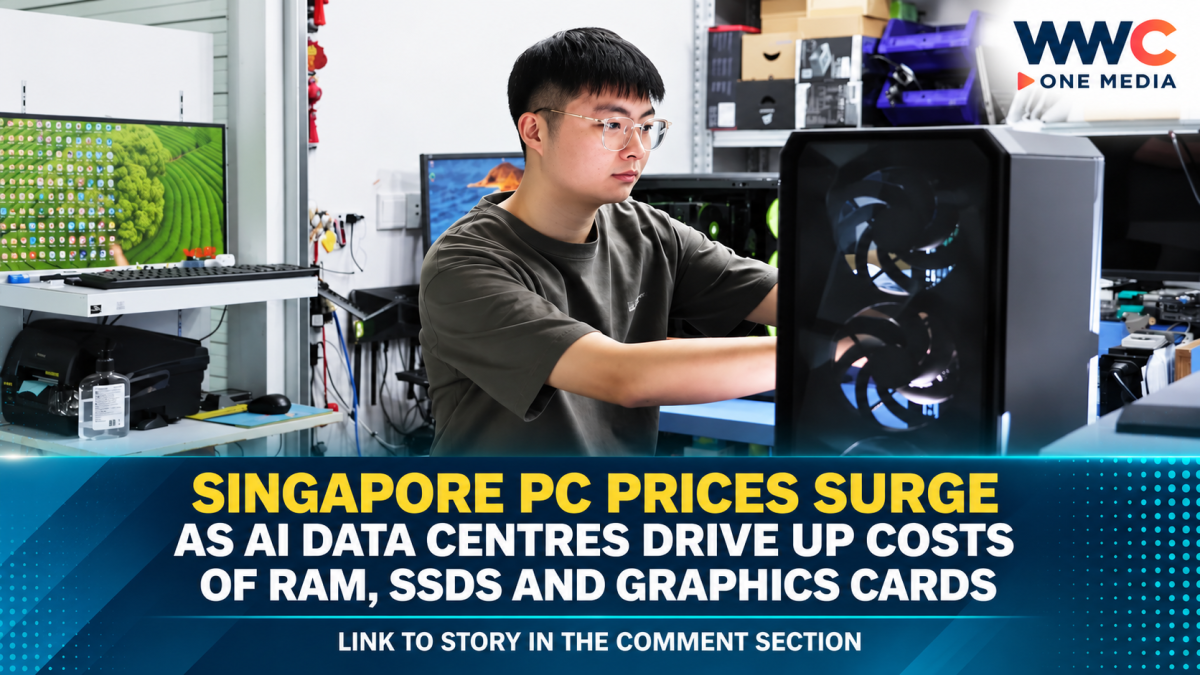
Singapore consumers are paying significantly more for personal computers in 2026 as the global artificial intelligence boom intensifies competition for memory chips, storage and other key components.
Desktop PC prices in Singapore have risen by about 40 per cent this year, with the increase being felt across components including RAM, storage drives and graphics cards. The squeeze is being driven largely by data-centre operators buying up large quantities of computing hardware to support increasingly demanding AI workloads.
The problem is particularly acute in the memory market. Manufacturers are diverting production capacity towards higher-value products used in AI servers, including high-bandwidth memory (HBM), as well as server-grade DRAM and enterprise storage.
That leaves less capacity for conventional PC memory and consumer storage. TrendForce said conventional DRAM contract prices were expected to rise 13 per cent to 18 per cent quarter-on-quarter in the third quarter of 2026, while NAND Flash prices were forecast to increase 10 per cent to 15 per cent. It also warned that capacity reallocations towards server applications were reducing the supply available for PC DRAM.
The impact extends beyond RAM. Graphics cards are also becoming more expensive because their video memory relies on the same broader memory supply chain. Industry analysts have reported that tight graphics-memory supply is supporting higher graphics-card prices even as shipments remain constrained.
For consumers, this means that upgrading a computer is becoming considerably more expensive than it was a year ago. A PC that previously offered a relatively affordable combination of processor, graphics card, RAM and SSD can now carry a much higher price tag, particularly at the higher-performance end.
The pressure is also being felt outside Singapore. Memory shortages are affecting PCs, smartphones and other consumer electronics worldwide, with manufacturers increasingly competing with AI infrastructure providers for limited DRAM and NAND capacity.
AI data centres require enormous amounts of memory and storage. Modern AI systems rely on specialised HBM alongside large quantities of conventional server memory, while the expansion of AI infrastructure is also increasing demand for high-capacity enterprise SSDs.
The economics are encouraging chipmakers to prioritise these products. AI-related components generally command higher prices and margins than traditional consumer memory, giving manufacturers a strong incentive to allocate scarce production capacity to data-centre customers.
The shortage could therefore persist even as manufacturers invest in additional production. New semiconductor facilities take years to build and bring online, meaning supply cannot immediately respond to the surge in AI demand. Analysts expect the memory market to remain tight well into the coming years.
For Singapore shoppers, the result is a difficult choice: pay more now, postpone an upgrade, or compromise on specifications.
Those who only need a computer for everyday tasks such as browsing, office work and streaming may have less reason to chase expensive upgrades. But gamers, content creators and professionals who require large amounts of RAM, fast SSDs or powerful graphics cards are likely to feel the squeeze more sharply.
The surge also highlights an unexpected consequence of the AI boom. While billions of dollars are being invested in building increasingly powerful AI infrastructure, ordinary consumers are increasingly competing for the same underlying components needed to build their PCs.
For now, the era of steadily cheaper computer hardware appears to be facing a major disruption, with AI data centres reshaping not only the technology industry but also the price consumers pay for everyday computing equipment.




Leave a Reply