
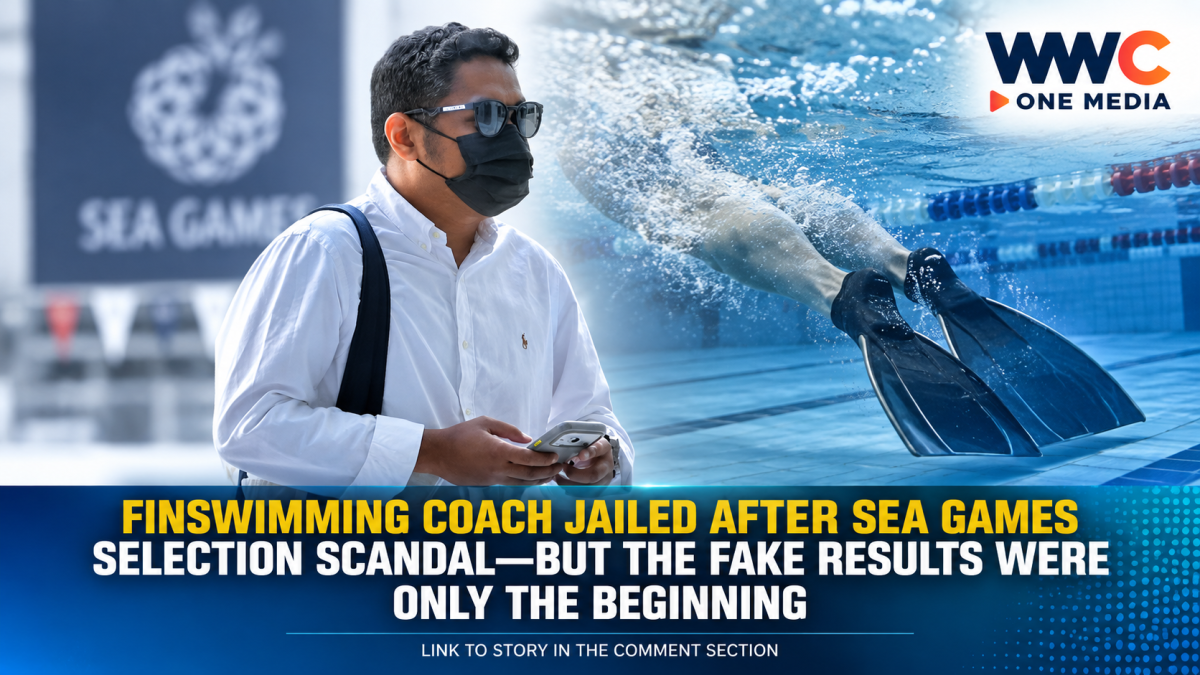
A Singaporean former finswimming coach has been jailed after admitting to his role in a scheme to falsify competition results that helped secure places for athletes at the 2023 Southeast Asian Games in Cambodia.
Muhammad Faiz Suhaimi, a former team manager and coach with the Singapore Underwater Federation (SUF), was sentenced to one week in prison after pleading guilty to conspiring to create a false electronic record for the purpose of cheating.
The case has raised serious questions about the integrity of athlete-selection processes after investigators found that fabricated competition results were used to convince the Singapore National Olympic Council (SNOC) to select athletes who otherwise would not have qualified.
Fake results helped six athletes make the SEA Games team
The scheme centered on results purportedly from the 1st Malaysia Fin Swimming Championship 2023, held in Malaysia in January 2023.
According to court proceedings reported by CNA, five Singaporean male athletes actually travelled to the competition. However, the women whose names later appeared in the falsified results had not competed in the relevant events.
Faiz allegedly used software to create a false electronic record covering four events, including the women’s 4x200m surface relay. The fabricated document indicated that female athletes had competed and achieved qualifying times, despite the fact that the female swimmers had not participated in those events.
The falsified information was subsequently submitted as part of an appeal to the SNOC during the selection process for the 32nd SEA Games.
The appeal succeeded.
Eight athletes were ultimately selected through the appeal process. Two had already been selected for other SEA Games events, while six additional athletes would not have been selected without the falsified results, according to the prosecution’s case.
Among the six was the daughter of then-SUF vice-president for sports and head finswimming coach Ho Ho Huat, who is also facing charges in connection with the case.
Singapore spent about S$15,700 on the additional athletes
The consequences went beyond the competition results.
Because of the additional selections, the SNOC incurred approximately S$15,700 in additional costs to send the six athletes to Cambodia for the 2023 SEA Games.
The four-member Singapore women’s 4x200m surface relay team eventually competed at the Games and finished fourth and last in the final, around 50 seconds behind Vietnam, according to reporting based on the Games’ archived results.
How the scheme was uncovered
The falsification did not immediately come to light.
Ho was removed from his position at SUF in December 2023. About three weeks later, Faiz and assistant coach Gary Lee Quan Hua informed an anonymous whistleblower about the falsified results.
Faiz also expressed regret over his involvement.
The whistleblower subsequently informed then-SNOC president Grace Fu, triggering investigations by the SNOC and Sport Singapore.
A Committee of Inquiry was established in July 2024. The inquiry interviewed 11 people and concluded that the submitted results had indeed been falsified. It also identified governance problems within SUF and a failure to report wrongdoing.
SNOC subsequently lodged a police report in March 2025.
Three former coaches were eventually charged
The case expanded into criminal proceedings in 2026.
Faiz, Ho and Lee were charged in March 2026 over their alleged involvement in the falsification. Faiz and Ho each faced three charges, while Lee faced two charges relating to the alleged conspiracy to commit forgery for the purpose of cheating.
The alleged offences involved creating falsified electronic records, entering the information into the SportSync system and altering a competition result sheet.
The potential punishment was serious: the forgery-for-cheating offence carries a possible jail term of up to 10 years and a fine.
Why Faiz received a lighter sentence
Faiz’s case was different from those of his alleged co-conspirators in one important respect: he eventually disclosed the wrongdoing before an official investigation began.
When he pleaded guilty in August, prosecutors sought a fine of between S$10,000 and S$15,000, highlighting his voluntary disclosure and his more junior position compared with Ho.
Despite that, the court ultimately imposed a one-week custodial sentence, underscoring the seriousness of falsifying sporting records connected to national-team selection.
The cases involving Ho Ho Huat and Gary Lee Quan Hua remain pending, with further proceedings expected in October.
The bigger issue: trust in sports selection
The scandal is significant because the falsification did not merely manipulate a race result. It was allegedly used to influence who would represent Singapore at an international sporting event.
The SNOC’s selection framework requires national sports associations to establish qualifying standards and submit their criteria for endorsement. Athletes are assessed not only on performance but also on factors such as conduct, commitment, fitness and potential.
That makes the case a broader governance issue for Singapore sport.
The episode also illustrates how a seemingly technical alteration to a timing sheet can have real consequences: athletes were added to a national delegation, public funds were spent on their participation, and confidence in the selection system was put under scrutiny.
For the athletes themselves, however, CNA reported that the swimmers involved said they were focused on training and were not responsible for the alleged manipulation. One of the athletes described the four women who competed as victims of the situation, emphasizing that they had represented Singapore and performed their duties as athletes.
What happens next?
Faiz’s one-week jail sentence closes one chapter of the scandal, but the case is not over.
The proceedings against Ho and Lee remain outstanding, meaning the courts have yet to determine the full legal responsibility of everyone accused of participating in the alleged scheme.
What began with questionable timings from a Malaysian competition has now become one of Singapore sport’s most closely watched cases involving forged results, athlete selection, governance and trust.
And the biggest question still hanging over the scandal is whether the system has done enough to ensure that something similar cannot happen again.




Leave a Reply