
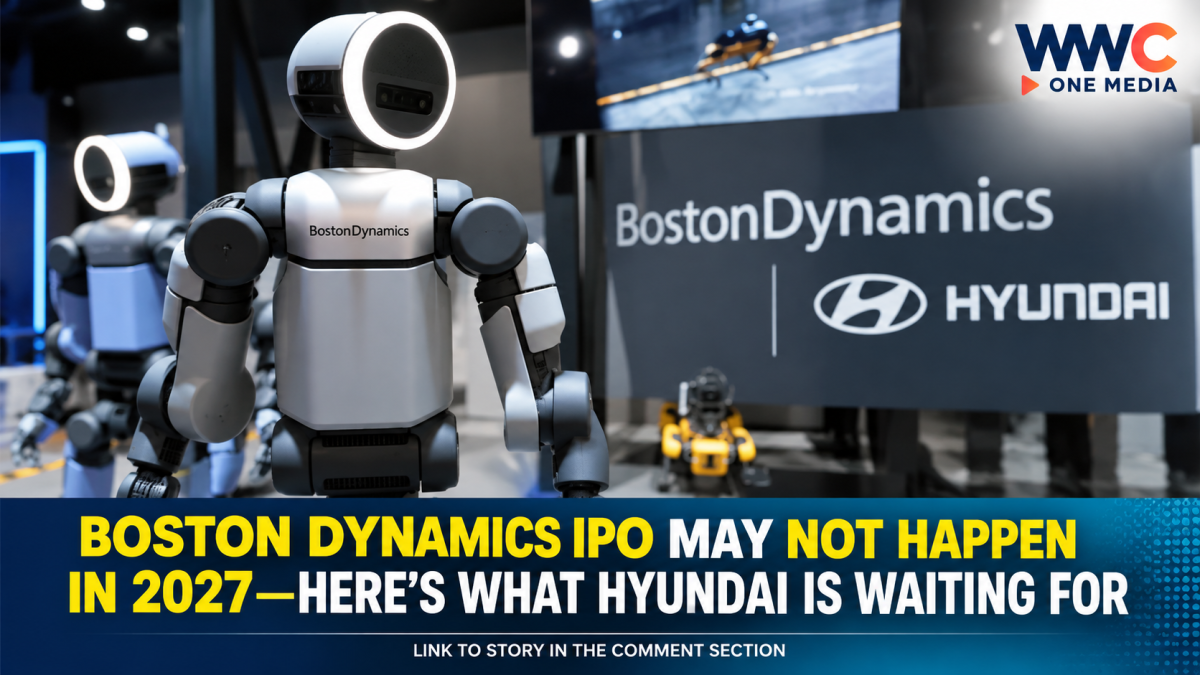
The long-anticipated stock market debut of Boston Dynamics may be further away than investors hoped.
Boston Dynamics, the Hyundai Motor Group-owned robotics company behind the humanoid Atlas robot, is unlikely to launch an initial public offering (IPO) in 2027, according to a senior Hyundai executive with direct knowledge of the matter, raising fresh questions about when the robotics giant will be ready for the public markets.
Asked whether Boston Dynamics could go public next year, the executive reportedly said, “It won’t be easy,” adding that the company still needs to assess market conditions and other circumstances.
The comments are significant because investor interest in Boston Dynamics has surged alongside the rapid growth of the global humanoid robotics industry.
From Robotics Sensation to IPO Candidate
Boston Dynamics has become one of the world’s best-known robotics companies, famous for machines such as Spot and Atlas.
Hyundai Motor Group acquired a controlling interest in Boston Dynamics in 2021. The company has since become a major part of Hyundai’s strategy to expand beyond traditional automobiles and into artificial intelligence, robotics and future mobility.
Boston Dynamics’ own information says Hyundai currently holds an 80% stake, while SoftBank owns the remaining 20%.
Reuters reported that Hyundai announced plans in July to acquire SoftBank’s remaining stake, potentially making Boston Dynamics a wholly owned Hyundai subsidiary. The reported value of that transaction was around 500 billion won, although the valuation was not officially disclosed.
That ownership structure has fueled speculation that Hyundai could eventually spin off Boston Dynamics through a public listing.
But the latest comments suggest investors may have to wait.
Atlas Is the Key
At the center of the IPO debate is Atlas, Boston Dynamics’ next-generation electric humanoid robot.
The company unveiled the production version of Atlas at CES 2026, describing it as a robot designed for industrial work rather than simply a research demonstration. Boston Dynamics says Atlas production has already begun, with deployments scheduled for Hyundai and Google DeepMind.
The robot stands about 1.9 meters tall, weighs approximately 90 kilograms and has 56 degrees of freedom. It features tactile sensing in its fingers and palms and a 360-degree camera view.
But producing impressive demonstrations is one thing. Proving that humanoid robots can operate reliably, safely and economically inside factories at scale is another.
That is precisely the challenge analysts say Boston Dynamics must overcome before an IPO becomes realistic.
Why 2027 Could Be Too Early
According to Reuters, Boston Dynamics remains unprofitable and has not yet deployed Atlas robots at large scale.
The company’s financial position is another major factor.
Boston Dynamics recorded a loss of about 528.4 billion won in 2025, according to a Hyundai Glovis filing cited by Reuters. Its accumulated losses from 2021 through 2025 were close to 1.7 trillion won.
Those figures do not necessarily mean the company’s long-term prospects are weak. Instead, they highlight the enormous cost involved in turning advanced robotics technology into a mass-market industrial business.
Analysts cited by Reuters believe a Boston Dynamics IPO could be more realistic around 2029 or 2030, after the company has accumulated more operational data and demonstrated that Atlas can be deployed commercially at scale.
Hyundai Is Betting on a Much Bigger Robotics Business
Hyundai is not waiting for an IPO to expand its robotics ambitions.
The automaker has said it wants to establish U.S. robot production by 2028, with annual capacity targeted at 30,000 robots. It also plans to deploy Atlas at its Georgia manufacturing operation and eventually expand the technology throughout its manufacturing network.
Hyundai has been testing humanoid robotics in manufacturing environments, including through its Robot Metaplant Application Center in the United States.
The strategy is to use Hyundai’s factories as real-world testing grounds where robots can learn industrial tasks and generate operational data.
That data could ultimately be just as important as the robots themselves.
AI Could Change the Equation
Boston Dynamics is also working with Google’s DeepMind on artificial intelligence for Atlas.
The partnership is intended to combine Boston Dynamics’ robotics expertise with Google’s AI models so Atlas can better understand its surroundings, perform complex tasks and adapt to changing situations.
The goal is to move beyond robots that simply repeat pre-programmed movements.
Instead, the industry is pursuing machines that can perceive their environment, learn tasks and respond to situations in ways that are closer to human decision-making.
That could dramatically expand the potential market for humanoid robots—from factories and warehouses to logistics and other industrial environments.
Boston Dynamics Is Expanding Its Manufacturing Footprint
The company is also investing heavily in its own infrastructure.
In June, Boston Dynamics announced plans to invest $100 million in a new 323,000-square-foot robotics and AI facility in Waltham, Massachusetts. The project is expected to create up to 1,250 jobs by 2033 and will support advanced manufacturing, artificial intelligence, research and development, and workforce training.
That investment underscores the company’s longer-term ambition.
Boston Dynamics isn’t simply preparing Atlas for a product launch—it is building the industrial infrastructure needed to support a larger robotics business.
The Humanoid Robot Race Is Getting Crowded
Boston Dynamics is also facing an increasingly competitive market.
Tesla is developing Optimus, while companies such as Figure, Agility Robotics and Apptronik are pursuing their own humanoid machines.
Chinese automakers and robotics startups are also moving aggressively into the sector. TechCrunch recently reported that Chinese companies are increasingly using their manufacturing expertise to compete in the rapidly developing humanoid robotics market.
The result is a race not just to build the most impressive robot, but to determine which company can manufacture and deploy humanoids profitably at scale.
That distinction could ultimately determine Boston Dynamics’ valuation.
Investors May Have to Wait
Market estimates for Boston Dynamics’ potential valuation vary dramatically.
Reuters reported that Samsung Securities estimates cited in the market place the company’s potential value between 50 trillion won and 100 trillion won, while IBK Securities has suggested a possible valuation of 141 trillion won by 2030 under a much more aggressive growth scenario.
Such a wide range illustrates the uncertainty surrounding the business.
The opportunity is enormous—but so are the technological, manufacturing and financial risks.
For now, Hyundai appears more interested in proving that Atlas can become a commercially viable industrial product than rushing Boston Dynamics onto the stock market.
And that may be the most important signal for investors.
The Boston Dynamics IPO story may not be ending—it may simply be moving further into the future.
The real question now is whether Atlas can prove that humanoid robots are ready for mass industrial deployment before Hyundai decides the company is ready for Wall Street.




Leave a Reply