MANILA, Philippines — November 4, 2026 | WWC ONE MEDIA | Technology, Business & Lifestyle
Filipino families are reimagining how they celebrate life’s biggest moments, and Japanese technology giant Epson sees a business opportunity in turning ordinary living rooms, condominium function rooms and intimate event spaces into personalized entertainment venues.
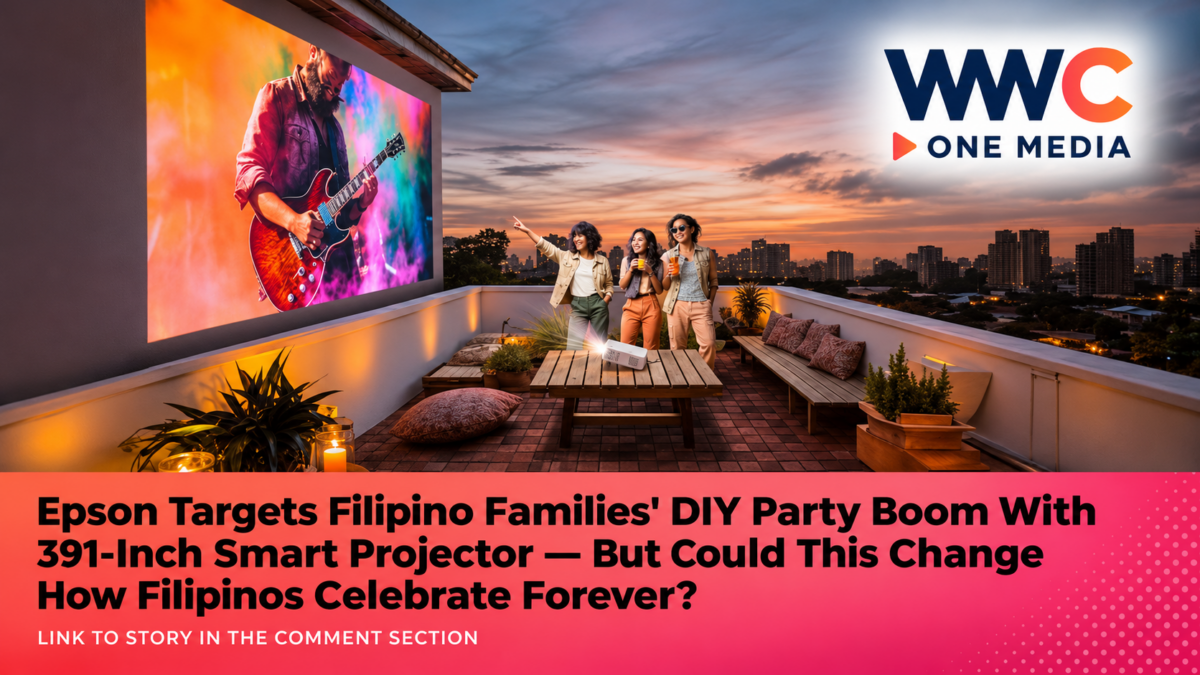
As more households explore do-it-yourself (DIY) parties, Epson is promoting its CO-FH02 Smart Projector as a versatile home entertainment device capable of transforming gatherings through large-screen videos, interactive games, family presentations and streaming entertainment.
The strategy reflects a broader consumer trend highlighted in recent Philippine media coverage: families using technology, online shopping and social media inspiration to organize celebrations without necessarily relying on elaborate event setups.
But beyond the excitement surrounding its enormous projection capability, a bigger question is emerging.
Could affordable access to large-screen entertainment change how Filipino families celebrate birthdays, weddings and holidays—or will the cost and practical limitations keep projectors from becoming everyday household essentials?
Filipino Families Are Rethinking the Traditional Party
For generations, Filipino celebrations have been associated with elaborate preparations, decorated venues, large guest lists and professional event services.
From children’s birthdays and debuts to weddings and Christmas reunions, these gatherings remain important parts of Filipino family life.
However, smaller residential spaces and increasingly accessible entertainment technologies are giving households more options.
According to reporting from InsiderPH, families are exploring celebrations in living rooms, condominium function rooms and smaller event venues, using personalized decorations, digital presentations and entertainment activities.
Instead of depending entirely on professional event coordinators, organizers can draw inspiration from social media, purchase supplies through online marketplaces and build their own celebration programs.
The shift does not mean that traditional venues or professional event services are disappearing.
Rather, it creates additional choices for families that want more control over their celebrations.
And Epson wants its projector technology to become part of those experiences.
Epson CO-FH02: A 391-Inch Screen for Home Entertainment
At the center of Epson’s latest consumer-focused promotion is the CO-FH02 Smart Projector.
The device delivers Full HD 1080p resolution and uses Epson’s 3LCD projection technology to produce 3,000 lumens of both white and color brightness under specified measurement conditions.
Its headline feature is the ability to create a projected image measuring up to 391 inches diagonally under suitable installation conditions.
That is substantially larger than most conventional household televisions.
However, achieving the maximum screen size requires sufficient projection distance and an appropriately large viewing surface.
Real-world image visibility also depends on lighting, screen conditions and setup.
The projector weighs approximately 2.6 kilograms, allowing users to move it between suitable rooms and venues.
It also comes with an Android TV dongle, Chromecast built-in functionality and a 5-watt integrated speaker.
These features allow households to use the projector for entertainment without requiring a dedicated home theater installation.
For Epson, the opportunity is to position a projector as a multipurpose household device rather than equipment reserved for offices, classrooms and formal events.
Weddings, Debuts and Birthdays Could Become More Interactive
One potential market for the CO-FH02 is the Filipino celebration industry.
During weddings and debuts, projected screens are commonly used to show photographs, videos and personal messages.
A projector can help families present childhood montages, wedding highlights, anniversary tributes and messages from relatives who are unable to attend.
For smaller celebrations, this can provide an alternative to renting elaborate audiovisual equipment, depending on the venue and technical requirements.
Families organizing birthday parties can also create personalized presentations and digital backdrops.
Instead of relying exclusively on traditional decorations, a projected display can become part of the event’s entertainment program.
However, projection equipment does not automatically eliminate the need for professional sound systems, screens or lighting.
Larger events may still require specialized equipment and technical assistance.
Epson’s opportunity is strongest where a compact, reusable setup can meet the needs of a smaller gathering.
Gaming and Movie Nights Expand the Projector’s Appeal
Epson is also highlighting entertainment applications beyond formal celebrations.
Through compatible connections, families can use the CO-FH02 for gaming sessions, film screenings and sporting-event watch parties.
Multiplayer games can become shared experiences on a large projected screen.
Meanwhile, birthdays and family reunions can feature animated presentations, videos and entertainment content.
The projector’s Android TV functionality also supports compatible streaming applications.
These capabilities broaden its potential use beyond an occasional birthday or holiday celebration.
A household that purchases a projector for one event may also use it for weekend movie nights, presentations or recreational activities.
That repeated-use proposition is central to Epson’s strategy.
Rather than selling the device as a single-occasion expense, the company can market it as a longer-term entertainment investment.
Overseas Filipino Families Could Benefit From Bigger Shared Screens
Another potential application involves Filipino families with relatives working or living overseas.
During Christmas, birthdays and anniversaries, video calls can help connect family members across countries.
A compatible device can display these calls through the projector, allowing more people to participate in a shared viewing experience.
For families accustomed to gathering around a small mobile phone or laptop, a larger projected image could make virtual participation more convenient.
However, the projector itself does not provide video-conferencing services.
Users need compatible external devices, applications and a reliable internet connection.
The broader significance lies in how households can combine existing communication tools with larger entertainment displays.
Epson’s Expansion Goes Beyond Home Entertainment
The company’s focus on consumer celebrations comes alongside a broader effort to expand its presence in Southeast Asia.
Epson has been strengthening its professional printing, textile, signage and imaging operations across the region.
As previously reported by WWC ONE MEDIA in its coverage of Epson’s ASEAN printing expansion, the company’s Philippine large-format printer market share increased to 26.9% in 2025, based on IDC figures cited in Epson’s regional announcement.
The Philippines is also an important part of Epson’s manufacturing network.
Its operations in Batangas produce printers and projection-related products for international markets.
That presence gives the country a role beyond being a consumer electronics market.
The promotion of home entertainment products represents another way Epson can connect its imaging technology to Philippine consumers.
The Smart Home Market Is Becoming More Competitive
Epson’s campaign also reflects a wider development in consumer electronics.
Technology companies are increasingly promoting products based on how they fit into everyday household activities.
Instead of emphasizing technical specifications alone, manufacturers are highlighting convenience, versatility and practical uses.
For example, WWC ONE MEDIA previously examined TCL’s campaign offering free laundry services to Filipino consumers, demonstrating how consumer electronics brands use real-life experiences to introduce their products.
In Epson’s case, the focus is on making family celebrations more engaging through projection technology.
The challenge is convincing consumers that the additional entertainment possibilities justify the cost of purchasing and maintaining the equipment.
Households already own televisions, smartphones, computers and other connected devices.
A projector therefore needs to provide enough additional value to earn a place among those existing technologies.
Online Shopping Could Help Epson Reach More Filipino Families
Digital marketplaces are another important part of Epson’s distribution strategy.
The CO-FH02 is available in the Philippines through Shopee, Lazada, TikTok Shop and authorized Epson dealers, according to recent product coverage.
These channels allow consumers to compare products, examine specifications and evaluate potential purchases without visiting a traditional electronics showroom.
Their accessibility is especially relevant to consumers who use online shopping platforms when planning home celebrations.
The expanding digital retail environment was also explored in WWC ONE MEDIA’s report on Filipino entrepreneurs building e-commerce brands.
However, consumers should carefully assess product authenticity, warranties, seller credentials and delivery conditions before buying expensive electronic equipment online.
As discussed in WWC ONE MEDIA’s coverage of TikTok Shop and the DTI’s online shopping safety campaign, buyers should verify product information and seller credibility before completing transactions.
For projectors, consumers should also examine official specifications and ensure that the equipment suits their intended room size and lighting conditions.
What Buyers Should Know Before Purchasing
Despite its large-screen capabilities, the Epson CO-FH02 is not a universal replacement for conventional televisions or professional projection equipment.
Several practical considerations matter.
First, the projected image’s size depends on how far the device can be positioned from the screen or wall.
Second, brighter surroundings may reduce perceived image contrast compared with a darkened room.
Third, the projector’s integrated 5-watt speaker may be insufficient for larger celebrations, making an external sound system desirable.
Fourth, buyers should consider electricity consumption, lamp life and eventual maintenance costs.
Epson lists a lamp life of up to 6,000 hours in normal mode and 12,000 hours in Eco mode under its published specifications.
These figures are rated operating-life specifications, not guarantees that every unit will perform identically.
For households that frequently host gatherings, the value of a projector may depend on how often it is used beyond special occasions.
A Bigger Opportunity for the Philippine Home Entertainment Industry
Epson’s campaign highlights how technology manufacturers are discovering new ways to market established product categories.
Projectors are not new inventions, and the CO-FH02 itself was being promoted by Epson in the Philippines as early as 2023.
What is changing is the company’s marketing emphasis.
By associating projection technology with family milestones, home-based celebrations and shared entertainment, Epson is attempting to appeal to consumers beyond the traditional education and business markets.
There are also potential opportunities for smaller event organizers, photographers and home entertainment providers that use projection equipment in their services.
However, the available reporting does not quantify the size of the Philippine DIY celebration market or establish how much additional projector demand the trend will produce.
The commercial impact remains to be seen.
Can Epson Turn DIY Celebrations Into Long-Term Growth?
The company’s strategy arrives at a time when consumer technology brands face pressure to demonstrate everyday usefulness.
For Epson, the CO-FH02 offers a way to present projection technology as part of family life rather than a specialized tool used only for formal presentations.
Its combination of Full HD resolution, large-screen projection, streaming features and portability gives the product several possible applications.
But its success in the Philippine market will ultimately depend on affordability, consumer awareness, competition and whether households consider it a worthwhile purchase.
DIY celebrations may create additional interest, but stronger demand cannot be assumed without actual sales and market data.
The bigger question is whether Epson can transform occasional interest in home celebrations into sustained demand for smart projectors.
For Filipino families, the appeal is straightforward: bigger shared experiences in familiar spaces.
For Epson, the business opportunity could extend far beyond birthdays, weddings and Christmas gatherings.
But as technology companies compete to become part of everyday household life, can a smart projector genuinely become the centerpiece of Filipino celebrations—or will traditional televisions and cheaper entertainment alternatives continue to dominate?