
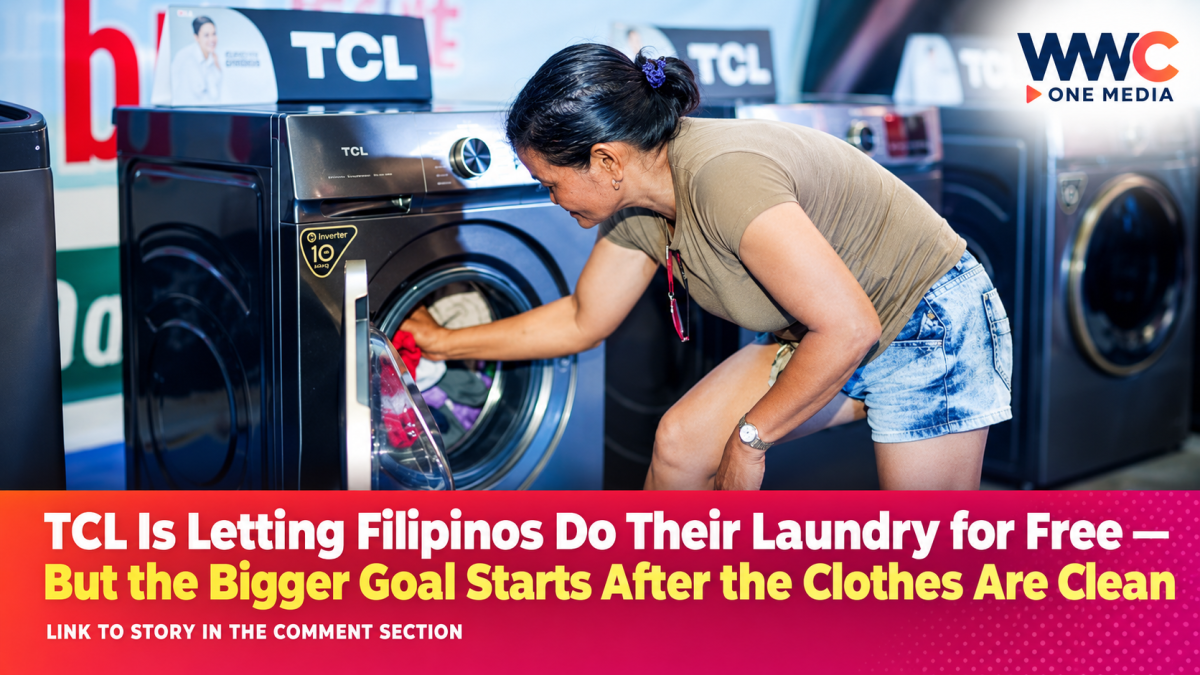
MANILA, Philippines — TCL Philippines is taking its battle for the laundry room outside the appliance showroom, offering Filipinos free washes in Tacloban and Cainta as the electronics brand tries to convince more households that connected washer-dryers can solve a very ordinary problem: getting clothes washed and dried when weather, space and time are working against them.
Together with Robinsons Appliances, TCL brought back its Labapalooza campaign for a second year, turning community locations into temporary laundromats where residents could bring clothes, use TCL machines at no charge and see the company’s smart-laundry features working under real household conditions.
The campaign included stops in Tacloban and Cainta, following the concept’s debut in La Union in 2025.
For TCL, the strategy is part community program and part product demonstration.
And behind the free laundry is a bigger commercial challenge: TCL is trying to gain ground in a Philippine washing-machine market where several established Japanese, Korean and American brands still command much of consumer spending.
Why TCL Is Taking Washing Machines Into Communities
Selling a television in a store is relatively simple.
Customers can immediately judge the picture, screen size and design.
A washing machine is different.
Claims about stain removal, drying, fabric care, noise levels or automatic detergent dosing are difficult to demonstrate on a showroom floor.
Labapalooza attempts to solve that problem by allowing consumers to use the appliances themselves.
Residents in Tacloban and Cainta were able to bring their actual laundry to the pop-up locations and experience TCL’s washer-dryer technology rather than relying solely on advertisements or salesperson explanations.
TCL Philippines Product Director for Washing Machine and Refrigerator Gavin Gui said the activations were intended to bring the company’s technologies closer to households and demonstrate how the machines could simplify everyday laundry.
That hands-on strategy is particularly relevant to appliances carrying features consumers may not immediately understand.
“Smart laundry” can sound like marketing jargon.
Using the machine makes the proposition easier to explain.
What TCL Means by ‘Smart Laundry’
The headline product associated with the campaign is TCL’s Super Drum C682 Washer & Dryer, model TWD120-C682DW.
TCL’s Philippine product page lists the machine with a 12-kilogram washing capacity and connected and automated features including Wi-Fi control, automatic detergent dosing, automatic stain removal, steam washing and several fabric-care systems.
Through the TCL Home app, users can remotely start or pause a cycle, select washing programs, monitor remaining time and receive notifications when the wash is completed.
That is an important distinction when describing the product.
The machine is “smart” primarily because of connectivity, sensors and automated washing functions. It should not automatically be described as an artificial-intelligence washing machine unless TCL specifically identifies a particular feature as AI-powered.
Among its other advertised features are:
- a 540-millimeter-diameter Super Drum designed to give clothes more space to tumble;
- jetBubble, which mixes water, detergent and air before applying it to clothes;
- Auto Dose, which automates detergent dispensing;
- Steam Wash for deeper cleaning and hygiene;
- Dynamic Rinse for removing detergent residue and dirt;
- Quick 15’/30′ cycles for smaller or faster loads;
- activeFresh, which periodically tumbles clothes for up to 10 hours after a cycle to help prevent wrinkles; and
- Easy Start, a simplified one-touch cycle setup.
The commercial pitch is essentially convenience: put more of the decisions normally made by the user into the machine.
The Washer-Dryer Combination Matters During Rainy Weather
The drying function is arguably more relevant to Philippine households than some of the headline connectivity features.
A combined washer-dryer can move directly from washing into drying without requiring clothing to be transferred to another appliance.
That is especially useful for households with limited outdoor drying space or during prolonged rainy periods.
TCL itself acknowledges that combined washer-dryers come with trade-offs.
Its Philippine website notes that washer-dryer combinations can take longer to dry clothes than dedicated dryers because of the way compact combination units handle moisture and airflow.
That caveat is worth highlighting because an all-in-one machine is not automatically the best solution for every household.
Families processing very large volumes of laundry may still prefer separate washing and drying machines because both appliances can operate at the same time and dedicated dryers can provide faster drying performance.
For apartments, condominiums and homes where space is the bigger constraint, however, the combination format has a clearer advantage.
The C682 Isn’t a Budget Appliance
TCL’s campaign may make the technology easier to experience, but affordability remains another question.
A current SM Appliance listing places the TCL TWD120-C682DW 12kg/8kg washer-dryer at ₱36,995, reduced from a listed regular price of ₱49,995.
Retail prices and promotions can change, so that figure should be treated as a current retailer listing rather than a permanent suggested retail price.
That puts the machine well above the price of basic top-load washers.
The value proposition therefore depends on whether a buyer places enough importance on the integrated dryer, large capacity, Wi-Fi controls, automated dosing and other convenience features to justify the additional cost.
This is precisely why the community-demo strategy may make sense.
TCL is trying to sell not merely a washing machine but a more automated way of doing laundry.
That argument is easier to make when customers can actually use the product.
Labapalooza Started in La Union
The Tacloban and Cainta events are not the first Labapalooza.
TCL and Robinsons Appliances launched the program in Barangay Sevilla, San Fernando, La Union, in 2025.
That original activation combined free laundry services with demonstrations of washer-dryer combos, front-load units and inverter top-loading machines.
The event also became an introduction platform for the C682 Super Drum machine.
At the time, Robinsons Appliances said strong community feedback encouraged it and TCL to bring the program to additional locations.
The 2026 Tacloban and Cainta campaign is therefore the fulfillment of that expansion plan rather than an entirely new marketing idea.
What has changed is the scale and geographic reach.
TCL is taking the demonstration format from northern Luzon into Eastern Visayas and Rizal, exposing the appliance line to consumers outside a single metropolitan retail setting.
TCL Added Entertainment—and an Auction
The second-year Labapalooza was deliberately designed to feel less like an appliance expo.
Alongside the free laundry services, TCL and Robinsons Appliances added interactive booths, karaoke, giveaways and local food stalls.
Attendees could also participate in a live auction for a TCL washer-dryer.
That approach turns what could be a dry technical demonstration into a community activity.
From a marketing perspective, it also gives TCL more time with potential buyers than a traditional store visit might.
Instead of consumers walking past a row of washing machines and comparing specification cards, they see clothes being loaded, cycles running and laundry coming out of the machine.
For home appliances, that physical demonstration can be more persuasive than simply advertising specifications.
TCL Also Donated Four Washing Machines
The campaign extended beyond product demonstrations.
TCL donated four high-efficiency washing machines to beneficiaries associated with Tahanang Walang Hagdanan and One Cainta Sunset Retreat Home for the Elderly.
That gives Labapalooza a corporate-social-responsibility component alongside its obvious marketing purpose.
For organizations handling the clothing, bedding and other laundry requirements of multiple residents or beneficiaries, washing capacity can represent a meaningful operational need.
It also allows TCL to position its community campaign around practical assistance rather than pure product promotion.
But TCL Faces Strong Competition in Philippine Laundry Appliances
The bigger business story is that TCL is entering a category with entrenched competitors.
Euromonitor’s February 2026 Philippine home-laundry report described the market as moderately concentrated, with the five biggest players accounting for more than half of retail unit sales in 2025.
Its published market summary listed:
Sharp — 12%
Panasonic — 12%
LG — 10%
Whirlpool — 9%
Concepcion Industries, through Midea and Toshiba — 8%.
TCL does not appear among that published top-five ranking.
That makes Labapalooza more strategically interesting.
TCL already has high visibility in televisions, but brand strength in one electronics category does not automatically guarantee leadership in washing machines.
It has to persuade consumers to trust TCL with an appliance expected to operate several times a week for years.
Hands-on demonstrations can help bridge that gap.
Efficiency, Hygiene and Convenience Are Becoming Bigger Selling Points
Euromonitor expects Philippine laundry-appliance manufacturers to continue competing through new products emphasizing energy efficiency, hygiene and convenience.
TCL’s current lineup fits almost exactly into those categories.
Its C682 promotes automated detergent use, steam cleaning, fabric-care cycles and connected controls.
Its more conventional 10.5kg DD Inverter Washer & Dryer Combo promotes lower-temperature drying, air-refresh functions, drum cleaning and an inverter direct-drive motor.
Competitors are pushing in the same direction.
LG, Panasonic, Samsung, Sharp, Whirlpool and other brands increasingly market inverter technology, steam treatment, connected controls and efficiency alongside traditional washing performance.
That means features once associated mainly with premium machines are gradually becoming part of mainstream competition.
For manufacturers, the question is no longer simply:
How well does it wash?
It is increasingly:
How much water and electricity does it use? How much work does it remove from the household? Can it dry clothes? Can it protect delicate fabrics? Can it be controlled remotely?
Smart Features Still Have to Solve Real Problems
There is an important lesson behind TCL’s community strategy.
Consumers do not necessarily buy appliances because they contain more technology.
They buy them when that technology removes a problem.
Wi-Fi control may be convenient, but it is less important if the basic wash is poor.
Automatic detergent dosing sounds sophisticated, but its value is ultimately measured by whether it saves detergent and avoids repeated manual adjustments.
A dryer is useful during rainy weather, but consumers must still consider electricity costs, drying capacity and cycle duration.
That is why the strongest aspect of Labapalooza may be that it forces TCL’s technology into real-world use.
Consumers can judge for themselves whether the extra features make laundry noticeably easier.
Why This Matters for TCL
TCL has spent years building its Philippine identity around televisions and, increasingly, air conditioners and other household appliances.
Laundry represents another opportunity to turn the brand into a broader whole-home electronics player.
The company already sells multiple Philippine washer categories, including top-load machines, front-load washers and washer-dryer combinations.
The challenge is convincing households that TCL belongs on their appliance shortlist beside brands that have been selling washing machines in the country for decades.
That is where Labapalooza becomes more than a colorful roadshow.
It is customer acquisition through experience.
Instead of waiting for Filipinos to enter a store and ask about TCL washing machines, the company is bringing the laundry room to them.
The Real Test Comes After the Free Wash
Tacloban and Cainta residents may have enjoyed free laundry, karaoke, giveaways and an opportunity to test smart appliances.
For TCL, however, the important numbers come later.
Will consumers who used the machines remember the brand when their old washer needs replacing?
Will enough households pay a premium for automatic dosing, app controls and integrated drying?
Can TCL convert its strong position in other electronics categories into meaningful washing-machine market share?
Those questions matter because the Philippine laundry market already has powerful incumbents.
Labapalooza gives TCL a different way of competing.
Rather than telling consumers that smart laundry can make life easier, the company is letting them bring a basket of dirty clothes and find out for themselves.
And in a market where TCL still has ground to gain, that hands-on experience could prove more valuable than another specification sheet.


Leave a Reply