
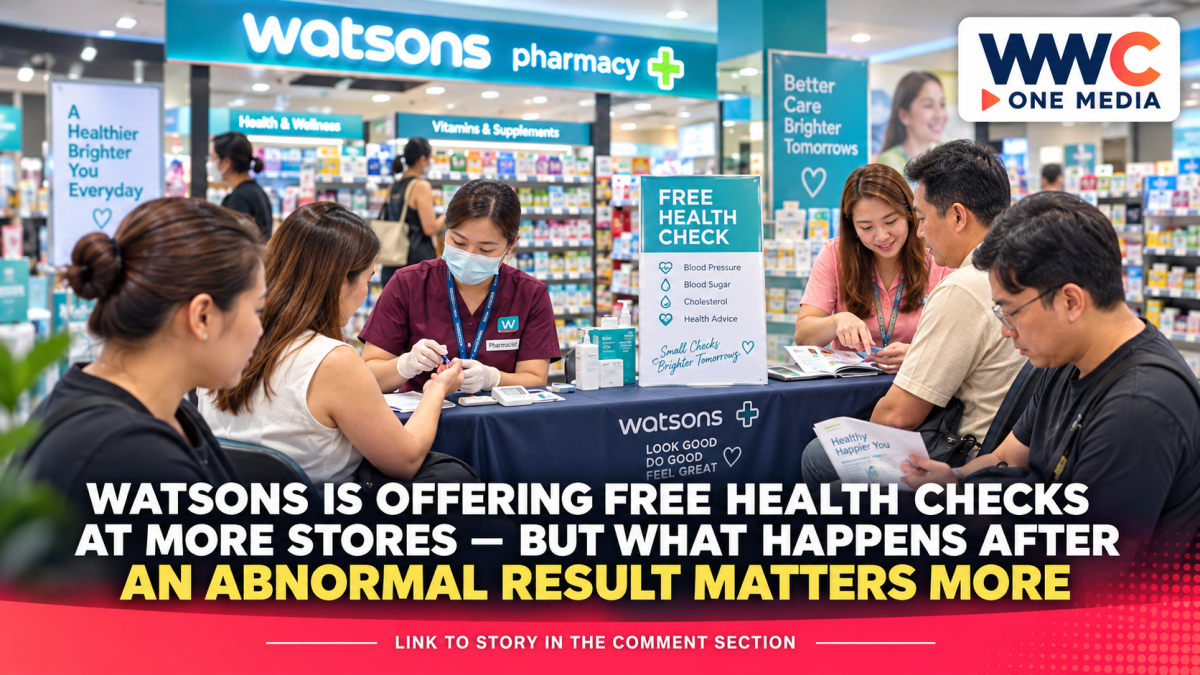
MANILA, Philippines — A pharmacy run may increasingly double as a basic health check as Watsons Philippines expands free screenings and physician consultations at selected stores this September, bringing preventive care into malls and neighborhood retail locations where Filipinos already shop.
The health and beauty retailer is offering services ranging from iron blood tests and nerve screening to cardiometabolic checks, fasting blood sugar tests, serum uric acid screening, bone and anemia screening, and free medical consultations at selected branches in Metro Manila and nearby areas.
The initiative continues a much broader preventive-health campaign Watsons rolled out in August, when free services were made available across more than 140 stores nationwide.
The strategy is straightforward: instead of waiting for consumers to visit a hospital or diagnostic center, Watsons is trying to put selected basic screenings closer to their daily routines.
But the bigger story goes beyond free tests.
With more than 1,200 stores across the Philippines, Watsons is gradually turning part of one of the country’s largest health-and-beauty retail networks into another front door for preventive healthcare.
Where the free September screenings are happening
Watsons’ September schedule includes several types of screening spread across different locations.
Cardiometabolic screening and physician consultations are scheduled at:
- Watsons SM City Fairview on September 17
- Watsons Matalino PHC on September 21
Free iron blood testing will be available from September 18 to 20 at:
- SM Novaliches Mall
- SM San Lazaro Mall
Free nerve screening is scheduled from September 19 to 20 at:
- Eastwood 1800
- North EDSA The Block
- Ever Gotesco Commonwealth
- Forbeswood Parklane
- SM City Fairview
Meanwhile, Watsons at SM City San Jose del Monte will offer fasting blood sugar and serum uric acid screening from noon to 5 p.m. on September 17, together with free medical consultations, bone screening and anemia screening.
Consumers should still verify schedules through Watsons’ official channels before traveling to a branch because participating stores, times and availability may change.
One geographical detail needs correcting
The campaign has been described as an expansion across Metro Manila stores, but technically not every listed location is inside the capital region.
SM City San Jose del Monte is in Bulacan.
That makes “Metro Manila and nearby areas” the more accurate description of the September rollout.
It is a small distinction, but an important one for consumers deciding where to go—and for news reports seeking to avoid implying that all of the services are confined to the National Capital Region.
Why Watsons is putting health checks inside stores
Watsons Managing Director Danilo S. Chiong said the company wants health monitoring to become easier to fit into everyday life rather than something people automatically associate with a separate hospital or clinic visit.
The logic is particularly relevant for conditions that can remain unnoticed for long periods.
High blood pressure, elevated blood glucose and other cardiometabolic risks can develop before a patient experiences obvious symptoms.
The World Health Organization estimates that one in three adults in the Philippines has hypertension, equivalent to about 16.8 million adults.
Even more concerning, WHO reported that only about 19% of Filipinos with hypertension had the condition under control in the data it cited in 2025.
Across Southeast Asia, the problem is even larger.
WHO said in May 2026 that more than 273 million people in the region live with hypertension, while more than 159 million do not know they have it.
Nearly eight in 10 people with hypertension in the region do not have their blood pressure adequately controlled.
That helps explain why a seemingly simple screening program can matter.
For conditions that may remain silent until complications emerge, sometimes the first important step is simply finding out that something may be wrong.
Diabetes is another reason early screening matters
Blood sugar screening is particularly relevant in a country dealing with a substantial diabetes burden.
International Diabetes Federation data previously estimated that about 4.3 million Filipino adults, or roughly 7.2%, were living with diabetes.
Globally, the IDF’s latest atlas estimated that 589 million adults aged 20 to 79 were living with diabetes in 2024, with around 252 million unaware they had the disease.
Watsons has already made diabetes screening a larger part of its health strategy.
Through a partnership with Diabetes Philippines Inc., its STOP Diabetes Program screened nearly 5,000 people from April to May 2026 for diabetes, hypertension and overweight or obesity.
Almost 70% of those screened were found to have at least one health risk factor or condition, according to Watsons and Diabetes Philippines.
That figure does not mean 70% were newly diagnosed with diabetes.
Rather, it demonstrates how often health risks can emerge when people who may otherwise feel well are given basic screening.
August was much bigger
September’s program follows an unusually broad screening campaign during the previous month.
Manila Bulletin reported that Watsons offered free preventive-health services in more than 140 branches nationwide during its July-August campaign.
Those services included iron blood tests, reproductive-health checks, bone scans, liver screening, medical consultations, cardiometabolic assessments, fasting blood sugar and serum uric acid tests, and bone and anemia screening.
The September schedule therefore appears less like a one-off promotion and more like an extension of a strategy Watsons has been developing throughout 2026.
Watsons is also turning stores into vaccination points
Screening is only one part of that strategy.
By late August, more than 85,000 patients had received vaccinations through Watsons, according to the company.
Vaccination services were available in more than 300 Watsons branches nationwide, including 22 vaccination hubs offering daily services.
Flu shots were the most requested, followed by vaccines covering HPV, pneumonia, shingles and pertussis.
The scale is notable because Watsons has something many healthcare providers do not: a massive existing retail footprint.
The company had already reached 1,166 Philippine stores by the end of 2024, after opening 80 branches that year, according to BusinessWorld.
By January 2026, company information cited in recent reports put its network at more than 1,200 stores.
That network gives Watsons the ability to place selected health services in locations where customers are already going for medicines, personal care products and ordinary shopping.
Pharmacies are becoming more than places to buy medicine
The shift reflects a broader transformation in retail pharmacy.
Traditionally, consumers entered a pharmacy after a healthcare professional had already diagnosed a condition or prescribed medication.
Increasingly, pharmacy chains want to engage consumers earlier.
That can include vaccination, basic screening, pharmacist counseling, health education and referrals when results indicate that further evaluation may be needed.
Watsons has already trained pharmacists through its diabetes partnership to provide education around disease prevention and management.
The retailer has also expanded campaigns around respiratory health, gut wellness, obesity and women’s health.
In other words, the business model is gradually moving from simply selling health products toward becoming part of the consumer’s broader health journey.
But a free screening is not a diagnosis
That distinction matters.
A blood pressure reading, fasting blood sugar result, anemia screen or other retail-based test can identify a potential concern.
It does not automatically establish a medical diagnosis.
Abnormal results may require repeat testing, laboratory confirmation or evaluation by a licensed healthcare professional depending on the condition being investigated.
That is particularly important with diseases such as hypertension and diabetes, where diagnosis and treatment decisions depend on established clinical criteria and the patient’s broader medical history.
WHO itself emphasizes that screening and early detection should connect patients with appropriate diagnosis, treatment and follow-up rather than operate as isolated events.
For Watsons, therefore, the real value of the program will not simply be measured by how many tests it performs.
The bigger question is whether people with concerning results ultimately reach the appropriate healthcare provider.
Retail healthcare is filling a convenience gap
The attraction of programs like this is easy to understand.
Getting a routine test can require transportation, waiting time, clinic fees and time away from work.
For someone already visiting a mall or pharmacy, getting a basic screening during the same trip lowers at least some of those barriers.
That convenience cannot replace a hospital, primary-care clinic or physician.
But it may provide another entry point into the healthcare system—particularly for people who continuously postpone routine checks because they do not feel sick.
WHO has repeatedly emphasized that early detection, screening and treatment are essential components of controlling noncommunicable diseases such as cardiovascular disease and diabetes.
That puts retail-based healthcare programs into a much larger public-health conversation.
The business angle should not be ignored
Watsons is also a commercial retailer, and health services can strengthen customer engagement.
A shopper who visits for a free screening may also buy medicines, vitamins, personal-care products or other merchandise.
Providing health consultations and screenings can deepen the relationship between a pharmacy and its customers while differentiating the chain from competitors.
That does not erase the potential public-health benefit.
It simply means preventive-health services can simultaneously serve healthcare-access and retail-strategy objectives.
For a chain with more than 1,200 Philippine outlets, even a small shift in how consumers use its stores could have substantial commercial implications.
The bigger story
Watsons’ September health program may initially look like another series of free mall screenings.
It is more revealing when viewed alongside everything else the company has been doing.
More than 140 stores offered health services during the previous campaign.
Nearly 5,000 people were screened under its diabetes partnership in just two months.
More than 85,000 people have already received vaccines through the retailer.
And Watsons has a physical footprint extending to more than 1,200 Philippine stores.
Put those numbers together and a larger strategy becomes visible.
Watsons is trying to make the pharmacy one of the places Filipinos encounter healthcare before they become seriously ill—not only somewhere they go after a doctor has already written a prescription.
For a country where millions live with hypertension, diabetes and other chronic health risks, bringing screening closer to everyday life could help more people discover problems earlier.
But that is only half the equation.
Finding a risk is useful only when patients know what to do next—and actually have access to the medical care needed to follow it up.




Leave a Reply