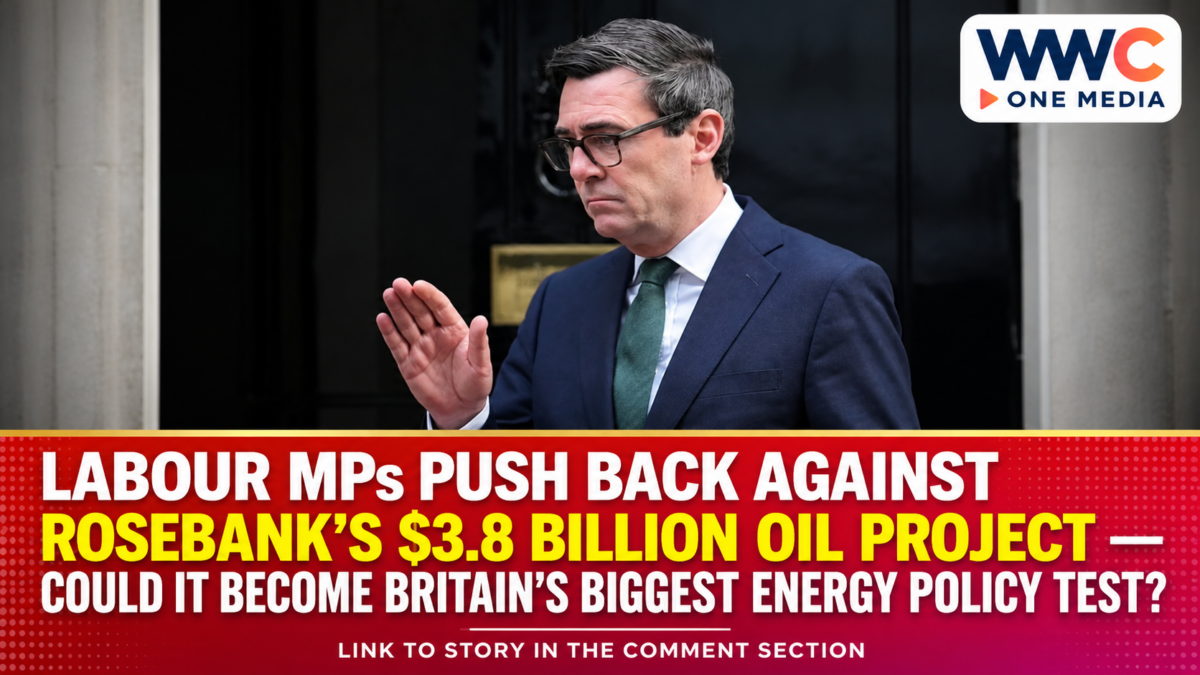
LONDON, United Kingdom — Britain’s proposed Rosebank oilfield is facing renewed political opposition after Labour lawmakers appealed to Prime Minister Andy Burnham to reject the offshore development, placing the government’s energy strategy and environmental commitments under closer scrutiny.
On November 26, 2026, Labour MP Catherine Fookes publicly confirmed her involvement in organising the appeal against the project, which is undergoing a renewed regulatory assessment.
The controversy centres on an oilfield estimated to contain approximately 300 million barrels of recoverable oil across two development phases, with an original first-phase investment commitment of US$3.8 billion.
The decision presents Britain with a difficult policy question: how can it maintain investment in domestic energy production while meeting its environmental obligations?
Rosebank Oilfield Becomes a Political Test for Labour
The opposition from Labour lawmakers adds another dimension to an already complicated regulatory process.
Energy Secretary Miatta Fahnbulleh is responsible for determining whether the government should agree to development consent, while the North Sea Transition Authority must subsequently make the final regulatory decision.
During a parliamentary debate on November 18, the government maintained that the application must be assessed under the relevant legal requirements rather than prejudged through political debate.
The dispute reflects competing priorities involving employment, industrial investment, domestic energy production and climate protection.
Similar questions surrounding petroleum development and long-term energy security have emerged elsewhere in Europe, including Norway’s Arctic oil expansion strategy.
However, political opposition does not automatically determine whether Rosebank will receive regulatory approval.
Why the $3.8 Billion Rosebank Project Matters
Rosebank lies approximately 130 kilometres northwest of Scotland’s Shetland Islands.
Discovered in 2004, the field is now operated by Adura, which holds an 80% interest. Ithaca Energy owns the remaining 20%.
The original investment decision, announced on September 27, 2023, allocated US$3.8 billion towards the project’s first development phase.
That phase targets an estimated 245 million barrels of oil, while the combined development phases could recover approximately 300 million barrels.
The proposed infrastructure includes underwater production wells connected to a floating production, storage and offloading vessel.
These investments illustrate the substantial financial commitments associated with offshore petroleum development.
The renewed regulatory assessment also highlights a wider investment consideration: committing capital to a major energy project does not eliminate its exposure to legal, environmental or policy risks.
Court Ruling Changed Rosebank’s Future
The project’s regulatory difficulties intensified following a ruling by Scotland’s Court of Session in January 2025.
The court determined that the earlier approval process was unlawful because the environmental assessment had not adequately considered emissions generated when the extracted oil and gas would eventually be consumed.
The ruling required the decisions to be reconsidered.
It also prevented petroleum extraction during the suspension period pending fresh decisions.
The distinction is important. Rosebank’s original development approval was not sufficient to guarantee that commercial production could proceed.
The renewed environmental assessment must address both the consequences of extracting fossil fuels and the climate implications of their subsequent combustion.
Energy Security and Climate Commitments Collide
Supporters of offshore petroleum development argue that domestic production can contribute to economic activity, employment and energy security.
Rosebank’s developers have incorporated plans that could allow its offshore production vessel to receive electricity from shore, potentially reducing emissions associated with extraction operations.
However, reducing emissions during production does not eliminate the emissions created when petroleum products are ultimately consumed.
For policymakers, the challenge is determining how these environmental considerations should be weighed against potential economic benefits.
Energy investment strategies across the Asia-Pacific region also involve balancing conventional fuels with changing environmental and commercial requirements.
Projects such as Vietnam’s proposed $20.5 billion Dung Quat energy hub illustrate the continuing importance of large-scale infrastructure investment in national energy planning.
Can Rosebank Transform Britain’s Energy Outlook?
Rosebank’s estimated recoverable resources make it a commercially significant development.
Nevertheless, the existence of substantial petroleum resources does not guarantee immediate reductions in household energy prices or establish how much government revenue the project could ultimately generate.
Its economic contribution would depend on production volumes, operating expenses, commodity prices and the applicable fiscal framework.
Investors examining international energy opportunities must also consider the regulatory conditions surrounding infrastructure development.
The continuing pursuit of foreign investment in Vietnam’s LNG industry provides another example of how energy infrastructure, commercial partnerships and national energy requirements intersect.
For Rosebank, the immediate issue remains whether its revised application can satisfy Britain’s environmental and regulatory requirements.
What Happens Next for Rosebank?
In a written parliamentary response dated November 19, the British government confirmed that Rosebank remained within the regulatory assessment process.
A fresh decision must consider the relevant evidence and applicable legal obligations.
For the developers, the outcome could determine whether their substantial offshore investment progresses towards commercial extraction.
For Labour, the controversy raises questions about how the government will reconcile differing views within its parliamentary ranks while maintaining a legally defensible energy strategy.
The project’s future remains dependent on the regulatory determination, rather than political speculation alone.
Ultimately, Rosebank represents more than an offshore oil development. It is a test of how Britain intends to manage the relationship between established petroleum industries, future energy investment and environmental responsibility.