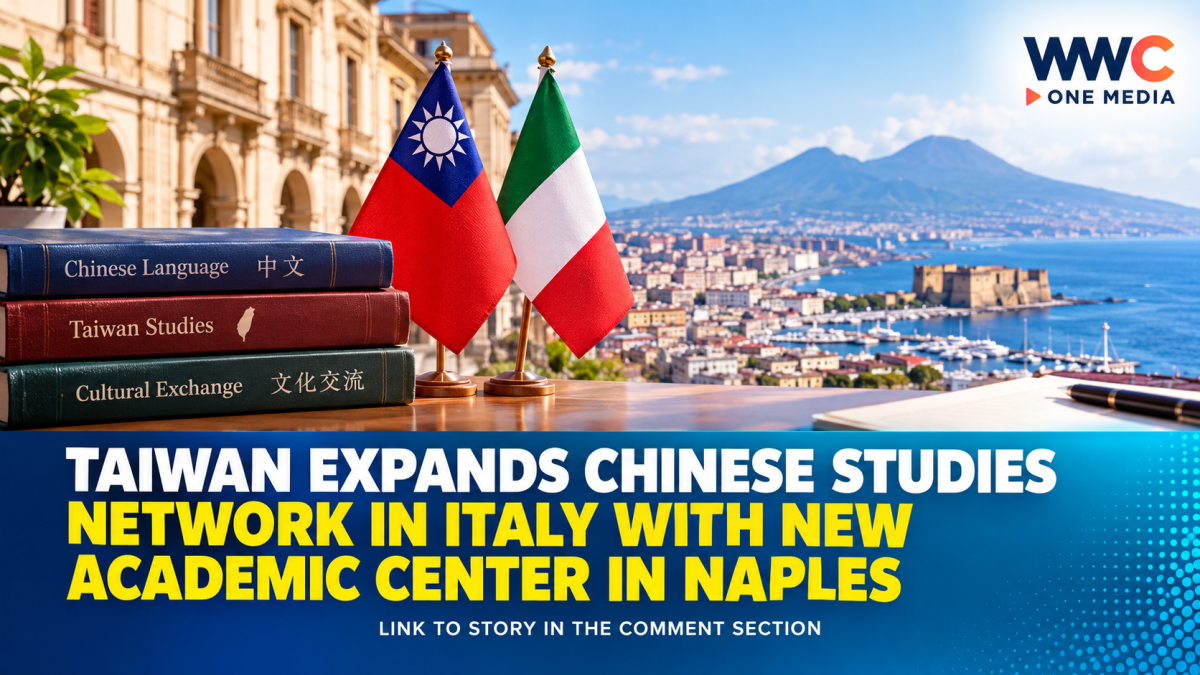
NAPLES — Taiwan is expanding its international academic and cultural outreach in Italy with a new Taiwan Resource Center for Chinese Studies at the University of Naples “L’Orientale,” strengthening its presence at one of Europe’s oldest institutions for the study of China and the Chinese language.
The partnership was formalized on September 4, 2026, when National Central Library Acting Director-General Weng Chih-tsung and University of Naples “L’Orientale” Rector Roberto Tottoli signed an agreement establishing the resource center.
The Naples center becomes Taiwan’s third Taiwan Resource Center for Chinese Studies in Italy, joining partnerships with Ca’ Foscari University of Venice and Sapienza University of Rome, according to Taiwan News.
Why Naples Matters
The University of Naples “L’Orientale” has a particularly long history in Asian and Chinese studies.
Founded in 1732, the institution has taught Mandarin since 1724 and is widely recognized for its longstanding specialization in Asian languages and cultures.
The new Taiwan-backed center will provide academic resources on Chinese and Taiwanese studies, including books, digital resources and research materials.
The National Central Library has initially supplied 248 volumes, with plans for annual additions, as well as access to digital archives and research databases. Two facsimiles, including one of the Diamond Sutra, are also part of the materials provided.
Taiwan and China Both Have Cultural Presence at the University
The development is notable because L’Orientale also hosts a Confucius Institute, established in 2007 in cooperation with Shanghai International Studies University.
That means students and researchers at the university now have access to Chinese-language and China-related resources associated with both Taiwan and China.
Taiwan News’ contributing writer describes the development as part of a wider competition over cultural and academic influence. That interpretation is the author’s analysis rather than a statement of fact established by the university or Taiwan’s government.
Taiwan’s Mandarin Network Is Expanding
The Naples partnership is part of Taiwan’s broader Taiwan Center for Mandarin Learning initiative.
According to Taiwan News, the Overseas Community Affairs Council had expanded the network to 93 locations worldwide by mid-2026, with most centers located in the United States and three in Italy.
The centers promote Mandarin education associated with Taiwan and use traditional Chinese characters, while providing a platform for learning Taiwanese culture and Chinese-language materials.
Taiwan’s approach differs from the Chinese government’s Confucius Institute network in institutional structure and sponsorship. Taiwan News’ report characterizes this distinction as part of Taipei’s effort to promote what it describes as greater transparency and academic independence.
A Quiet Form of Cultural Diplomacy
The Naples agreement may appear primarily academic, but it also reflects the growing role of language, education and research institutions in international cultural engagement.
For Taiwan, establishing resource centers at major universities provides a way to expand access to Taiwanese publications, research and Mandarin-learning resources without requiring universities to abandon their existing China-related programs.
The new center therefore adds another layer to the academic landscape at L’Orientale rather than replacing its existing Confucius Institute.
Why This Development Could Matter Beyond the Classroom
Taiwan’s growing network of Mandarin-learning and Chinese-studies partnerships comes as universities around the world continue to debate how Chinese-language education should be structured, funded and governed.
The Naples center gives Italian students and researchers another institutional source for studying Chinese-language materials and Taiwanese perspectives while maintaining the university’s existing academic relationships.
For Taiwan, the September agreement represents a relatively low-profile expansion of its international cultural and academic presence.
And in a university with centuries of experience studying China, the addition of a Taiwan-backed center could become an important new chapter in how Chinese language, history and contemporary Taiwan are studied in Europe.
WWC ONE MEDIA G,A