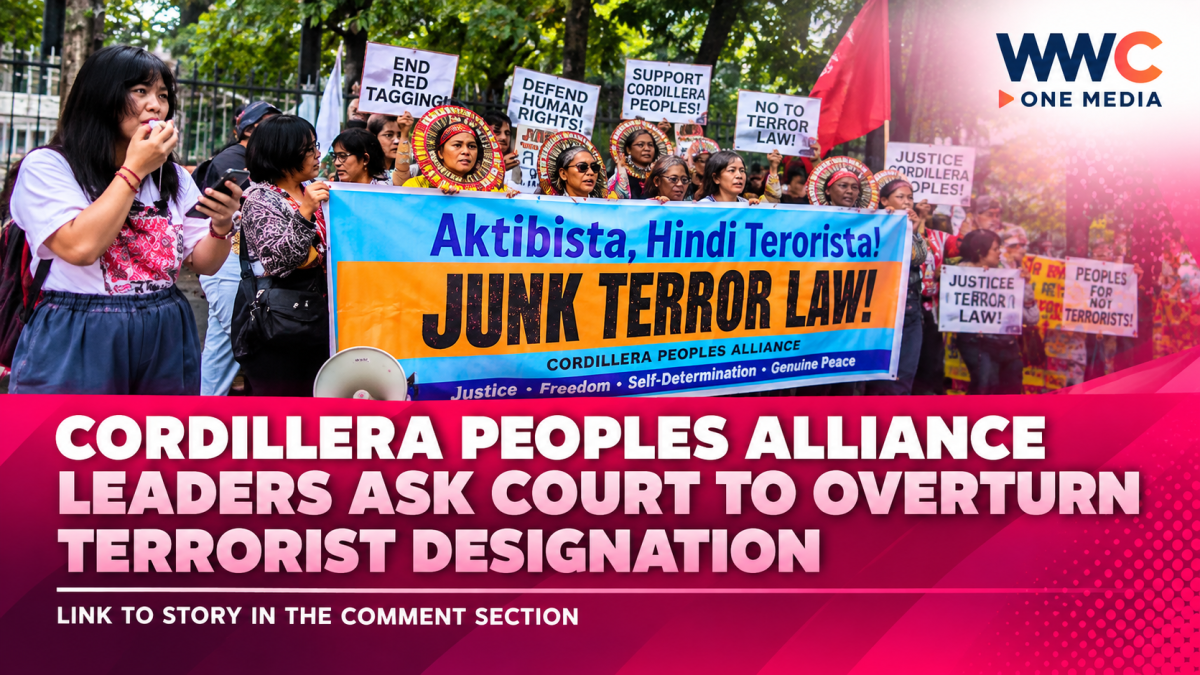
Four officers and members of the Cordillera Peoples Alliance have asked the Court of Appeals to overturn their designation as “terrorist individuals” by the Anti-Terrorism Council, arguing that the process violated their constitutional right to due process.
Windel Bolinget, Sarah Abellon-Alikes, Jennifer Awingan-Taggaoa and Stephen Tauli filed an 84-page Joint Memorandum on Appeal seeking to reverse an April 30, 2026 ruling by the Baguio City Regional Trial Court that rejected their challenge to the designation.
The four were designated by the ATC through Resolution No. 41 dated June 7, 2023. Government authorities have alleged that they were linked to or provided assistance to the Communist Party of the Philippines-New People’s Army. The four have challenged the allegations and their designation in court.
In their appeal, the petitioners are asking the Court of Appeals to declare the third paragraph of Section 25 of the Anti-Terrorism Act unconstitutional as applied to them, annul the ATC resolution and lift the asset-freezing measures imposed in connection with the designation.
A central issue in their case is the procedure for designating individuals as terrorists. The petitioners argue that they were not given prior notice or an opportunity to respond to the allegations before the designation took effect. They said they learned of the designation only after it had been issued and their financial accounts were subsequently frozen.
The petitioners are also challenging the freezing of assets through the Anti-Money Laundering Council. They argue that the AMLC should have independently assessed the evidence rather than relying on the ATC designation when imposing the freeze orders.
They further contend that the Baguio RTC incorrectly relied on the Supreme Court’s 2021 ruling in Calleja v. Executive Secretary. According to their appeal, that case addressed a facial challenge to the Anti-Terrorism Act, while their case is an “as-applied” challenge focused on how the designation provisions were actually implemented against them.
The petitioners also dispute the use of the presumption of regularity in official duties as sufficient basis for upholding the designation. They argue that the government must still demonstrate that the ATC’s findings were supported by substantial evidence and that constitutional safeguards were observed.
The case follows the April ruling of Baguio RTC Branch 78, which denied the activists’ petition to invalidate the designation. The latest appeal now places the dispute before the Court of Appeals, which will have to consider the constitutional and evidentiary issues raised by the petitioners.
The case has also drawn attention from civil society groups that have urged the courts to review the designation. The groups maintain that the four are advocates for Indigenous peoples’ rights, ancestral lands and environmental protection, while the government’s allegations concerning their alleged links to the CPP-NPA remain contested by the petitioners.
The Court of Appeals will now determine whether the ATC’s 2023 designation and the related asset-freezing measures should remain in force. The proceedings could also further clarify how due-process protections under the Anti-Terrorism Act apply when the government designates individuals based on a finding of probable cause.