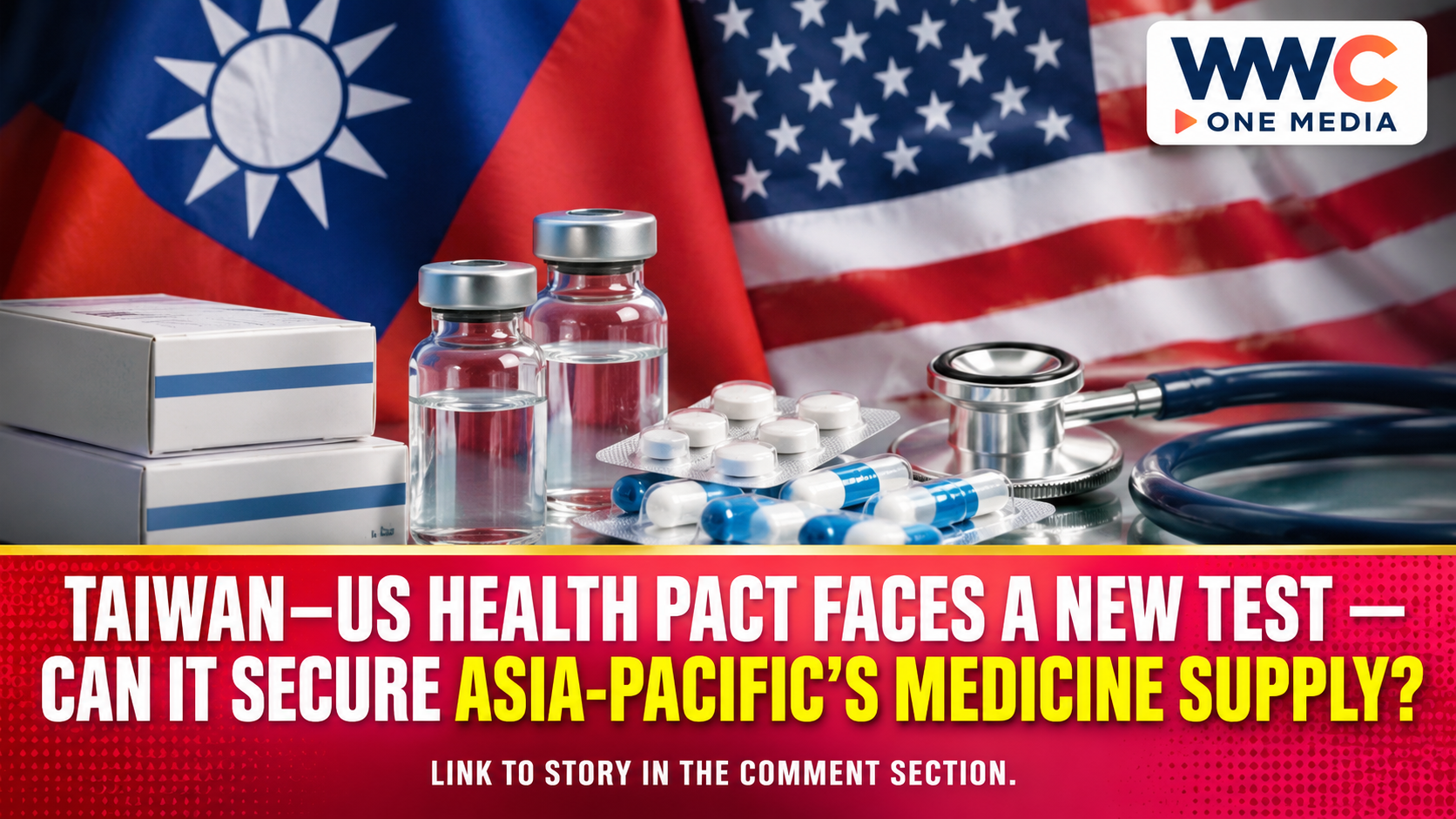
TAIPEI, TAIWAN — Six years after Taiwan and the United States signed their landmark health cooperation agreement on August 10, 2020, the Taiwan–US health pact faces a broader strategic question: how can international partnerships help protect access to essential medicines?
With pharmaceutical supply chain security becoming increasingly important to economic and public health policy, expanding bilateral healthcare cooperation could create new opportunities for pharmaceutical manufacturers, biotechnology companies, hospitals and research institutions across the Asia-Pacific.
The challenge extends beyond preventing another pandemic. It involves ensuring that patients can access essential medicines even when manufacturing disruptions, transportation problems or unexpected increases in demand threaten supplies.
Although a renewed health agreement has not been officially confirmed, existing bilateral arrangements provide a foundation for broader cooperation.
Taiwan–US Health Pact: From Pandemic Response to Medicine Security
Taiwan and the United States formalised their health cooperation in August 2020 during the COVID-19 pandemic.
The agreement was signed in Taipei by representatives of both sides, witnessed by then-Taiwan Health and Welfare Minister Chen Shih-chung and then-US Health and Human Services Secretary Alex Azar.
The framework built upon more than two decades of public health collaboration.
Its areas of cooperation included infectious disease prevention, digital healthcare, chronic disease research, environmental health and global health security.
The agreement also established opportunities for joint research, professional exchanges and information sharing.
However, the next phase of cooperation could focus more directly on pharmaceutical production, medicine availability and emergency preparedness.
Much like the broader challenges surrounding international cooperation and global trade diversification, healthcare security requires coordination across national borders.
The Hidden Vulnerability Behind Essential Medicines
A pharmaceutical shortage does not necessarily begin at a hospital or pharmacy.
It can originate at a manufacturing facility, through a disruption involving pharmaceutical ingredients or because suppliers cannot increase production quickly enough to meet demand.
Older sterile injectable medicines are particularly vulnerable when relatively few manufacturers operate with limited production capacity.
Manufacturing complexity and lengthy production schedules can make replacing lost supplies difficult.
This creates an important policy question: should medicine security be treated as a strategic economic priority rather than solely a healthcare responsibility?
A stronger Taiwan–US partnership could explore mechanisms for identifying vulnerable medicines, improving communication between regulators and developing alternative procurement arrangements.
For businesses, diversified pharmaceutical supply networks could potentially reduce dependence on individual suppliers.
However, establishing alternative manufacturing capacity would require investment, regulatory compliance and commercially sustainable production.
A 2026 Trade Agreement Opens Another Door
On February 12, 2026, Taiwan and the United States signed an Agreement on Reciprocal Trade in Washington, D.C.
The agreement includes commitments involving pharmaceutical products, medical devices, investment and economic security.
Taiwan committed to accepting US regulatory marketing authorisations for pharmaceuticals and medical devices manufactured in the United States without additional market-entry requirements.
It also committed to improving transparency and fairness in healthcare reimbursement and product listing procedures.
These commitments could create opportunities for pharmaceutical exporters while strengthening regulatory cooperation.
However, regulatory market access should not be confused with guaranteed medicine availability or automatic healthcare reimbursement.
The distinction is particularly important for hospitals, pharmaceutical distributors and healthcare investors evaluating future commercial opportunities.
The wider economic principle is similar to efforts to establish alternative international supply routes for strategic industrial materials: additional suppliers can create flexibility, but infrastructure and commercial arrangements determine whether that flexibility delivers practical benefits.
Could Technology Transform Pharmaceutical Security?
Technology could become another important component of an expanded health partnership.
The January 2026 Taiwan–US investment memorandum outlined cooperation involving semiconductors, electronics manufacturing, artificial intelligence applications and other strategic industries.
Connecting these technological capabilities with healthcare research could offer opportunities in several areas:
- Artificial intelligence-assisted pharmaceutical research.
- Digital monitoring of medicine inventories.
- Advanced pharmaceutical manufacturing.
- Clinical research data management.
- Supply chain forecasting and automation.
These remain potential areas of collaboration rather than confirmed projects under a renewed health agreement.
Any expansion involving sensitive healthcare information would also require appropriate privacy protections, scientific validation and regulatory oversight.
As developments surrounding Singapore’s semiconductor supply chain and US technology regulations illustrate, international technology cooperation must operate within increasingly complex regulatory environments.
Healthcare technology partnerships would face their own requirements involving patient safety, data governance and product quality.
A Bigger Opportunity for Asia-Pacific Healthcare
The potential benefits of pharmaceutical cooperation could extend beyond Taiwan and the United States.
In February 2024, the two sides signed a separate memorandum on international development cooperation.
That framework allows Taiwan’s International Cooperation and Development Fund and the US International Development Finance Corporation to explore collaboration in healthcare and other development sectors.
It provides an existing institutional channel through which future international healthcare projects could be considered.
For Asia-Pacific economies, potential areas of interest include pharmaceutical manufacturing partnerships, emergency procurement coordination, healthcare infrastructure and medical research.
Local healthcare capacity remains an important consideration, particularly as communities manage demand for medical services, as explored in Playa del Carmen’s healthcare utilisation and clinic activity.
A diversified pharmaceutical network could complement domestic healthcare investment, but it would not eliminate the need for local preparedness.
Regional cooperation would also need to balance medicine affordability with the financial requirements of maintaining dependable manufacturing capacity.
What Happens Next?
The immediate question is whether Taiwan and the United States will formally expand their existing health cooperation framework.
A future agreement could establish clearer priorities for pharmaceutical supply security, medicine shortage prevention and advanced healthcare research.
Businesses and healthcare institutions should watch for official announcements concerning regulatory cooperation, investment programmes, research partnerships and emergency medicine procurement arrangements.
No new bilateral health agreement, dedicated pharmaceutical funding package or implementation timetable has been confirmed for the proposed expansion.
Nevertheless, the existing healthcare, trade and international development frameworks provide several avenues through which deeper cooperation could be pursued.
The ultimate measure of success would not simply be the number of agreements signed.
It would be whether international cooperation improves the reliability, safety and accessibility of medicines when patients need them most.