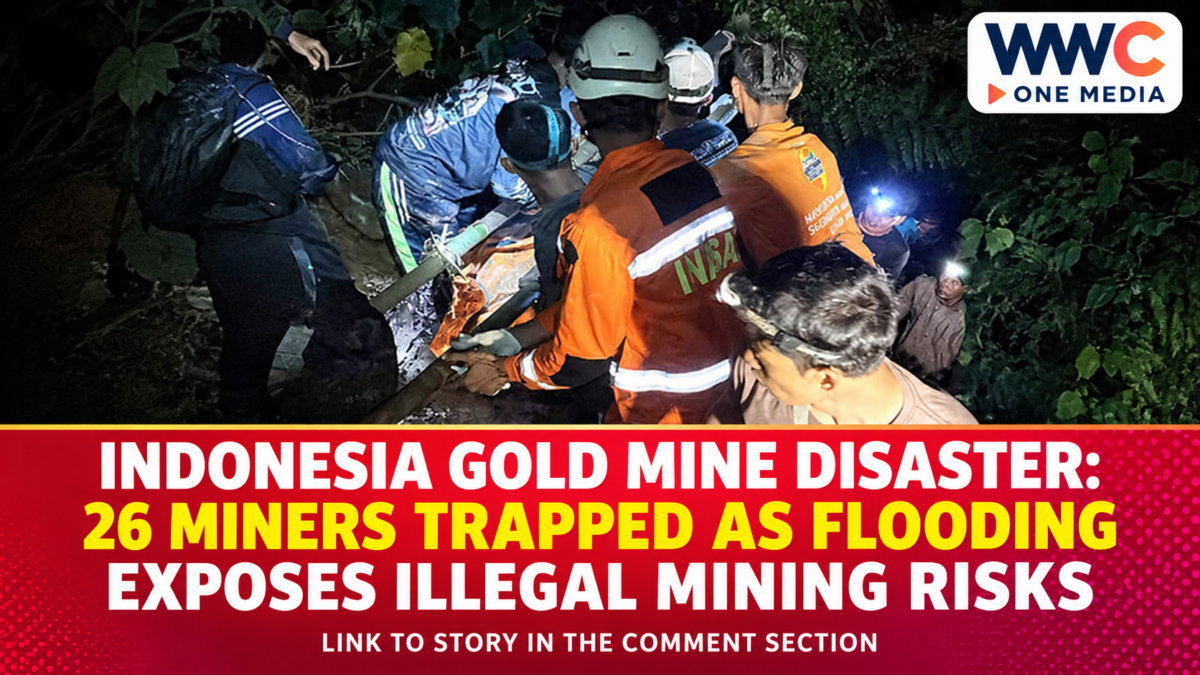
BOGOR, Indonesia — A deadly gold mining disaster in Indonesia’s West Java province has intensified concerns over unauthorised mining activities after floodwaters entered two underground excavations in the Pongkor mining area on Nov. 23, 2026, initially trapping 26 miners.
An official police update issued on Nov. 26 confirmed that 13 miners had been found dead at that stage of the operation, while search and recovery efforts continued under difficult weather and geological conditions.
Beyond the immediate emergency, Indonesian authorities are investigating the individuals suspected of financing and organising the unauthorised mining activities, raising broader questions about accountability and mining safety.
Indonesia Gold Mine Disaster: How the Flooding Started
The incident occurred in the Gunung Butak area of Bantar Karet village, Nanggung district, Bogor Regency, after intense rainfall caused the Ciseureuh River to overflow.
Floodwater entered two unauthorised mining excavations, leaving workers unable to escape.
Initial witness accounts indicated that 11 miners managed to reach safety, while 26 others were reported trapped underground.
Emergency personnel faced an increasingly difficult operation as water and mud continued entering the excavations.
The incident demonstrates how quickly rising waterways can create dangerous conditions around underground infrastructure, particularly where adequate safety protections may be absent.
Similar concerns surrounding rapidly changing water conditions were examined in WWC ONE MEDIA’s coverage of dangerous river levels and persistent flood risks in Kapit, Malaysia.
Difficult Conditions Complicate Rescue Operations
Emergency operations involve Indonesia’s National Search and Rescue Agency, commonly known as Basarnas, alongside police officers, regional disaster management personnel and firefighters.
The teams have encountered restricted underground access, continuing water infiltration and unstable ground conditions.
The narrow excavations have also limited the effectiveness of some emergency equipment, requiring specialist assessments before personnel can proceed safely.
Removing accumulated water does not necessarily eliminate the danger when additional rainfall and unstable soil remain potential hazards.
Authorities have consequently prioritised the safety of emergency personnel while continuing efforts to locate the missing miners.
The disaster also highlights the importance of coordination between emergency agencies, a subject previously explored in WWC ONE MEDIA’s coverage of Malaysia’s civil defence and flood recovery operations.
Authorities Investigate Who Financed the Mining Activities
The investigation into the disaster extends beyond the workers involved in the underground operations.
West Java Police have instructed investigators to examine the individuals responsible for financing, managing and organising the unauthorised mining activities.
Investigators have begun examining witnesses and individuals associated with the excavations.
Further examinations of the disaster site and collection of relevant evidence are expected once emergency personnel determine that conditions are sufficiently safe.
The investigation could help establish how the mining activities were organised and who exercised control over the operation.
However, the initiation of an investigation does not establish criminal responsibility. Any determination of liability must follow the applicable legal process.
Indonesian Ombudsman Calls for Stronger Mining Oversight
Indonesia’s Ombudsman has called for a comprehensive response to the Pongkor disaster, emphasising that addressing unauthorised mining requires more than closing dangerous excavations after accidents occur.
The institution has urged authorities to examine the wider networks supporting illegal extraction activities, including those responsible for supplying capital and operational resources.
It has also highlighted the environmental and occupational hazards associated with mining conducted without appropriate technical standards.
The Pongkor disaster has renewed attention on preventive measures, including stronger monitoring, community engagement and coordination among government agencies, mining permit holders and law enforcement authorities.
The Ombudsman has identified earlier mining incidents in Pongkor as evidence of the need for sustained preventive action.
Antam’s Mining Permit Area Faces Renewed Scrutiny
The disaster occurred within the mining permit area associated with PT Aneka Tambang Tbk, commonly known as Antam, and its Pongkor gold mining business unit.
The excavations involved in the incident have been identified as unauthorised mining operations.
That distinction is important because the geographical location of an accident within a mining permit area does not independently establish that the activity was operated or authorised by the permit holder.
The Indonesian Ombudsman has nevertheless urged Antam to strengthen monitoring, early detection and coordination with relevant authorities.
For mining businesses across the Asia-Pacific region, the incident raises questions about how permit holders, regulators and local authorities can work together to identify hazardous unauthorised activities before emergencies occur.
What Happens Next?
The immediate priorities remain locating missing miners, identifying deceased victims and assisting affected families.
Indonesia’s Disaster Victim Identification teams have been conducting examinations and collecting information to establish victims’ identities.
Police have also advised members of the public against entering the hazardous area or attempting independent rescue operations.
Continued rainfall and unstable ground remain important considerations for emergency personnel. WWC ONE MEDIA has previously examined the relationship between heavy rainfall warnings and regional flood hazards in Northern Luzon.
Beyond the emergency response, the investigation into the organisation and financing of unauthorised mining activities will represent another important stage in determining accountability.
For affected families, however, the most immediate concern remains receiving reliable information about their missing relatives.
The Pongkor disaster has placed mining safety, emergency preparedness and regulatory enforcement at the centre of renewed public attention in Indonesia.