
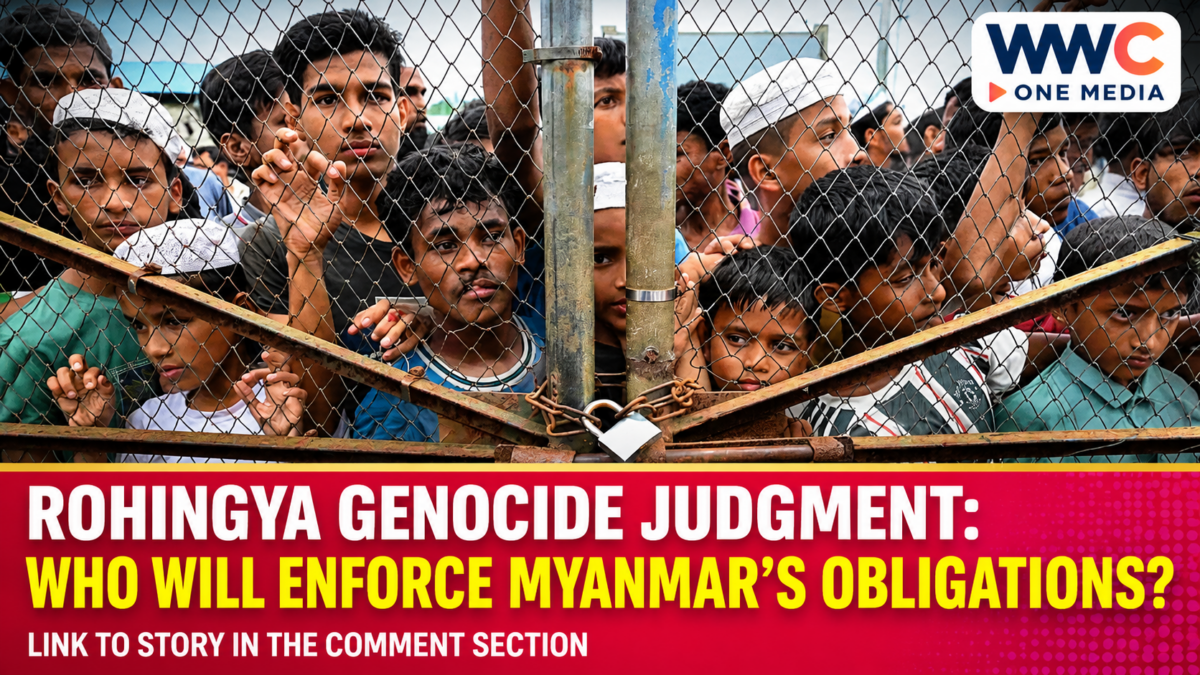
THE HAGUE — Nov. 22, 2026. The International Court of Justice ruled on Nov. 19 that Myanmar committed genocide against the Rohingya during its 2017 military operations in northern Rakhine State. The ruling requires Myanmar to pursue accountability, enable restitution and compensate damage, but its central test now lies in implementation.
The judgment is binding and cannot be appealed. That resolves the question of Myanmar’s state responsibility under the Genocide Convention, but does not itself deliver compensation, prosecute individual suspects or demonstrate that displaced families can safely return home.
What the Rohingya genocide judgment requires
The case began when The Gambia filed its application in November 2019. After considering the parties’ arguments and evidence, the Court found that the 2017 operations involved acts committed with the specific intent required for genocide.
The judges also found breaches of Myanmar’s obligations to prevent and punish genocide and to enact legislation giving effect to the Convention. The Court separately identified a violation of its January 2020 order to preserve evidence relevant to allegations of genocide.
Those findings matter because they generate different obligations. A declaration of responsibility establishes that Myanmar breached international law. Orders concerning investigation, legislation, non-repetition and reparations set out what the state must now do in response.
The first test is measurable action
The Court required Myanmar to take immediate and effective steps to investigate people reasonably suspected of acts prohibited under the Convention. Prosecution and punishment must follow where warranted. It also called for legislative action to give full effect to the treaty and assurances and guarantees against repetition.
These are not convictions of named individuals. The ICJ decides disputes between states, while determining whether a particular person is criminally responsible requires separate proceedings and evidence assessed under the applicable criminal law.
In practical terms, meaningful compliance would need more than a public pledge. Analysis: Observers should look for identifiable legislative measures, credible investigations, protection of evidence and demonstrable arrangements for redress. The judgment itself does not verify that those steps have already occurred.
The distinction is especially important because regional diplomacy follows a different process. WWC’s earlier examination of ASEAN’s restrictions on Myanmar’s political representation explains the bloc’s separate conditions for restoring high-level participation. Those regional decisions do not replace Myanmar’s obligations under the Court’s judgment.
Reparations are ordered, but amounts remain unsettled
The Court directed Myanmar to adopt restitution measures in the interest of the Rohingya, including allowing and facilitating safe, voluntary and dignified return for those displaced by its wrongful acts, whether within Myanmar or abroad. Family reunification is also part of the remedy.
Where restitution does not fully repair damage, Myanmar must provide compensation to the Rohingya group and its members. The Court left the amount and arrangements for compensation to a later phase of proceedings, rather than announcing a payment figure on Nov. 19.
This difference is crucial. A legally recognised right to a remedy is not equivalent to cash reaching a household, a family recovering its property or a displaced person receiving documents needed to rebuild a life.
Analysis: The quality of any restitution programme will depend on whether displaced people can exercise meaningful choices and obtain protection. A nominal offer to return would not, by itself, show that the Court’s requirement of safe, voluntary and dignified return had been met.
The wider challenge is already reflected in WWC’s reporting on Myanmar’s changing relationship with ASEAN, where political engagement and conditions for regional participation remain contested. That diplomacy is relevant context, not proof of a workable repatriation arrangement.
Why the two-year report matters
Myanmar must transmit a report to the Court within two years of the judgment, setting out restitution measures adopted and the proposed amounts and arrangements for compensation. Based on the Nov. 19, 2026 judgment date, that creates a reporting benchmark of Nov. 19, 2028.
The date is important precisely because it is limited. It is a reporting deadline, not a guarantee that every eligible person will have received compensation by then. Nor does it certify that all prosecutions will be complete or that displaced communities will be able to return safely.
The United Nations refugee agency reported on Nov. 19 that more than 1.3 million Rohingya refugees remained displaced across the region, most hosted by Bangladesh, with more than 100,000 people internally displaced in Rakhine State. Those figures show why translating legal remedies into real protection is a large and ongoing challenge.
Can international pressure deliver compliance?
The judgment is final and binding on the parties. Under Article 94 of the UN Charter, a state undertakes to comply with an ICJ decision in a case to which it is a party. Where a party fails to perform its obligations under a judgment, the other party may have recourse to the Security Council, which can decide whether to make recommendations or take measures.
That possibility should not be mistaken for an automatic sanction. A Council response requires a separate institutional decision, and the judgment does not itself create a police force capable of executing its orders.
Meanwhile, diplomatic efforts continue through channels beyond the Court. WWC’s coverage of Thailand’s engagement on Myanmar peace talks illustrates the region’s continuing attempts to support dialogue. Such talks could provide a political setting for progress, but they are not substitutes for legal compliance.
What happens next
The immediate questions are whether Myanmar enacts the necessary protections, conducts genuine investigations, preserves relevant material and adopts practical restitution measures. Compensation arrangements will require further proceedings, while the two-year reporting requirement gives the Court a defined future checkpoint.
Analysis: The most credible measure of progress will be evidence that affected Rohingya can exercise rights and obtain remedies in practice. The ruling settles a major legal question. Whether it becomes a turning point for survivors depends on actions that remain to be demonstrated.
Frequently asked questions
Did the ICJ find Myanmar responsible for genocide?
Yes. On Nov. 19, 2026, the Court found that Myanmar committed genocide against the Rohingya during the 2017 operations in northern Rakhine State.
Did the Court convict Myanmar military officials?
No. The decision establishes Myanmar’s responsibility as a state. Criminal liability for specific individuals requires separate proceedings.
Has the ICJ ordered compensation?
Yes, for damage not repaired through restitution. The amount and arrangements for compensation remain to be determined in a subsequent phase.
When must Myanmar report to the Court?
Within two years of the Nov. 19, 2026 judgment, making Nov. 19, 2028 the reporting benchmark.
Does the judgment mean Rohingya refugees can return immediately?
No. It requires measures enabling safe, voluntary and dignified return, but does not establish that present conditions meet those requirements.










