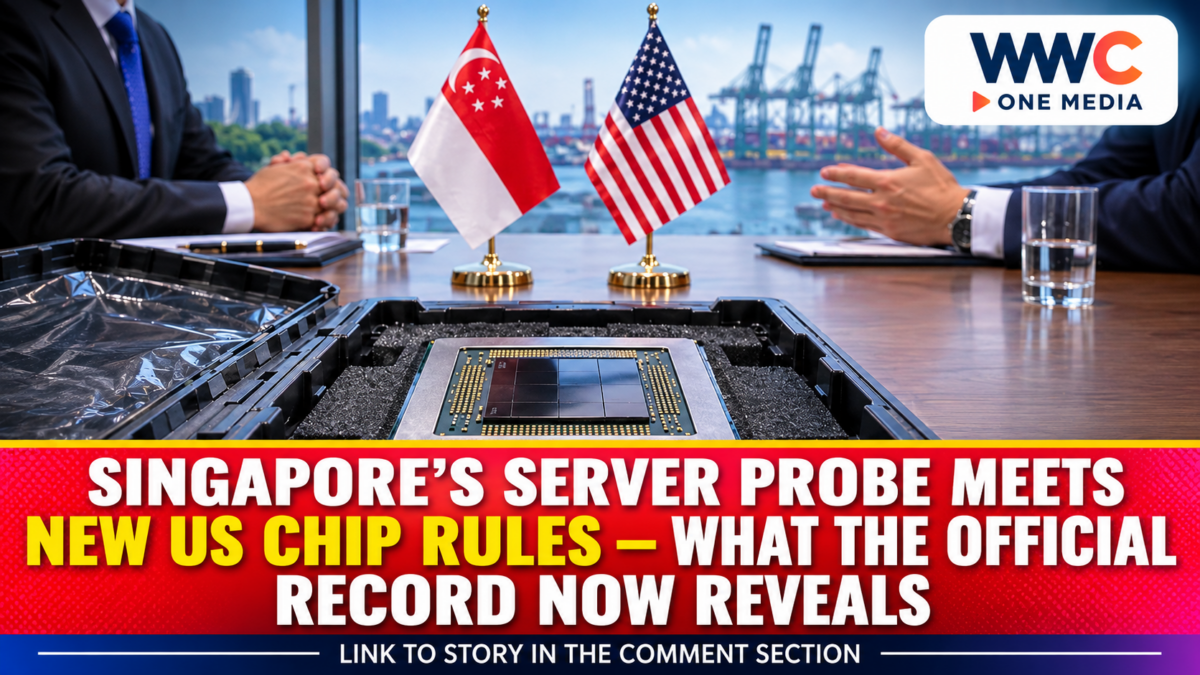
Singapore’s investigation into suspected false declarations involving server purchases remains ongoing, even as new United States export rules place additional licensing requirements on advanced semiconductors and certain overseas computing services. The two developments have brought renewed attention to how technology equipment moves across borders — and how regulators determine who ultimately uses it.
The distinction is important. Singapore’s investigation concerns possible breaches of Singapore law, while Washington’s new controls govern specified transactions involving US-origin advanced computing technology. The cases intersect around international technology supply chains, but they are not the same legal process.
Singapore server probe began before the latest US restrictions
The Singapore Police Force and Singapore Customs began an independent investigation in February 2025 into several companies and key officers, including Singapore-incorporated Megaspeed International Pte Ltd and its controllers.
The suspected domestic offences involved potential false declarations connected with server purchases and other related matters. Singapore’s Ministry of Home Affairs said the investigation was not initiated at the request of another country or government.
The authorities later examined the movement of physical servers purchased by companies under investigation. The equipment was exported through Singapore to Malaysia without entering the Singapore market. Investigators were checking whether the servers were subsequently routed from Malaysia to another destination contrary to declarations made in Singapore.
That distinction matters because a shipment’s immediate destination may not establish its eventual destination or end user. Investigators said they needed information from other jurisdictions to verify the declarations and trace the equipment’s movement.
The ministry also disclosed that the US Bureau of Industry and Security conducted a voluntary post-shipment verification check at Megaspeed on June 24, 2025. Singapore said this was the first time it became aware of the US agency’s interest in the company and Alice Huang, who was then Megaspeed’s chief executive, chairperson and one of its key controllers.
What Singapore has clarified about Alice Huang
The government’s November 12 statement provided an important update on Huang’s status.
In February 2026, the Singapore Police Force, after consulting the Attorney-General’s Chambers, concluded that there was insufficient evidence to establish that Huang had committed offences connected with the possible inaccurate declarations under investigation.
The authorities nevertheless assessed that she had provided information she knew to be inaccurate during the investigation in a way that downplayed her role in Megaspeed. She received a stern warning and was barred from re-entering Singapore. Her passport was returned on February 26, 2026, and she left the country that day.
These are separate findings and should not be conflated. The stated lack of sufficient evidence to establish her involvement in the suspected server-declaration offences is not the same as a finding that the broader Megaspeed investigation has ended.
The ministry said investigations into Megaspeed and six other individuals remained ongoing. It also said none of those six individuals had been in Singapore since the investigation began in February 2025.
Singapore separately reported that four individuals and four companies had been charged in court between February 2025 and July 2026 for offences including fraud by false representation involving server purchases. The statement did not identify those charges as findings against Megaspeed. They should therefore not be presented as proof of wrongdoing by that company.
New US chip rules reach beyond physical shipments
The US Department of Commerce’s Bureau of Industry and Security introduced a separate interim final rule titled Addressing Remote Access to Advanced Semiconductors. Published in the Federal Register on November 19, 2026, it took effect on the same date.
The regulation adds licensing requirements for specified advanced semiconductor exports, re-exports and transfers involving Indonesia, Malaysia, Singapore, Thailand and Brazil. It provides an exception for qualifying transactions destined for companies headquartered in the United States, or whose ultimate parent company is headquartered there, provided reporting requirements are met.
The rule also addresses overseas data centres that provide significant computing capacity remotely to companies headquartered in restricted destinations or Macau. This matters because advanced computing resources can be accessed through cloud services without the customer physically receiving the processors.
For covered data-centre arrangements, the regulation requires attention to the identity and ownership of customers, including direct or indirect control involving restricted jurisdictions. It also addresses connected data centres that share computing resources or workloads.
The measure is not a blanket ban on all chip shipments or data-centre operations in the five named countries. Its application depends on the technology, transaction, destination, customer and intended use. WWC has examined the wider regional implications in its report on new AI chip controls and Southeast Asia’s data-centre industry.
Singapore says it will enforce its own laws
Singapore has drawn a clear boundary between domestic enforcement and foreign export-control regimes.
In a November 24 press conference, Prime Minister Lawrence Wong said Singapore does not enforce US export controls. He said the government does not want companies to use Singapore as a route to circumvent those controls and that Singapore would act against companies found to have breached its own laws.
Wong also addressed the Megaspeed investigation directly. He said Singapore had investigated Huang but released her because there was no basis for further prosecution. He added that the investigation into Megaspeed was continuing and that Singapore was still seeking information from US authorities about end users and the verification of documents.
The government’s November 16 joint statement from the Ministry of Digital Development and Information and the Ministry of Trade and Industry said Singapore was studying the new US measure, engaging affected companies and discussing its scope and implementation with US authorities.
The two ministries also said they were exploring ways to facilitate trusted access to advanced semiconductors for legitimate businesses operating in Singapore.
For companies working with advanced computing equipment, this creates a practical compliance challenge. They may need to assess not only the immediate buyer and shipping destination, but also the ultimate customer, corporate ownership and the way computing capacity is used. The distinction between an export licence and a completed shipment remains important, as explored in WWC’s report on US approvals for advanced AI-chip exports to China.
Why the two developments matter to technology businesses
The Singapore investigation and the new US regulation point to a wider change in how governments examine advanced computing supply chains.
Traditional export checks often focus on the physical movement of equipment. Cloud computing complicates that model because servers can remain in one country while customers elsewhere access their processing power remotely.
That makes end-user verification, corporate ownership checks and accurate transaction records increasingly important. Businesses may face additional compliance work even when their operations are legitimate.
For semiconductor suppliers and data-centre operators, the commercial question is whether they can maintain reliable access to advanced equipment while meeting the requirements of multiple jurisdictions. The regulatory challenge is not limited to whether a shipment crosses a border; it can also involve who benefits from the computing capacity after delivery.
WWC has also examined the commercial consequences of changing export restrictions in its analysis of the pressure facing US chip-export licensing.
What happens next
Singapore’s investigation into Megaspeed and six other individuals remains ongoing as of November 26, 2026. The government has not announced a final finding in that investigation.
The US interim final rule is already effective. The Federal Register gives January 19, 2027, as the deadline for submitting comments on the rule’s revisions and additions.
The next developments to watch are official updates on Singapore’s investigation, further guidance from US authorities and any practical arrangements that clarify how legitimate businesses in Singapore can continue accessing advanced US technology.
For now, the public record establishes two parallel realities: Singapore is pursuing possible domestic offences involving server declarations, while the United States has expanded licensing and end-use controls over certain advanced computing technology. Neither development, by itself, proves that every company operating in the region has violated the law.
Frequently asked questions
1. Is Singapore’s Megaspeed investigation over?
No. Singapore’s Ministry of Home Affairs said investigations into Megaspeed and six other individuals remained ongoing in its November 12, 2026 statement.
2. Was Alice Huang prosecuted for the suspected server-declaration offences?
The Singapore government said investigators concluded in February 2026 that there was insufficient evidence to establish that Huang committed offences connected with the possible inaccurate declarations under investigation. She received a stern warning over information the authorities assessed she knew to be inaccurate and was barred from re-entering Singapore.
3. Which countries are covered by the new US advanced-chip licensing requirements?
The rule identifies Indonesia, Malaysia, Singapore, Thailand and Brazil for additional licensing requirements covering specified advanced semiconductors.
4. Does the US rule ban all advanced-chip shipments to Singapore?
No. It establishes additional licensing requirements for covered transactions. It also provides an exception for qualifying transactions involving US-headquartered companies, subject to reporting requirements.
5. Why do overseas data centres matter to US chip controls?
A data centre can hold advanced processors in one country while providing computing capacity remotely to customers elsewhere. The new US rule addresses certain arrangements involving significant computing capacity and customers in restricted destinations.