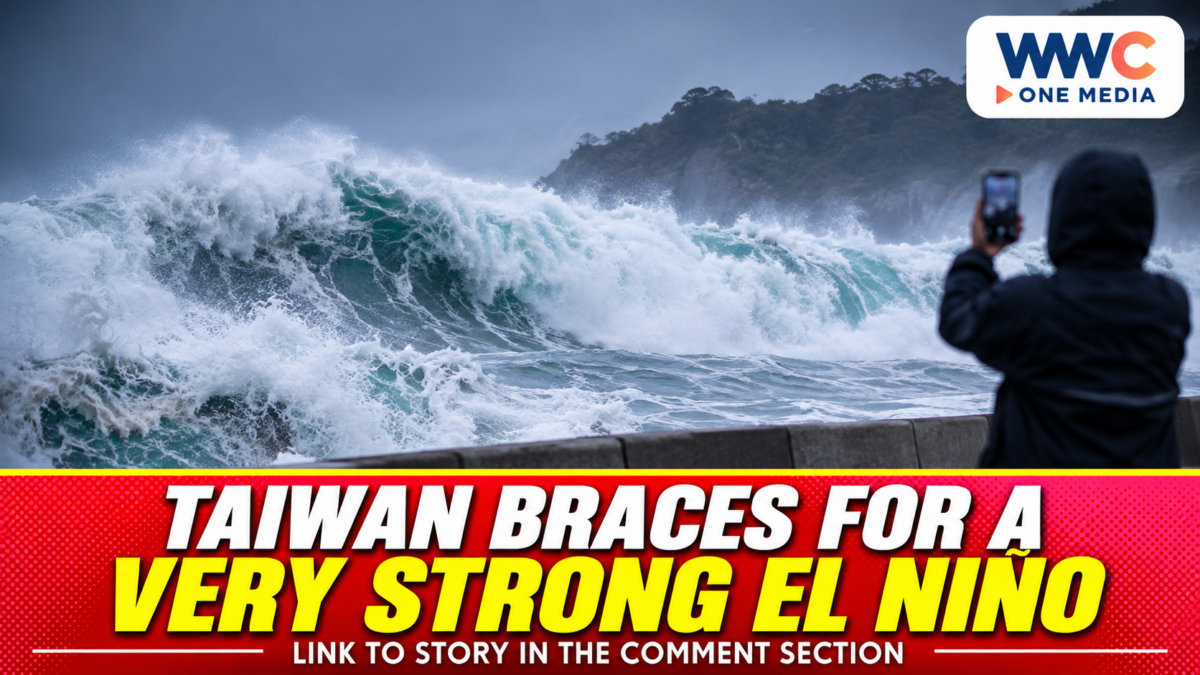
TAIPEI, Nov. 27, 2026 — Taiwan is preparing for a winter shaped by an unusually powerful El Niño, with the country’s weather agency warning of warmer-than-normal conditions, potentially heavier rainfall in parts of the island and an increased risk of localised extreme weather.
The warning comes as Taiwan prepares for its Nov. 28 local elections, but the larger concern extends well beyond polling day. The Central Weather Administration (CWA) said on Nov. 26 that the 2026–27 El Niño event continues to strengthen and is expected to persist into next spring.
The agency’s seasonal outlook points to average temperatures that are more likely to be normal to above normal between December 2026 and February 2027. Rainfall is also expected to be normal to above normal.
That combination may appear less alarming than a forecast of widespread drought. However, the agency is warning that seasonal averages do not rule out sudden heavy rainfall, cold-air outbreaks or significant changes in weather conditions.
For Taiwan, the challenge is preparing for a winter in which prolonged dry periods and intense rainfall events could both become important concerns.
Taiwan’s El Niño Index Has Climbed Above 3°C
The CWA said the weekly sea-surface temperature index in the Niño 3.4 region of the tropical Pacific has exceeded 3°C.
The Niño 3.4 region is an area of the central and eastern equatorial Pacific used by climate agencies to monitor El Niño and La Niña conditions. When its sea-surface temperatures remain significantly warmer than normal, the resulting ocean-atmosphere changes can influence rainfall and temperature patterns across the world.
The CWA described the current event as a very strong El Niño and said it could continue until spring 2027.
The agency’s assessment also points to a warmer-than-normal winter, while rainfall across western Taiwan has a tendency to increase during comparable ocean-atmosphere conditions.
However, the CWA cautioned that different El Niño events do not produce identical effects. Historical patterns provide guidance, not a guarantee that every region will experience the same weather.
The agency has established a dedicated 2026–27 El Niño information section on its official website to consolidate monitoring data, seasonal forecasts and potential climate impacts.
Winter Could Bring More Rain — But Not Every Day Will Be Wet
Taiwan’s December-to-February forecast places both temperature and rainfall in the normal-to-above-normal categories.
This does not mean the island will experience continuous rainfall or unusually warm weather every day.
Seasonal outlooks describe the overall probability of conditions across a period of several months. They cannot predict every individual rainstorm, cold spell or temperature change.
The CWA specifically warned that cold-air outbreaks and short periods of heavy rainfall could still occur despite the warmer seasonal outlook.
Western Taiwan is expected to have a tendency toward increased winter rainfall based on the agency’s analysis of similar ocean-atmosphere conditions. The agency also warned that localised extreme rainfall should remain part of disaster-preparedness planning.
The implications extend to urban drainage, flood management, transport infrastructure and water-resource planning. Authorities need to prepare for both the possibility of water shortages during dry periods and the consequences of intense rainfall when weather systems bring concentrated precipitation.
The warning is particularly relevant to areas where heavy rain can affect transport links, low-lying communities and infrastructure.
Taiwan Recorded Its Fewest Autumn Rainy Days Since 1951
The CWA’s latest assessment also highlights how dry Taiwan’s autumn has been.
From September to November 2026, accumulated rainfall was less than 60% of the climatological average. The number of rainy days reached its lowest level for the same period since records began in 1951.
The agency also recorded nine typhoons forming in the northwestern Pacific during autumn, below the climatological average of 10.8.
But the number of strong storms was notable. Four of the five typhoons that formed in October reached super typhoon intensity, the highest number recorded for October in 30 years.
These figures illustrate why the number of storms alone does not tell the full story of a season’s climate risks. Rainfall distribution, storm intensity and the timing of weather systems all matter.
A season can record fewer rainy days while still experiencing powerful storms. For communities and infrastructure planners, the concentration of rainfall can be as important as the seasonal total.
NOAA Also Expects El Niño to Remain Strong Into 2027
Taiwan’s warning is consistent with the broader outlook from the US National Oceanic and Atmospheric Administration (NOAA).
In its Nov. 12 ENSO diagnostic discussion, NOAA’s Climate Prediction Center said El Niño continued to strengthen. It assessed that a strong-to-very-strong event was likely to persist through January–March 2027, with a probability greater than 79%.
NOAA reported that its Niño 3.4 index had reached +2.5°C, while the Niño 3 index reached +3.6°C and the Niño 1+2 index reached +4.4°C.
These figures use NOAA’s monitoring framework and should not be treated as identical to Taiwan’s weekly index measurement. Both agencies, however, identify a powerful warming pattern across the tropical Pacific.
NOAA also cautioned that even a very strong El Niño does not guarantee that every region will experience the expected climate impacts. The likelihood of El Niño-related effects increases, but local outcomes depend on other atmospheric and oceanic conditions.
The wider outlook is important for Asia because El Niño can influence rainfall patterns across the tropical Pacific, including parts of Southeast Asia.
Southeast Asia Faces Different El Niño Risks
The effects of El Niño are not uniform across the region.
In the Philippines, the Philippine Atmospheric, Geophysical and Astronomical Services Administration (PAGASA) confirmed on Nov. 4 that a very strong El Niño was present in the tropical Pacific and could persist through the first half of 2027.
PAGASA warned that the phenomenon increases the likelihood of rainfall deficits, dry spells and drought in several parts of the country. Its November outlook expected below-normal to way-below-normal rainfall across most of the Philippines.
The agency also stressed that tropical cyclones and other rain-bearing weather systems can still bring heavy rainfall during an El Niño event.
The potential consequences for water supplies and agriculture are already part of the regional discussion. WWC has examined the possible dry-spell threat facing Davao Occidental, where continued rainfall deficits could affect communities and agricultural activity.
Cebu is also preparing for possible water-supply pressure. The province’s preparations include emergency deliveries and measures to protect communities with limited access to alternative water sources, as explored in WWC’s report on Cebu’s El Niño water-rationing preparations.
The contrast with Taiwan’s winter rainfall outlook is important. While some areas of Southeast Asia face a heightened risk of rainfall shortages, Taiwan’s CWA expects normal-to-above-normal rainfall overall during the coming winter.
That does not make Taiwan immune to climate-related disruption. It means regional preparedness must account for different local conditions rather than treating El Niño as a single uniform weather event.
Kinmen and Matsu Face a Separate Spring Travel Concern
The CWA has also identified a potential transport issue for next spring.
The agency warned that fog could affect Kinmen and Matsu, two offshore areas located near the Chinese mainland, and potentially disrupt transportation.
Fog can reduce visibility and affect air and maritime operations. For residents, businesses and travellers who rely on regular transport connections, disruptions can have consequences beyond inconvenience.
The agency also expects temperatures next summer to be higher than the climatological average.
Its broader warning is that the unusually strong El Niño could produce more pronounced weather fluctuations, requiring continued monitoring rather than reliance on a single seasonal forecast.
What Happens Next?
The CWA said it will continue publishing weekly climate-monitoring information and updating its monthly and seasonal outlooks.
For Taiwan, the immediate priorities include monitoring rainfall distribution, preparing drainage and flood-control systems, managing water resources and keeping transport operators informed about changing conditions.
For the wider Asia-Pacific region, the NOAA and PAGASA assessments reinforce the importance of monitoring El Niño’s development into 2027.
The central issue is not simply whether the coming winter will be warmer or wetter. It is whether governments, utilities, farmers and transport operators can prepare for a climate pattern that may bring very different risks to neighbouring economies.
Taiwan’s forecast offers a clear warning: even when seasonal rainfall is expected to be normal or above normal, the possibility of extreme local weather should not be ignored.
Frequently Asked Questions
What is Taiwan forecasting for winter 2026–27?
The Central Weather Administration expects average temperatures to be normal to above normal and rainfall to be normal to above normal from December 2026 through February 2027.
How strong is the current El Niño?
Taiwan’s CWA said the weekly Niño 3.4 sea-surface temperature index has exceeded 3°C. NOAA’s November assessment recorded a Niño 3.4 index of +2.5°C using its own monitoring framework.
Will El Niño cause heavy rain in Taiwan?
The CWA says western Taiwan has a tendency toward increased winter rainfall under comparable conditions. It also warns that localised extreme rainfall is possible, but the seasonal outlook does not guarantee heavy rain every day or in every location.
How long could the El Niño event last?
Taiwan’s CWA expects it to continue into spring 2027. NOAA assessed that strong-to-very-strong conditions were likely through January–March 2027.
Is the Philippines also affected by El Niño?
Yes. PAGASA confirmed a very strong El Niño in November 2026 and warned of increased rainfall-deficit, dry-spell and drought risks in parts of the Philippines.
Could Taiwan still experience cold weather during a warmer winter?
Yes. The CWA said seasonal temperatures are expected to be normal to above normal, but cold-air outbreaks can still occur. Residents should continue following short-term forecasts and official weather warnings.