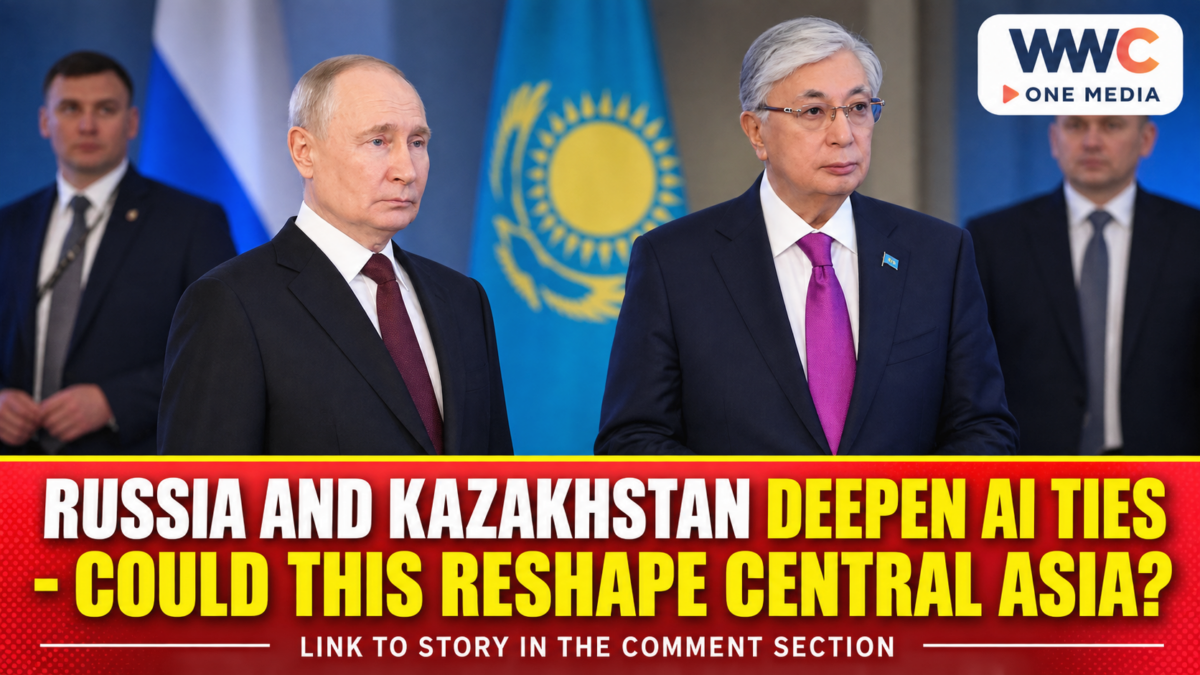
MOSCOW, Russia — Russia and Kazakhstan are moving artificial intelligence higher on their strategic agenda, with Presidents Vladimir Putin and Kassym-Jomart Tokayev using a Moscow meeting and an international technology conference to promote closer cooperation in digital development.
Tokayev travelled to Moscow for the AI Journey 2026 International Conference on Artificial Intelligence, where he met Putin on Nov. 26. The discussions covered high technology, artificial intelligence, trade, investment, energy, industry, agriculture and transport.
The meeting was more than a technology showcase. Kazakhstan is pursuing an ambitious national digitalisation programme, while Russia is seeking to strengthen its technology sector and expand commercial relationships with neighbouring countries.
The question now is whether their political support can translate into practical projects that deliver measurable benefits for businesses, government services and the wider Central Asian economy.
Why AI Is Becoming a Strategic Priority
Tokayev described advanced technology cooperation as a potential central component of the strategic partnership between the two countries.
He also highlighted the established presence of Russian technology companies in Kazakhstan, particularly Sber and Yandex Kazakhstan. The Kazakh president said these businesses were developing in the local market and that his government was providing support for their operations.
The two countries are already closely connected economically. During the Nov. 26 meeting, Tokayev said bilateral trade was approaching US$30 billion. He also reported that 124 of 178 joint projects on the bilateral agenda had been implemented, with the remaining projects under way or nearing completion.
These figures provide important context for the AI discussions: the proposed technology relationship is developing within a much broader economic partnership.
Russia’s AI Journey conference, organised by Sberbank, provided a platform for the two presidents to examine technology applications and meet industry participants. The conference ran from Nov. 26 to 28.
WWC previously examined how four Filipino teenagers competed at the 2026 International Olympiad in Artificial Intelligence in Kazakhstan. The competition highlighted how Central Asia is becoming a venue for international AI education and talent development, not just government-level technology discussions.
Kazakhstan Wants More Than Imported Technology
Kazakhstan’s ambitions extend beyond adopting foreign AI products.
In June 2026, the government approved its Digital Qazaqstan national strategy through 2029. The programme aims to expand digitalisation across public administration, industry, logistics, energy, agriculture and other economic sectors.
The strategy sets out an ambition to build a more integrated digital economy, with AI and data becoming part of government operations and business activity.
The government projected that comprehensive AI adoption and industrial digitalisation could contribute an additional 1.5 percentage points per year to GDP on average by the end of 2029. It also estimated that comparable market investments over a three-year period could range from US$10.5 billion to US$16.5 billion.
These are government projections, not guaranteed economic outcomes.
Tokayev also highlighted the country’s existing digital infrastructure. He said more than 90% of public services were available online and that 13 million users were registered in the eGov Mobile application.
Under the AI-Sana programme, more than 100,000 students were acquiring practical skills in applying artificial intelligence, according to the president’s conference address.
For Kazakhstan, the challenge is to turn these investments and training initiatives into technology companies, skilled employment and solutions that can compete beyond its domestic market.
Transport, Energy and Data Infrastructure Are Part of the Plan
The partnership is not limited to chatbots, robots or software development.
Tokayev identified transport and logistics as important areas for cooperation. Kazakhstan has presented its Smart Cargo and AI Jol digital projects, which are intended to improve freight transportation and transport infrastructure management.
He also disclosed that a pilot road shipment between Kazakhstan and Russia had been carried out in October using an electronic waybill.
The next challenge is to make the two countries’ national information systems compatible and expand the practical use of digital transport solutions. Tokayev said a full digital transport corridor could be considered over the longer term.
Such a corridor could improve the exchange of freight information and support more coordinated cross-border logistics. However, it remains a longer-term possibility rather than an established operating system.
Energy is another major consideration. AI development requires computing infrastructure, and data centres depend on reliable electricity and power networks.
Tokayev cited rising electricity demand from data centres and discussed Kazakhstan’s decision to build several nuclear power plants. He identified the first plant, Balkhash, as a project being developed in partnership with Russia, with Rosatom playing the leading role.
The connection is significant: the AI race is not simply about software. It also depends on access to electricity, computing capacity, infrastructure and qualified personnel.
The Technology Partnership Faces a Geopolitical Test
Closer cooperation also takes place against a complicated international technology environment.
Russia faces restrictions affecting access to some advanced technologies and components. Reuters reported on Nov. 26 that sanctions-related limitations on US-made chips and constraints involving electricity and infrastructure are among the challenges facing Russian AI development.
That context helps explain why relationships with neighbouring markets matter. Kazakhstan offers an established commercial relationship, a growing digital economy and access to regional transport networks.
However, closer cooperation does not automatically mean that Kazakhstan will become a route around international restrictions. Any cross-border technology transaction still needs to comply with applicable export controls, sanctions and other legal requirements.
Kazakhstan is also developing its own regulatory framework. Its AI law, which entered into force in January 2026, establishes requirements involving transparency, data protection, accountability and risk classification. The country also introduced a national AI application standard effective Jan. 1, 2026.
Those rules matter as foreign technology companies expand their presence. Governments and businesses need to consider not only what AI systems can do, but also how they handle personal information, automated decisions and security risks.
WWC has examined the wider regulatory questions in its report on Chile’s OpenAI agreement and digital sovereignty. The same broad issue applies to Central Asia: international partnerships can accelerate innovation, but countries still need control over their data, infrastructure and legal safeguards.
What Happens Next?
The immediate test is whether the political commitments produce specific projects.
Potential areas include AI applications in logistics, industrial operations, cybersecurity, education and public services. The countries will also need to address practical issues such as technical compatibility, infrastructure investment, data governance and the availability of skilled workers.
Kazakhstan’s Digital Qazaqstan strategy provides a domestic framework for its ambitions. Its existing cooperation with Russian companies offers a possible commercial foundation, while AI Journey gives both sides a platform to discuss technology development.
But conference appearances and presidential statements are not the same as signed commercial contracts, completed infrastructure or deployed AI systems.
The relationship will ultimately be judged by implementation: whether projects move beyond announcements, whether businesses adopt the technology and whether citizens experience tangible improvements.
WWC’s coverage of Russia’s business environment and the sanctions restrictions affecting investment explains why international companies must assess the legal environment alongside commercial opportunities.
Russia and Kazakhstan have made their intentions clear. The next question is whether their AI partnership can deliver results without creating new economic, technological or regulatory vulnerabilities.
Central Asia’s AI ambitions are growing. Whether Moscow and Astana can turn their latest commitments into a lasting technology advantage remains to be seen.