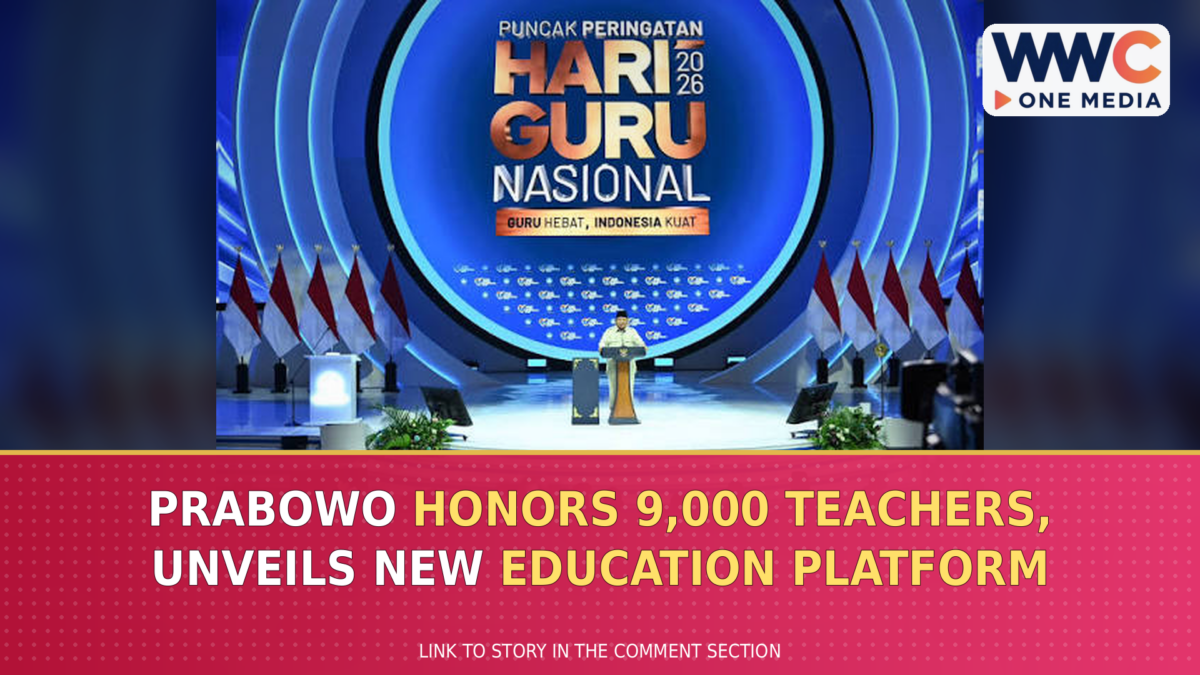
BOGOR, Indonesia — President Prabowo Subianto joined 9,000 teachers in Bogor Regency, West Java, on Nov. 26 for Indonesia’s 2026 National Teachers’ Day celebration, placing educators at the centre of the government’s message about national development.
But the event carried a more practical announcement than a presidential tribute. Prabowo also launched Studio Guru Republik Indonesia, an education initiative designed to connect schools in different regions with experienced teachers through interactive distance-learning broadcasts.
The programme is intended to help schools that lack educators with expertise in particular subjects. Instead of depending entirely on the availability of specialised teachers in every location, participating schools are expected to access lessons delivered from a central studio.
The initiative raises an important question for Indonesia’s education system: can technology help close differences in teaching access between major cities and remote communities without weakening the role of teachers inside individual classrooms?
9,000 Teachers Gather for National Teachers’ Day
The main 2026 National Teachers’ Day commemoration took place in Bogor Regency, West Java, on Thursday, Nov. 26.
Prabowo attended alongside Minister of Primary and Secondary Education Abdul Mu’ti. The celebration carried the theme “Great Teachers, Strong Indonesia”, recognising teachers and education personnel for their contribution to learning, character development and preparing younger generations.
The presidential message focused on the responsibility teachers carry beyond delivering academic lessons.
Prabowo highlighted their role in developing students’ character, national values, love of country, optimism and resilience. He also acknowledged educators serving in remote areas, where geographical conditions can make teaching and access to educational resources more difficult.
The President thanked Indonesian teachers for their dedication and sacrifice, extending his appreciation to educators wherever they work.
For the government, the celebration was an opportunity to recognise teachers as contributors to Indonesia’s long-term development rather than treating education as a matter limited to classroom instruction.
Studio Guru Could Bring Specialist Lessons to More Schools
The most significant programme announcement was the launch of Studio Guru Republik Indonesia.
The initiative is designed as a centralised teaching and learning platform. Experienced educators will deliver lessons through broadcasts that schools in different parts of Indonesia can access.
The government’s plan includes interactive distance learning, allowing teachers and students in participating schools to follow lessons delivered from the studio.
This could be particularly relevant to schools that have difficulty securing educators for specific subjects. A school with limited specialist teaching personnel could potentially access instruction from a teacher with the required expertise elsewhere.
The programme is also intended to support teachers’ professional development. Educators would have opportunities to observe teaching practices, exchange knowledge and learn from colleagues working in other regions.
The Ministry of Primary and Secondary Education described Studio Guru as part of a wider effort to improve learning quality and strengthen teacher competence.
However, the launch should not be confused with proof that every Indonesian school already has access to the service. The announcement establishes the programme’s intended model, but nationwide availability, technical readiness, participation levels and measurable learning outcomes will determine its actual reach.
Technology Is Meant to Support Teachers, Not Replace Them
Studio Guru reflects Indonesia’s effort to use education technology to address differences in access to teaching resources.
The government has also been developing the use of Interactive Flat Panels, or IFPs, in schools. These digital boards are intended to support classroom instruction and make learning materials more accessible and engaging.
Together, centralised broadcasts and interactive classroom equipment could help connect educators and learners across geographically separated communities.
Yet technology alone cannot guarantee better education.
Schools need reliable electricity, internet connectivity, suitable equipment and technical support. Teachers also need preparation to integrate remote lessons into classroom activities rather than simply displaying a broadcast without meaningful interaction.
The quality of instruction will remain important. A digital lesson can expand access to subject expertise, but students still need classroom guidance, feedback, assessment and support from educators who understand their learning needs.
That is why Studio Guru’s implementation will matter as much as its launch.
Teacher Qualifications and Awards Also Feature in the Celebration
The National Teachers’ Day programme included other measures related to professional development and recognition.
The ministry announced the inauguration of teachers participating in the S-1/D-IV Academic Qualification Fulfillment Programme, known as PKA. The programme is intended to address teachers’ academic qualification requirements at undergraduate or equivalent level.
The celebration also included the presentation of Teacher and Education Personnel Awards, recognising contributions across the education sector.
These activities complement the government’s stated aim of strengthening teacher professionalism and encouraging continuous competency development.
The ministry has not provided a detailed breakdown in the event announcement of the number of teachers inaugurated under the PKA programme or the full list of award recipients. Those figures should therefore not be assumed from the overall attendance of 9,000.
The distinction matters: the 9,000 figure refers to teachers attending the national commemoration, not necessarily the number enrolled in a qualification programme or receiving awards.
WWC has previously examined Indonesia’s broader plans to improve educators’ employment conditions and professional opportunities in its report on major teacher reforms scheduled for 2027. The National Teachers’ Day announcements add a separate focus on learning access and professional development.
Why Teacher Support Matters Beyond a National Celebration
Indonesia’s latest initiatives highlight a wider challenge facing education systems: improving the quality of teaching while ensuring that schools in less accessible areas are not left behind.
A shortage of teachers with particular subject expertise can affect the range and consistency of lessons available to students. Remote instruction may help address some of these gaps, especially when schools can connect with qualified educators through reliable technology.
But successful implementation requires more than broadcasting lessons. Schools need clear timetables, trained personnel, functioning equipment and a system for assessing whether students are actually benefiting.
Teacher development also needs to be sustained. Professional learning is more effective when educators can apply new approaches, receive feedback and collaborate with colleagues over time.
That broader challenge is familiar across the Asia-Pacific. WWC has reported on a Philippine initiative that trained 22 public school principals to address learning gaps and absenteeism, showing how education improvement can involve school leadership and community partnerships alongside classroom instruction.
Teacher welfare is another part of the discussion. The Philippines’ protected teacher wellness break illustrates the importance of working conditions and recovery time in supporting educators.
Meanwhile, digital access remains a practical consideration. The distribution of laptops to Filipino public school teachers highlights the equipment and infrastructure needed to make technology-based education programmes useful.
These examples are not identical to Indonesia’s Studio Guru initiative, but they underline a common point: education technology and teacher development work best when supported by practical resources and effective implementation.
What Happens Next for Studio Guru?
Indonesia’s National Teachers’ Day celebration has placed Studio Guru among the government’s latest education initiatives.
The next test is whether the programme can move from a centralised studio concept to a dependable service for schools across the country.
Important questions include which schools will participate first, how lessons will be scheduled, what subjects will be prioritised, how schools with weak connectivity will be supported and how the ministry will evaluate learning outcomes.
The government will also need to ensure that the platform strengthens the work of local teachers rather than treating remote instruction as a substitute for classroom support.
Prabowo’s appearance with 9,000 educators delivered a public message of appreciation. The launch of Studio Guru added a more concrete policy direction: using technology to share teaching expertise across Indonesia.
The real measure of success will not be the size of the launch event. It will be whether students in remote communities gain access to better lessons — and whether teachers receive the support needed to make those lessons count.