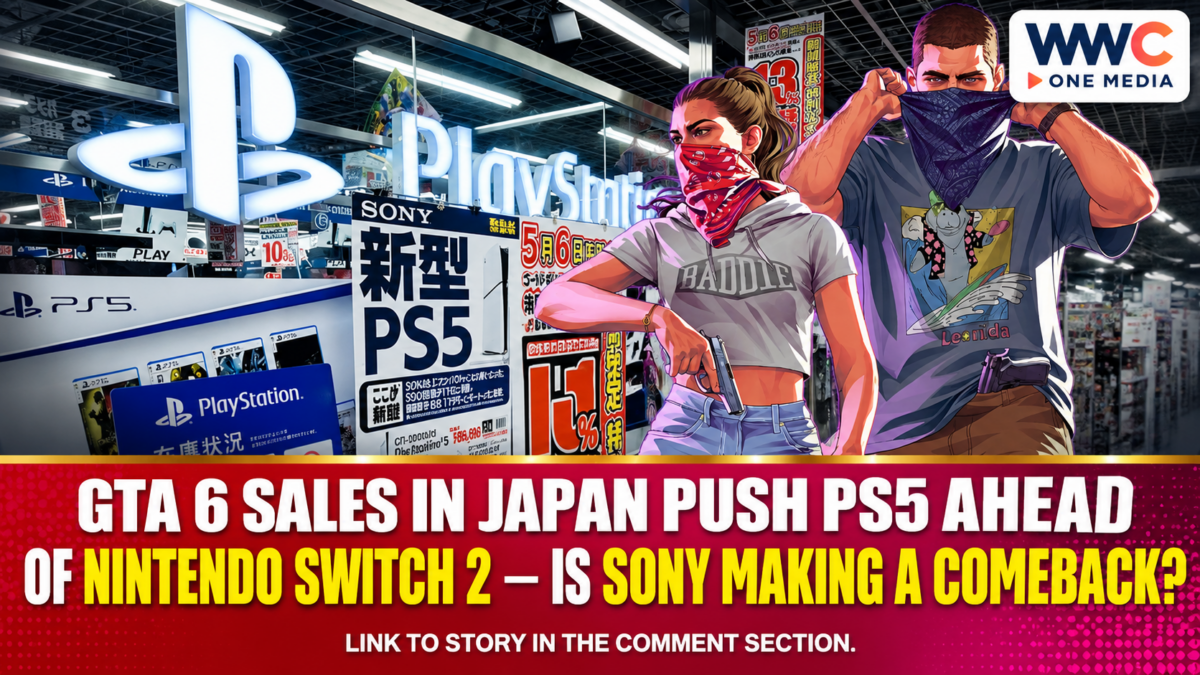
TOKYO, JAPAN — November 27, 2026 — Grand Theft Auto VI has opened a new chapter in Japan’s gaming console competition, recording an estimated 200,759 retail sales on PlayStation 5 and debuting at the top of the country’s weekly video game rankings.
During the November 16–22, 2026 tracking period, Sony’s PlayStation 5 family sold 41,472 consoles, overtaking Nintendo Switch 2, which recorded 36,817 units.
The result gives Sony a weekly hardware sales advantage of 4,655 units, coinciding with the arrival of Rockstar Games’ blockbuster and a new Japanese-market edition of the PS5.
However, the bigger question facing the gaming industry is whether Sony can sustain that momentum beyond the game’s opening week.
GTA 6 sales shake up Japan’s gaming rankings
Released on November 19, 2026, Grand Theft Auto VI immediately climbed to first place in Japan’s estimated retail software rankings.
The game recorded more than 200,000 retail sales within the reporting period, substantially ahead of its closest competitors.
The three leading games were:
| Video game | Platform | Estimated weekly sales |
|---|---|---|
| Grand Theft Auto VI | PS5 | 200,759 |
| The Legend of Zelda: Ocarina of Time | Switch 2 | 35,295 |
| Nintendo Switch Sports Resort | Switch 2 | 10,486 |
GTA VI recorded approximately 5.7 times the weekly retail sales of its closest competitor.
The figures represent estimated sales through tracked retail channels rather than comprehensive sales across every digital distribution platform. Direct online downloads should therefore not be assumed to be included in the reported total.
The game’s arrival also highlights the commercial importance of digital distribution, an issue extending beyond video games and into the wider entertainment industry, including changes to how smart TV platforms distribute and promote streaming content.
PlayStation 5 overtakes Nintendo Switch 2
The software rankings were accompanied by a notable result in Japan’s hardware market.
Sony’s PS5 family finished the week ahead of Nintendo Switch 2, with the Digital Edition accounting for the overwhelming majority of PlayStation console sales.
Japan’s estimated weekly console sales were:
| Gaming console | Units sold |
|---|---|
| PlayStation 5 family | 41,472 |
| Nintendo Switch 2 | 36,817 |
| Original Nintendo Switch family | 4,362 |
| Xbox Series X and S family | 751 |
The PlayStation 5 Digital Edition alone recorded 40,362 units, representing approximately 97.3% of total PS5 family sales during the week.
The standard PS5 registered 79 units, while the PS5 Pro recorded 1,031 units.
Although the timing coincides with GTA VI’s debut, the figures do not establish how many consumers purchased a PlayStation specifically to play the game.
Sony introduces a ¥55,000 PlayStation 5
Rockstar’s blockbuster was not the only significant gaming product scheduled to arrive on November 19.
Sony Interactive Entertainment also introduced a Japanese-language-only Midnight Black PS5 Digital Edition with a suggested retail price of ¥55,000, including tax.
The console comes with an 825GB solid-state drive and a DualSense wireless controller.
Designed specifically for the Japanese market, the system requires Japanese-language settings and a PlayStation account registered in Japan.
The simultaneous arrival of a major software release and a locally tailored console gives Sony two potential drivers of consumer demand.
For hardware manufacturers, balancing product affordability, technical capabilities and market-specific requirements remains an important commercial consideration.
These developments also sit within a broader technology landscape shaped by Japan’s expanding semiconductor supply policies, although the latest console sales figures do not establish a direct connection with those policies.
Nintendo’s position remains substantial
Despite losing the weekly hardware comparison, Nintendo Switch 2 continues to have a substantial presence in Japan.
Its cumulative estimated domestic sales reached 6,653,675 units by November 22, 2026.
Meanwhile, combined lifetime Japanese sales across the three reported PS5 hardware categories reached 7,868,730 units.
The figures reflect different product generations and periods of availability, making direct lifetime comparisons more complicated than a single weekly ranking suggests.
Nintendo’s software ecosystem also remained strongly represented, with nine of the week’s ten highest-selling retail games available on either the original Switch or Switch 2.
The Legend of Zelda: Ocarina of Time retained second place in the software rankings, bringing its cumulative estimated retail sales to 658,433 units.
Sony’s weekly hardware advantage is therefore significant, but it does not demonstrate that Nintendo has lost its broader competitive position.
Rockstar Games and Take-Two’s blockbuster strategy
Grand Theft Auto VI was released for PlayStation 5 and Xbox Series X and S.
Nintendo Switch 2 was not included among the game’s launch platforms.
Rockstar Games operates under Take-Two Interactive Software, the Nasdaq-listed entertainment company whose publishing operations also include 2K and Zynga.
At the time of GTA VI’s launch, the company reported that the preceding title, Grand Theft Auto V, had reached nearly 235 million units sold into distribution worldwide.
That established franchise provides an extensive commercial foundation for the latest instalment.
For entertainment companies, a major intellectual property can influence not only software revenue but also the attractiveness of the platforms carrying it.
Such competition forms part of the wider transformation of the technology sector, where companies are increasingly evaluating new markets and business opportunities, as illustrated by Qualcomm’s strategy to diversify beyond its traditional smartphone business.
However, Japan’s retail rankings alone cannot establish GTA VI’s worldwide profitability or its ultimate contribution to Take-Two’s financial performance.
What happens next for Sony and Nintendo?
The next several weeks of hardware and software sales will help determine whether PlayStation’s performance represents a temporary launch-related increase or the beginning of more sustained demand.
Sony will need to maintain consumer interest after the initial excitement surrounding Grand Theft Auto VI.
Nintendo, meanwhile, retains an extensive software presence across its two console generations.
For gaming businesses and consumers across Asia-Pacific, the Japanese market offers an important example of how software availability, hardware pricing and platform-specific strategies can influence purchasing decisions.
The latest figures have established one clear result: PlayStation 5 won the weekly hardware comparison, while GTA VI captured the leading position in retail software sales.
Whether Sony can turn that achievement into a longer competitive advantage remains an open question.