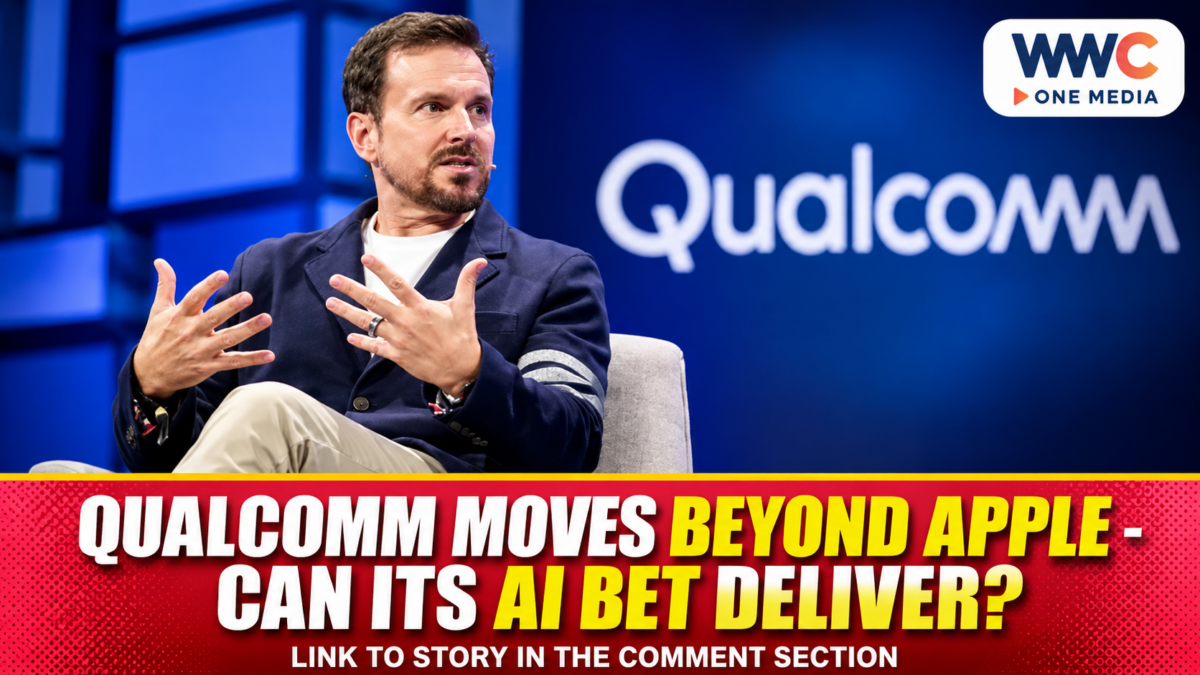
SAN DIEGO, California — November 26, 2026 — Qualcomm is preparing for a future in which its business is less dependent on smartphone processors and more closely tied to artificial intelligence infrastructure, connected vehicles and industrial computing.
The transition places a new responsibility on the company’s marketing leadership. Don McGuire, Qualcomm’s executive vice-president and chief marketing officer, leads global marketing across the company’s businesses as it expands beyond mobile technology.
The challenge is bigger than introducing new products. Qualcomm must convince customers, investors and technology partners that it can compete in markets where its reputation as a smartphone-chip supplier does not automatically guarantee success.
The company has already outlined an ambitious diversification strategy. The question now is whether its investments in data centres, automotive technology and connected devices can compensate for the expected decline in modem-chip sales to Apple.
Apple’s move towards its own modems changes Qualcomm’s outlook
Apple’s development of its own cellular modem technology represents a major change for Qualcomm.
In its fiscal 2026 annual report, Qualcomm identified customer concentration as a significant business risk. The company disclosed that Apple and Samsung each accounted for at least 10% of its consolidated revenue during the year.
Qualcomm also stated that Apple has historically been one of its largest customers for modem products. It expects Apple to use its own internally developed modem products primarily in its devices going forward.
The company warned that this transition would have a significant negative effect on its Qualcomm CDMA Technologies (QCT) revenue, operating results and cash flows.
That disclosure makes the diversification strategy a financial priority, rather than simply an opportunity to enter new markets.
However, the relationship between the two companies has not ended entirely.
On Sept. 24, 2026, Qualcomm announced the renewal of its global patent-licensing agreement with Apple, effective April 1, 2027. Patent licensing and modem-chip supply are separate parts of the relationship.
The distinction matters: Apple can increasingly use its own modem technology while continuing to license Qualcomm’s patented technologies.
Qualcomm is placing a bigger bet on AI data centres
One of the company’s most significant growth opportunities is artificial intelligence infrastructure.
At its June 24, 2026 Investor Day, Qualcomm expanded its data-centre strategy and raised its fiscal 2029 target for non-handset revenue to US$40 billion.
The company also set a target of more than US$15 billion in data-centre revenue by fiscal 2029. Its broader targets include US$10 billion in automotive revenue and more than US$14 billion in Internet of Things revenue.
These targets show the scale of the intended transformation. Qualcomm wants its technology to support computing workloads across personal devices, vehicles, industrial systems and large-scale data-centre infrastructure.
Its Dragonfly portfolio is central to that plan.
In June, Qualcomm introduced the Dragonfly C1000 data-centre CPU, Dragonfly AI300 inference accelerator and High Bandwidth Compute technology. The portfolio is designed to address computing performance, memory bandwidth and energy efficiency in AI infrastructure.
The company also announced a multi-year, multi-generation collaboration with Meta involving data-centre CPUs. The Dragonfly C1000 is planned to power Meta’s next-generation server fleet.
A separate agreement announced in September established a multi-generation collaboration with Amazon to develop customised silicon for large-scale AI data centres and work on optical connectivity solutions.
These agreements give Qualcomm a route into the infrastructure market, although the company’s targets and product plans should not be confused with revenue already achieved.
Automotive and connected devices are already contributing
Qualcomm’s diversification is not limited to future data-centre products.
Its fiscal 2026 results show that automotive and Internet of Things businesses are already generating substantial revenue.
Automotive revenue in its QCT segment reached US$6.004 billion in fiscal 2026, compared with US$3.957 billion in the previous fiscal year. That represented an increase of approximately 52%.
IoT revenue reached US$7.132 billion, up from US$6.617 billion in fiscal 2025.
Handset revenue, by comparison, declined from US$27.793 billion to US$24.072 billion.
The figures illustrate why Qualcomm is seeking a broader business mix. Automotive and IoT are growing, but handset revenue remains a major part of the company’s semiconductor operations.
The expansion also creates opportunities across the wider technology supply chain.
Taiwan’s growing advanced-packaging industry, examined in WWC ONE MEDIA’s report on TSMC’s planned Kaohsiung advanced-packaging hub, highlights the manufacturing infrastructure required to support increasingly sophisticated processors.
Meanwhile, the AI server component supply race shows how rising demand for computing infrastructure is affecting semiconductor substrates and printed circuit boards across Asia.
Don McGuire’s marketing challenge extends beyond smartphones
For McGuire, Qualcomm’s expansion creates a different kind of marketing problem.
A company known primarily for mobile processors must communicate its capabilities to several distinct markets.
Consumer-device manufacturers, automakers, industrial equipment companies and cloud-service providers do not necessarily evaluate semiconductor technology in the same way.
Qualcomm’s product portfolio reflects this broader positioning. Snapdragon is associated with consumer computing and mobile platforms, while Dragonwing and Dragonfly extend the company’s branding into industrial and data-centre applications.
That distinction matters because Qualcomm’s customers are not only consumers buying smartphones. They include manufacturers and infrastructure providers deciding which processors, connectivity systems and computing platforms to integrate into their products.
The company’s marketing strategy therefore has to explain what its technology can deliver across different industries, rather than relying exclusively on smartphone recognition.
The wider AI-chip market is also becoming more competitive. WWC ONE MEDIA previously examined the growing competition from emerging AI-chip developers, illustrating how established semiconductor companies face pressure from new entrants as demand for specialised computing increases.
Can Qualcomm reduce its dependence on smartphones?
Qualcomm’s financial results show both the opportunity and the difficulty of its transition.
For fiscal 2026, the company reported US$43.12 billion in GAAP revenue, down 3% from US$44.284 billion in fiscal 2025.
Its QCT semiconductor business generated US$37.208 billion, compared with US$38.367 billion a year earlier. The decline in handset revenue was partly offset by growth in automotive and IoT.
Qualcomm’s November earnings announcement projected that non-handset revenue would grow by more than 60% year over year in fiscal 2027. It also reiterated its US$5 billion fiscal 2027 data-centre revenue target.
These are forward-looking expectations, not guaranteed outcomes.
The company must still deliver commercially competitive products, secure customers, expand its ecosystem and manage the financial impact of Apple’s move towards internally developed modems.
Its own annual report acknowledges that investments in automotive, IoT and data centres may not generate the operating income or growth management expects.
What happens next?
Qualcomm’s post-Apple strategy will be tested over the coming financial years as its data-centre products move towards commercial deployment and its non-handset businesses become a larger part of revenue.
The company’s agreements with Meta and Amazon provide important commercial relationships, while automotive and IoT results demonstrate that diversification is already under way.
But the scale of the ambition is substantial. Qualcomm wants to become a broader computing and AI infrastructure company while protecting the business that made it a major force in mobile technology.
For McGuire and the wider leadership team, the challenge is to make that transformation understandable to customers and investors.
Qualcomm no longer wants its future to be measured primarily by whether its chips appear inside the latest iPhone. Its next chapter will depend on whether it can establish a meaningful position in the much larger markets surrounding AI, connected vehicles and industrial computing.
The opportunity is clear. Whether the company can deliver on its targets remains the bigger test.