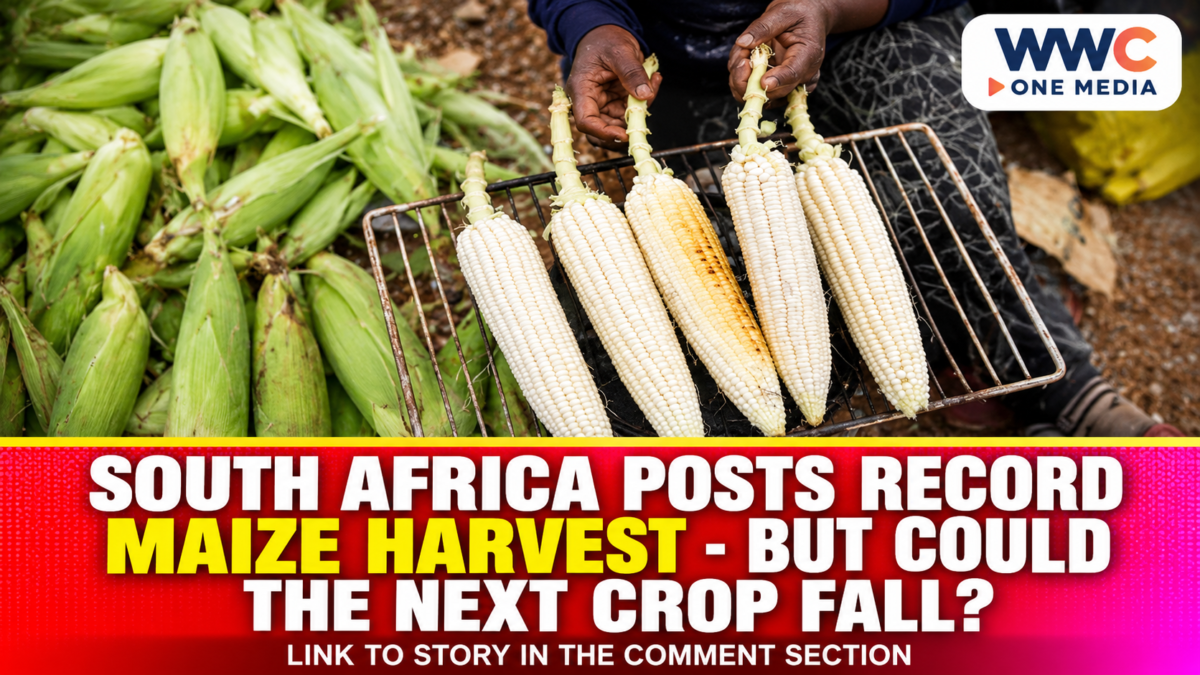
PRETORIA, SOUTH AFRICA — Nov. 27, 2026 — South Africa has officially recorded its largest commercial maize harvest on record, with final production reaching approximately 17.76 million tonnes in 2026. The result strengthens the country’s position as a major grain supplier in Southern Africa, but a sharp reduction in farmers’ planting intentions is already raising questions about the next harvest.
The Crop Estimates Committee (CEC), which operates under South Africa’s Department of Agriculture, released its final summer-crop production estimate on Nov. 26. It placed commercial maize production at 17.75989 million tonnes, an increase of 6.19% from the 16.725 million tonnes recorded in 2025.
When non-commercial production is included, South Africa’s estimated national maize crop reached 18.454915 million tonnes.
The record comes at an important time for regional food security. Maize is a staple food in many Southern African countries and an essential ingredient in animal feed. A strong harvest can improve domestic availability and create opportunities for exports, but production conditions in the following season will determine how long that supply advantage lasts.
South Africa’s commercial maize harvest reaches a new record
The CEC’s final estimate confirms that commercial maize production increased from 16.725 million tonnes in 2025 to 17.75989 million tonnes in 2026.
The increase represents approximately 1.03 million additional tonnes.
The final estimate also revised the committee’s previous forecast of 17.69139 million tonnes, released on Oct. 27.
White maize accounted for 9.84584 million tonnes of the final commercial harvest, while yellow maize contributed 7.91405 million tonnes.
The two varieties serve different but important markets. White maize is primarily used for human consumption, while yellow maize is widely used in animal feed.
The final estimate showed that white maize production increased from 8.5 million tonnes in 2025. Yellow maize production, however, remained unchanged from the previous forecast and was lower than the 8.225 million tonnes recorded in 2025.
The commercial crop’s estimated average yield reached 6.52 tonnes per hectare.
The distinction between commercial and non-commercial production is important. The CEC estimated non-commercial maize production at 695,025 tonnes, bringing the combined national estimate to 18.454915 million tonnes.
That means the 17.76-million-tonne figure refers to the commercial harvest, not the country’s entire maize output.
Three provinces account for most of the harvest
South Africa’s maize production remains concentrated in three major agricultural provinces: the Free State, Mpumalanga and North West.
Together, these provinces are expected to account for approximately 82% of the 2026 commercial maize crop.
The Free State recorded the largest provincial production estimate, with 7.446 million tonnes. Mpumalanga followed with 3.6855 million tonnes, while North West was estimated at 3.49025 million tonnes.
The figures highlight the importance of the country’s central and northern agricultural regions to national grain supply.
A concentrated production base can support large-scale farming and distribution, but it also makes the national harvest sensitive to weather and production conditions in the main growing areas.
The CEC’s provincial estimates show how much of the country’s maize supply depends on these regions. Any prolonged disruption affecting planting, rainfall or crop development there could have consequences beyond individual farming communities.
White maize strengthens the food-supply picture
The increase in white maize production is particularly relevant because the crop is primarily used for human consumption.
South Africa’s final commercial white maize estimate reached 9.84584 million tonnes, compared with 8.5 million tonnes in 2025.
A larger white maize crop can improve the availability of grain for milling and food production. However, the size of the harvest alone does not determine what consumers eventually pay.
Prices also depend on opening stocks, domestic demand, transport costs, processing expenses, exports and market conditions.
The harvest therefore creates an opportunity for stronger supply, but it does not guarantee that food prices will fall by a corresponding amount.
South Africa’s agricultural market also operates within a regional trading network. Countries that rely on imported maize can be affected by changes in South African production, export availability and transport costs.
For Southern African markets, the country’s harvest is therefore relevant beyond its domestic farming sector.
The record harvest comes with a warning for 2027
The next production season may prove more challenging.
The CEC’s survey of commercial farmers’ planting intentions, based on information collected in mid-October, indicated that producers intended to plant 2.3872 million hectares of maize for 2027.
That is 12.37% below the 2.7242 million hectares planted in 2026.
The reduction is especially pronounced for white maize. Farmers intended to plant 1.3702 million hectares, down 18.18% from the previous season.
Intended yellow maize planting was 1.017 million hectares, a 3.10% decline.
At the same time, intended sunflower seed planting increased by 44.64%, reaching 824,600 hectares.
These figures are intentions rather than completed planting results. Farmers may still change their decisions depending on rainfall, input prices, market conditions and other factors before planting is completed.
Nevertheless, the shift suggests that some producers are considering alternatives to maize for the next production cycle.
The potential implications are significant because a smaller planted area can reduce future production if yields do not compensate for the decline.
El Niño and production costs add pressure
The United States Department of Agriculture’s Foreign Agricultural Service identified a combination of weather and economic pressures behind the outlook for South Africa’s next maize crop.
Its Nov. 3 Grain and Feed Update forecast that maize production could fall to 14.9 million tonnes in the 2026/27 marketing year, from an estimated 18.4 million tonnes in 2025/26.
The forecast reflects lower expected planting and a return towards average yields. The report also identified the expected El Niño event, higher diesel costs and competition from oilseeds, particularly sunflower, as factors influencing farmers’ decisions.
This is a forecast, not a confirmed production outcome. The eventual harvest will depend on actual planting, rainfall distribution, crop development and yields.
South Africa’s own weather service has cautioned that El Niño does not automatically produce drought conditions across every part of the country. Its effects vary by region, and other climate factors also influence rainfall.
The broader agricultural risk is not limited to maize. WWC has examined how El Niño-related drought disrupted palm oil deliveries in Indonesia, showing how dry conditions can affect both agricultural production and the transport of harvested commodities.
In other markets, investment in water infrastructure has become part of the response to agricultural vulnerability. A new irrigation project in Kalinga illustrates why reliable water storage and distribution matter when rainfall becomes less dependable.
South Africa remains important to regional grain supply
The outlook for the next harvest matters because South Africa is an important maize supplier to neighbouring countries.
The USDA forecast exports of approximately 2.5 million tonnes for its 2026/27 marketing year, compared with 3 million tonnes in its estimate for 2025/26.
It also projected that South Africa would not need to import maize in the 2026/27 marketing year, with carry-over stocks helping to support domestic availability.
The USDA’s estimates use its own marketing-year definitions and should not be confused directly with the CEC’s calendar-year production estimates.
The report identifies Zimbabwe, Botswana, Namibia, Eswatini and Lesotho among the landlocked and import-dependent neighbouring markets that rely on South African maize.
That regional role makes the next production cycle important. If output declines, export availability could tighten even if the current record harvest provides a temporary buffer.
The wider issue is how agricultural systems manage climate-related uncertainty. WWC has also examined potential farm losses linked to El Niño in Central Visayas and the agricultural damage reported in Davao Region. These are separate regional situations, but they underline the importance of monitoring weather, water availability and farm resilience.
What happens next?
South Africa’s 2026 maize harvest is a major production achievement, with the final commercial estimate confirming a new national record.
The immediate challenge is turning that production into reliable domestic supply and maintaining the country’s ability to serve regional markets.
Attention will now shift towards the 2027 planting season. The reduction in intended maize acreage, the increased interest in sunflower seed and the possibility of more difficult weather conditions create uncertainty around future output.
The coming months will reveal whether farmers follow through on their planting intentions and whether rainfall conditions support the next crop.
For now, South Africa enters the next agricultural cycle with a record maize harvest behind it. The bigger test is whether the country can maintain that production strength when the next season brings a different set of conditions.
Frequently asked questions
How much maize did South Africa produce in 2026?
The Crop Estimates Committee’s final estimate put commercial maize production at 17.75989 million tonnes. Including non-commercial production, the estimated national crop reached 18.454915 million tonnes.
Is South Africa’s 2026 maize harvest a record?
Yes. The CEC described the 17.75989-million-tonne commercial maize crop as the largest on record.
Which South African provinces produce the most maize?
The Free State, Mpumalanga and North West are the country’s three main commercial maize-producing provinces. Together, they account for approximately 82% of the 2026 commercial crop.
What is the difference between white and yellow maize?
White maize is mainly used for human consumption, while yellow maize is widely used in animal feed.
Will South Africa produce less maize in 2027?
The CEC’s planting-intention survey showed that commercial farmers planned to plant 12.37% less maize area in 2027. The USDA also forecast lower production, but the final harvest will depend on actual planting, weather and yields.
How could lower maize production affect Southern Africa?
South Africa supplies maize to neighbouring countries. A smaller harvest could reduce export availability and place additional pressure on regional grain markets, although existing stocks may help cushion the impact.