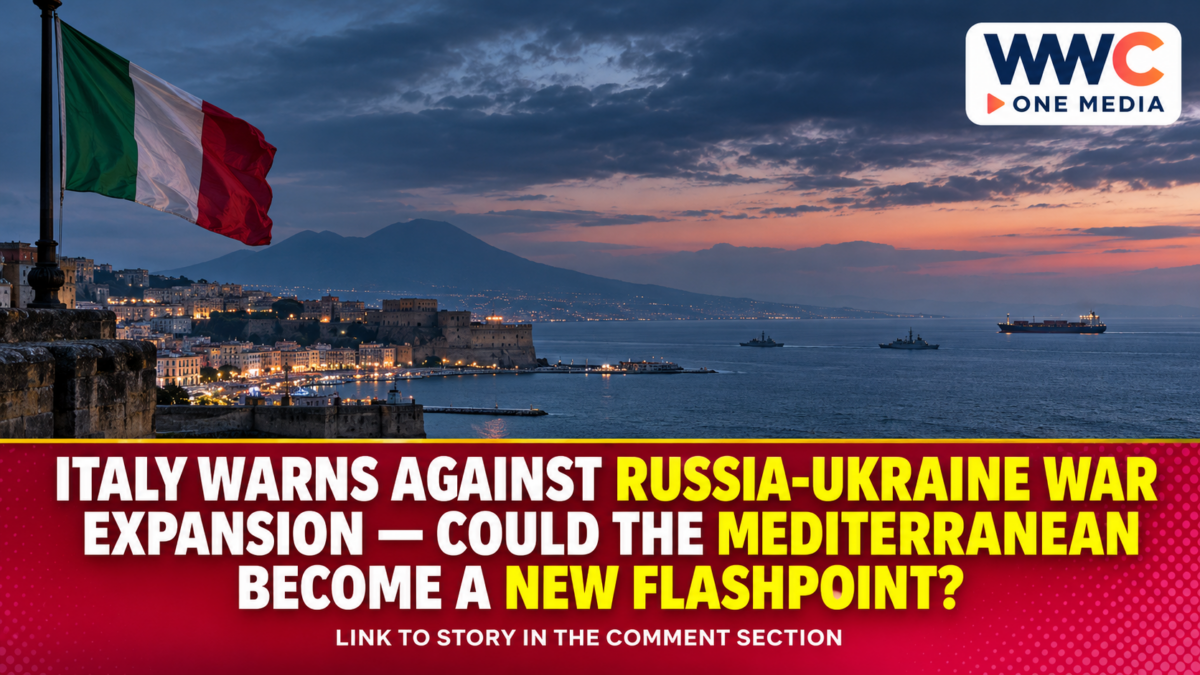
The Russia-Ukraine war is generating renewed concerns over Mediterranean security after Italy warned against extending the conflict into new territories, following Ukrainian-claimed military operations in eastern Libya.
Italian Foreign Minister Antonio Tajani conveyed Rome’s concerns to Ukrainian Foreign Minister Andrii Sybiha on November 24, while reaffirming Italy’s commitment to supporting Ukraine’s defence and pursuing a lasting peace.
The diplomatic intervention comes as Germany maintains its commitment to supporting Kyiv and international partners intensify efforts to prevent further escalation.
The developments highlight an increasingly complex international security environment, with implications extending beyond Europe to global shipping, energy security and Asia-Pacific economies.
Italy warns against Russia-Ukraine war expansion
Italy has emphasised that Libya’s sovereignty and territorial integrity must be respected amid growing concerns over military activities in the Mediterranean.
Tajani subsequently reiterated on November 25 that Italy would continue standing alongside Ukraine despite its objections to the military operations in Libya.
The Italian government maintains that protecting Ukraine’s sovereignty and preserving Mediterranean security are objectives that must be pursued simultaneously.
Rome also continues to support United Nations efforts to promote stability and national unity in Libya.
The latest diplomatic intervention adds another dimension to international discussions surrounding the conflict, including developments involving the strategically significant Kerch Bridge.
Germany maintains its commitment to Ukraine
Germany has reiterated its determination to support Ukraine throughout the winter and into 2027.
Speaking at the NATO Parliamentary Assembly in Berlin on November 23, German Foreign Minister Johann Wadephul outlined Germany’s continuing military assistance, with planned bilateral support valued at approximately €11.6 billion.
Wadephul also stressed the importance of meaningful peace negotiations involving Ukraine and European partners.
Germany’s position reflects the broader challenge facing European governments: maintaining Ukraine’s defensive capabilities while addressing security threats beyond the immediate conflict zone.
These concerns extend into other strategic regions, including energy and defence developments near Russia’s Arctic territory.
Trump and NATO address escalation risks
United States President Donald Trump and NATO Secretary General Mark Rutte discussed the dangers of an expanding conflict during their November 25 meeting at Mar-a-Lago in Florida.
Their joint statement, released on November 26, emphasised the importance of Russia avoiding actions that could deliberately or unintentionally widen the war.
Both leaders also discussed efforts to achieve a peaceful resolution as quickly as possible, alongside continued investment in defence capabilities across the alliance.
The meeting added momentum to existing diplomatic discussions concerning Ukraine’s long-term security and the prevention of further international confrontation.
Why Mediterranean security matters to Asia-Pacific economies
The Mediterranean is already a significant focus of international discussions involving maritime security, energy supplies and food distribution.
During discussions with Ukraine in August 2026, Italy highlighted the importance of Mediterranean and Black Sea security in maintaining Ukrainian grain exports and supporting international food supplies.
Foreign policy discussions at the Mediterranean Dialogues conference in Naples this November also covered trade routes, energy investment and regional security.
For Asia-Pacific businesses, the possibility of wider maritime instability presents potential risks involving transportation costs, supply-chain reliability and commodity markets.
These remain potential economic consequences rather than confirmed disruptions resulting from the latest military operations.
International involvement in Ukraine also extends beyond Europe and North America, as demonstrated by Taiwan’s continuing Ukraine assistance and funding commitments.
G7 countries push for peace and maritime stability
The foreign ministers of the Group of Seven met in Paris on November 9 and 10, reaffirming their support for Ukraine and calling for progress towards a comprehensive ceasefire.
Their discussions addressed the protection of civilian shipping, energy infrastructure and international food supply chains.
The G7 includes three APEC member economies — Canada, Japan and the United States — giving its diplomatic and economic decisions direct relevance to the Asia-Pacific region.
European security discussions also encompass threats outside conventional military operations, including cybersecurity and information manipulation.
These challenges have encouraged wider international cooperation, including discussions surrounding Taiwan and Europe’s efforts to counter disinformation.
What happens next?
International diplomatic efforts remain focused on establishing conditions for a negotiated settlement that protects Ukraine’s sovereignty and long-term security.
On November 10, representatives involving the European Union, Germany, Italy, France, the United Kingdom, Ukraine, the United States and NATO participated in discussions in Abu Dhabi.
The participants addressed security guarantees, mechanisms to reduce escalation risks and arrangements intended to support a durable peace.
Italy’s latest intervention adds Mediterranean security to the immediate diplomatic concerns surrounding the war.
Whether international negotiations can prevent further geographical expansion while securing a lasting settlement remains an important question for governments, businesses and communities across Europe and the Asia-Pacific.