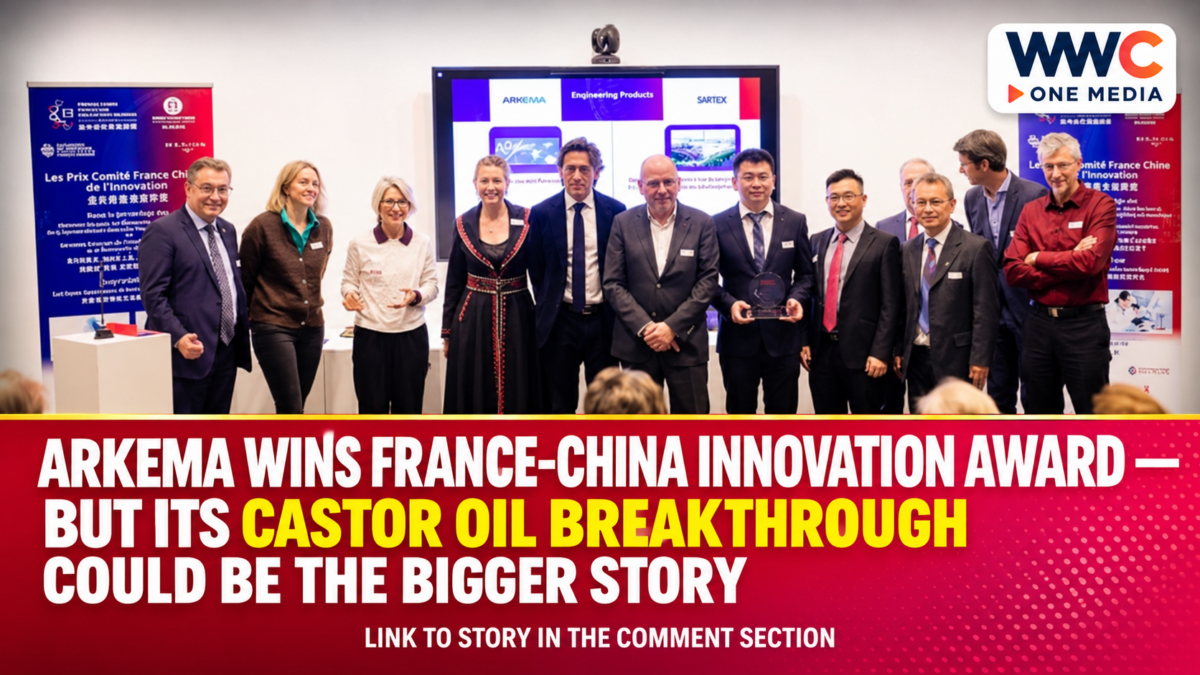
French specialty materials group Arkema has received international recognition for turning castor oil into advanced industrial materials designed for next-generation consumer electronics and manufacturing applications.
The Arkema Innovation Award, presented on Nov. 25, 2026, during the 12th France-China Committee Innovation Awards, recognised two commercially developed products in the Innovative Product category.
The winning technologies are low-density Rilsan® polyamide 11 (PA11) and Born2Bond™ Ultra K85, an instant industrial adhesive containing 60% bio-based content.
Both products emerged from collaboration between Arkema’s research and development teams in France and China.
Beyond the award, the development highlights an important commercial opportunity: using renewable agricultural resources to manufacture sophisticated materials that can compete with conventional petroleum-derived alternatives.
Arkema Innovation Award Highlights the Potential of Castor Oil
Castor beans are at the centre of Arkema’s renewable materials platform.
The company’s chemical processing capabilities allow castor oil to be transformed into specialised ingredients used in polymer and adhesive production.
Its Oleris® Advanced Oleochemicals portfolio provides renewable chemical building blocks that can be incorporated into different industrial formulations.
This approach creates opportunities to develop multiple products from a common agricultural resource rather than relying exclusively on fossil-derived ingredients.
Similar developments are emerging elsewhere in Asia, including research into coconut-based alternatives for industrial paint additives.
The commercial challenge for bio-based materials manufacturers is to combine renewable content with the technical performance, affordability and production consistency demanded by industrial customers.
Lighter Materials for Next-Generation Electronics
One of Arkema’s award-winning products is a low-density version of Rilsan® PA11 designed for consumer electronics.
The specialised polymer contains up to 85% bio-based content.
Its material properties allow manufacturers to explore lighter components while maintaining mechanical durability and dimensional stability.
The formulation is particularly relevant to applications requiring thin structures and complicated component designs.
Arkema’s wider Rilsan PA11 portfolio can also be processed using manufacturing techniques such as injection moulding, extrusion and 3D printing.
For electronics manufacturers, reducing component weight without sacrificing reliability could create additional flexibility when designing future products.
However, the actual benefits will depend on the specifications and operating conditions of individual applications.
An Industrial Adhesive With 60% Bio-Based Content
The second award-winning product, Born2Bond™ Ultra K85, addresses the requirements of manufacturers that need rapid bonding and resistance to challenging environmental conditions.
The adhesive contains 60% renewable-derived material and is designed for demanding industrial applications.
Its published technical specifications include resistance to temperatures of 85°C combined with 85% relative humidity for up to 1,000 hours under specified testing conditions.
The product also has a stated elongation of 30%, a fixture time of approximately 15 seconds under specified conditions, and characteristics intended to minimise odour and visible residue during bonding.
These properties could be particularly valuable where manufacturers require durable adhesive performance without substantially slowing assembly processes.
Bio-based content, however, should not be confused with biodegradability or proof that an entire finished product has a lower environmental footprint.
Arkema Expands Its Research Capabilities in China
The international award follows another significant development in Arkema’s Asian operations.
On Oct. 15, 2026, the company officially inaugurated its expanded research and development centre in Shanghai.
The facility was originally established in 2011 as Bostik’s Asia Technology Center, initially concentrating on adhesive technologies.
Its recent expansion increased laboratory space by approximately 20% and introduced additional facilities intended to support collaboration with industrial customers and technology partners.
Arkema has also identified China as its second-largest market.
The company’s expanding research capabilities reflect the importance of maintaining technical expertise close to customers and manufacturing operations.
This cooperation provides a different perspective on European and Chinese commercial relations, alongside continuing discussions over trade investigations involving European chemical products.
Why Bio-Based Materials Matter to Asia-Pacific Manufacturing
Arkema’s broader innovation strategy identifies advanced electronics, electric mobility, sustainable consumer products and energy-related technologies among its priority growth markets.
The company maintains a research network involving approximately 1,800 researchers across 17 research and development centres.
It also registered more than 200 new patents in 2025.
For manufacturers across APEC economies, developments in specialty polymers and industrial adhesives present potential opportunities to reconsider material selection, product design and procurement strategies.
The ability to manufacture advanced materials using renewable feedstocks could offer businesses additional options when developing products intended to meet environmental objectives.
Nevertheless, commercial adoption will depend on several factors, including material availability, regulatory requirements, manufacturing costs and product qualification.
These considerations remain important as governments and businesses navigate changing industrial policies, including European proposals for stronger trade-defence mechanisms.
What Happens Next for Arkema?
Arkema’s recognition demonstrates that renewable-derived materials can progress beyond laboratory research into commercial industrial products.
Its expanding research infrastructure in China could provide additional opportunities to work with manufacturers developing electronics, battery technologies and other specialised applications.
The next commercial test will involve broader customer adoption and the ability to deliver consistent product performance at competitive costs.
The award announcement did not disclose product-specific revenue, production volumes, new customer contracts or projected financial returns.
Those figures will be important in determining the longer-term commercial contribution of the two technologies.
For now, Arkema’s achievement offers a clear example of how agricultural feedstocks, chemical engineering and international research collaboration can converge to create advanced industrial materials.