
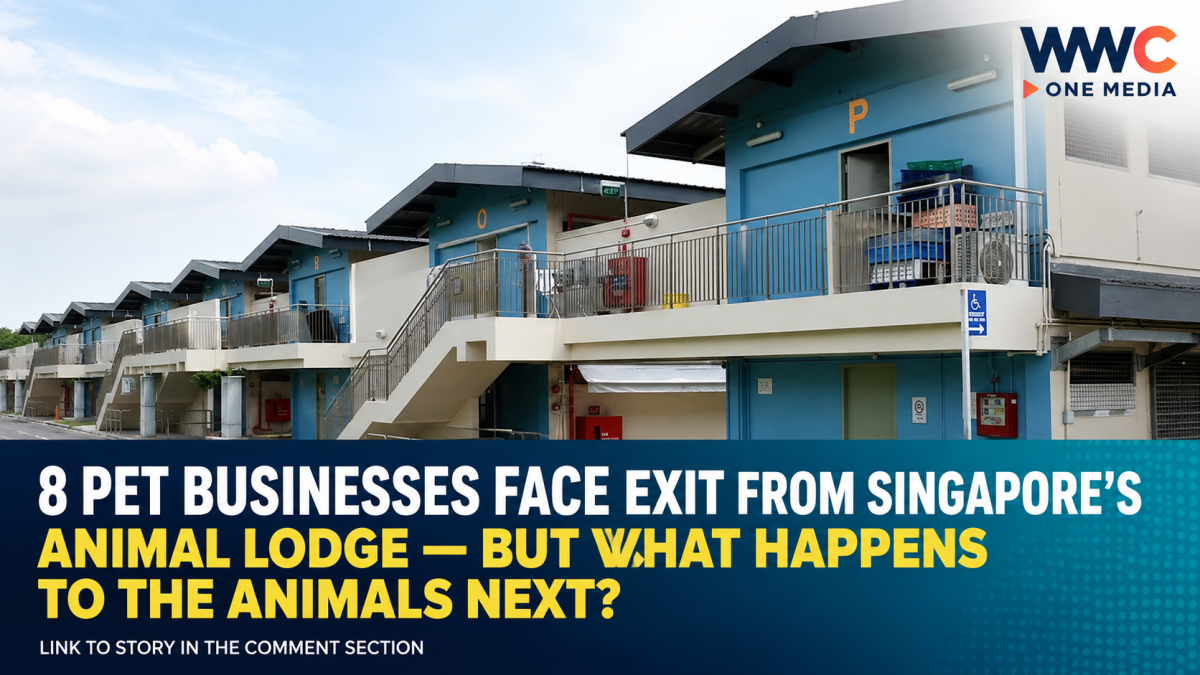
SINGAPORE — Eight commercial tenants at Singapore’s The Animal Lodge will not have their leases renewed after failing to meet requirements under a new tender exercise designed to push animal-welfare and operating standards higher.
The affected businesses include seven dog breeders and one pet boarding operator, with their current tenancies due to expire on Dec 5, 2026.
The decision affects eight of the facility’s 35 commercial tenants, who collectively occupy 53 units at The Animal Lodge in Sungei Tengah. The remaining 27 tenants met the requirements and can renew their tenancies for up to three terms, potentially extending their leases until Dec 5, 2035, according to Singapore’s Animal and Veterinary Service (AVS), a cluster under the National Parks Board (NParks).
AVS has not publicly identified the eight unsuccessful businesses, citing confidentiality. However, several affected operators spoke to CNA about the decision and the short timeline they now face to relocate their businesses and make arrangements for the animals under their care.
Why were the leases not renewed?
AVS said the businesses were required to demonstrate more than simply compliance with existing licensing requirements.
Under the targeted tender exercise, operators had to submit proposals showing how they would go beyond baseline animal-welfare and operational standards.
The proposals were assessed using both price and quality considerations, including:
- Animal health and welfare
- Husbandry practices
- Living and housing conditions
- Biosecurity measures
- Breeding and boarding facilities
- Regulatory track record
AVS said all existing tenants met the baseline requirements needed to operate legally, but the eight unsuccessful bidders did not propose enough additional measures to score sufficiently in areas such as animal welfare and husbandry.
One example illustrates the difference. A dog breeder providing the required annual health examination would meet the baseline standard, while proposing more frequent veterinary examinations could earn additional points in the tender.
AVS said tenants were given guidance during the process, with more than 15 engagement sessions held since November 2025, including town halls, tender briefings and workshops.
Some affected operators say the deadline is too tight
For the businesses that failed to secure renewals, the decision has created a difficult countdown.
Among them are House of Pups and Rayru Kennel, which CNA reported together house more than 200 dogs.
House of Pups owner Michael Teo questioned whether roughly three months would be enough time to wind down operations, relocate the business and rehome animals, including pregnant dogs.
He also disputed the assessment of his tender proposal, saying some welfare measures already practised at his premises were not included because he considered them basic animal-care practices.
Rayru Kennel owner Raymond Toh likewise questioned the decision and the short relocation period.
The operator of Tara Pet Care, the only pet-boarder among the unsuccessful tenants, also said she was considering leaving the industry after operating at The Animal Lodge for years.
She told CNA that she had recently spent thousands of dollars improving her premises, including adding fans for ventilation and replacing ageing doors, before learning that her lease would not be renewed.
What happens to the animals?
The immediate concern is not simply where the businesses will operate next — but where their animals will go.
AVS said it will work with the eight unsuccessful tenants to ensure transition plans are in place, including arrangements for relocation and rehoming where necessary.
The authority also said it will consider requests for extensions case by case, taking into account factors such as animal welfare, relocation plans and the progress made by individual tenants.
That means the Dec 5 deadline is significant, but it does not necessarily mean every affected animal must be moved on exactly the same timetable.
A broader shift in Singapore’s animal-welfare rules
The Animal Lodge decision comes at a significant moment for Singapore’s animal sector.
Just days before the lease announcement, AVS launched its first Guidelines for Animal Shelters, establishing common benchmarks and recommended practices covering shelter management, animal housing, animal care and healthcare.
The new guidelines address issues including animal capacity, veterinary care, disease prevention, housing, enrichment, financial planning and — importantly — exit plans for shelters that cease operations.
AVS said the guidelines were developed following consultations with animal welfare groups, veterinarians, trainers and the wider public. A public consultation conducted between December 2024 and February 2025 received more than 600 responses, with 82 per cent supporting the development of guidelines for animal shelters.
The timing has also drawn attention because of the earlier controversy involving Animal Lovers League (ALL), which lost its tenancy at The Animal Lodge after AVS raised concerns about the management of its premises and the welfare of animals under its care.
CNA previously reported that ALL had accumulated significant rental arrears and that AVS had worked with other animal welfare groups to develop longer-term arrangements for animals previously under the organisation’s care.
AVS has said development of the shelter guidelines began before the ALL situation became a major public issue, although authorities acknowledged that lessons from the case could help strengthen animal-welfare practices.
What happens to The Animal Lodge next?
The latest tender is not necessarily the end of the changes.
AVS said it will review the future use of The Animal Lodge based on industry needs and operational considerations. Units that become available could eventually be offered through future tenders, potentially allowing new entrants into the facility.
For the 27 successful tenants, however, the new leases come with expectations.
AVS said it will monitor whether successful operators deliver the commitments made in their tender proposals. Businesses that fail to maintain the promised standards could face consequences, including possible non-renewal at a future tenancy review.
The message from Singapore’s animal regulator is therefore becoming increasingly clear: meeting the minimum may no longer be enough.
For the eight businesses facing departure, the immediate challenge is finding a safe path forward for their animals before the end of the year.
For the wider pet industry, the more consequential question may be what these new standards mean for breeders, boarding operators and animal-care businesses across Singapore — and whether the Animal Lodge tender marks the beginning of a much broader push for higher welfare standards.
WWC ONE MEDIA MJE

Leave a Reply