
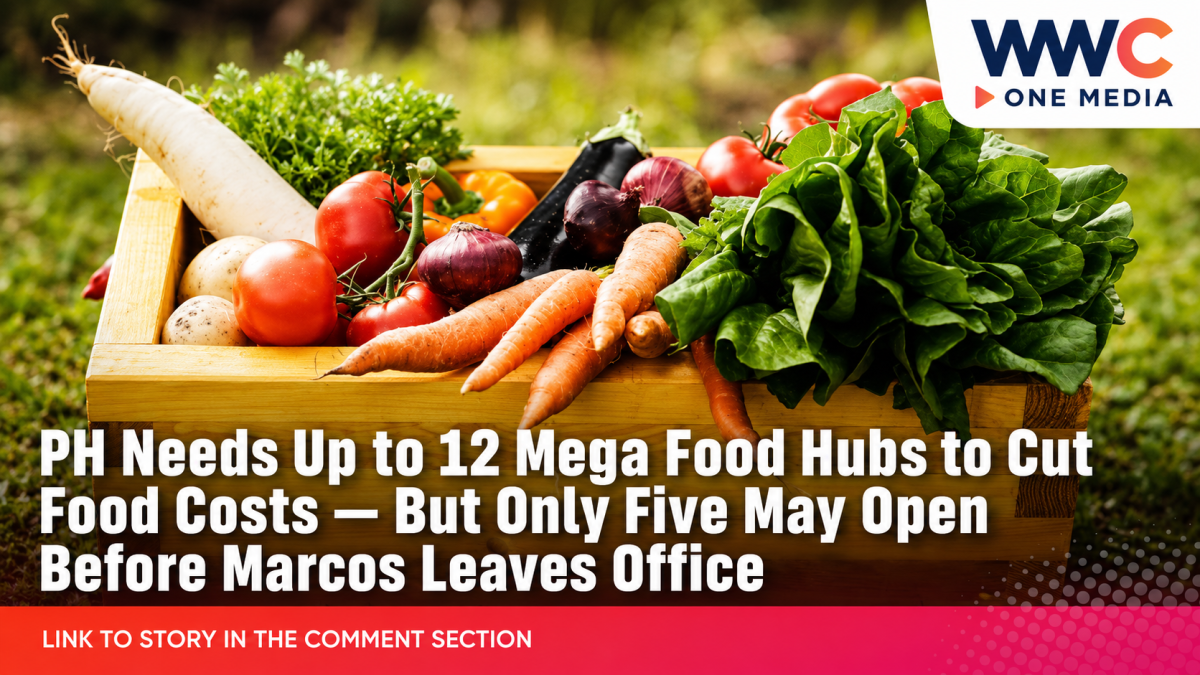
MANILA, Philippines — The Philippines may need as many as 10 to 12 massive food distribution hubs to fix one of agriculture’s most stubborn problems: farmers can produce food, but getting it efficiently from farms to consumers remains expensive, fragmented and heavily dependent on layers of traders.
Agriculture Secretary Francisco Tiu Laurel Jr. told lawmakers on Tuesday, September 1, that a nationwide network of mega food hubs could help farmers and fisherfolk reach markets more efficiently, potentially increasing producer earnings while improving the flow of food to public markets.
But there is a major gap between what the country needs and what it may actually have in the next two years.
Tiu Laurel said the Department of Agriculture is targeting the start of operations of five food hubs before the end of the Marcos administration in 2028, even as he estimated that the Philippines ultimately needs at least 10 to 12.
That means the government could still be less than halfway toward the nationwide network envisioned by the agriculture chief when the current administration ends.
Why mega food hubs matter
Mega food hubs are designed to do far more than simply provide warehouses.
Under the government’s plans, they can combine agricultural trading, cold storage, processing, packaging, food-safety facilities and distribution operations in strategic locations.
The idea is to consolidate produce from farmers and fisherfolk, preserve perishable products longer and connect producers with larger markets without forcing every shipment to pass through multiple intermediaries.
Tiu Laurel told lawmakers the hubs should help reduce the number of trading layers between producers and consumers while increasing the share of revenue that reaches farmers.
The problem is especially important for vegetables, fruits, fish and meat, where delays and inadequate refrigerated storage can quickly turn unsold products into losses.
The DA has already been expanding cold-storage infrastructure separately from the mega food hubs. In March, the government switched on a ₱500-million mega cold-storage warehouse in Pili, Camarines Sur, designed for meat, fish, fruits and vegetables. The DA says the facility has an annual handling capacity exceeding 200,000 tons.
Seven additional cold-storage facilities were also being constructed in the Cordillera Administrative Region as of August after bad weather and landslides disrupted vegetable trading and contributed to crop wastage.
Those projects illustrate why the food-hub strategy is not simply about constructing large buildings. The real objective is to build an interconnected logistics system capable of moving food when markets, roads or weather conditions disrupt the normal supply chain.
Eight locations are now appearing in the government pipeline
During the September 1 House Committee on Appropriations hearing, Tiu Laurel identified three food hubs being implemented under the 2026 national budget:
Clark, Pampanga; Isabela; and Pili, Camarines Sur.
Under the proposed 2027 budget, the DA is also planning hubs in:
Tiaong, Quezon; San Pablo, Laguna; Albay; Roxas, Zamboanga del Norte; and Manolo Fortich, Bukidnon.
That is eight locations across the current and proposed budget pipelines.
However, a proposed site should not be confused with a completed or fully funded project. The 2027 national budget still has to go through Congress, and individual projects remain subject to appropriations, procurement, construction and implementation timelines.
The list also shows how rapidly the government’s food-logistics program is evolving.
In July, state-run Food Terminal Inc., or FTI, publicly described a network involving five mega food hubs in Clark, Tiaong, Manolo Fortich, Camarines Sur and Cebu, together with 16 regional food terminals and the integration of Commonwealth Market into the distribution network. FTI estimated at the time that the broader program would require roughly ₱20 billion over several years.
The locations discussed at the September budget hearing therefore represent a broader and somewhat different pipeline from the five-hub list announced in July.
Clark is becoming the flagship test
The Clark project in Pampanga is among the most advanced and could become the government’s biggest early test of whether the food-hub strategy can deliver what officials are promising.
The DA said in August that around ₱4 billion had been committed to the Clark National Food Hub, which will occupy around 40 hectares at Clark Aviation Capital with room for future expansion.
Agriculture officials have been directed to make the facility partially operational before the end of 2027.
Plans call for the complex to include food aggregation and distribution facilities, cold storage, processing areas, food-safety laboratories, export-processing facilities and wholesale and retail spaces.
Once fully developed, the government estimates that the Clark hub could support around 2,500 jobs while creating new commercial opportunities across agriculture and fisheries.
The project has evolved from earlier plans. An October 2025 agreement described a roughly ₱3.6-billion development on a 46-hectare property, while the latest DA announcement refers to around 40 hectares and ₱4 billion already committed—an indication that the project’s scope and financing have continued to develop.
The bigger problem: Can government afford the network fast enough?
The food-hub push is unfolding while the Agriculture Department itself faces tighter fiscal limits.
The DA is seeking a ₱198.45-billion budget for 2027, around 8 percent below the ₱215.69 billion approved for 2026.
The proposed amount is also significantly below the roughly ₱260 billion the department initially submitted to the Department of Budget and Management, according to Philippine News Agency reporting from the same September 1 budget hearing.
That creates an unavoidable question for a mega food-hub program that could require tens of billions of pesos over several years:
How quickly can the Philippines build the network if agriculture is simultaneously competing for money for irrigation, farm-to-market roads, livestock programs, fisheries, machinery, climate resilience and other infrastructure?
Government is already exploring ways of bringing private capital into agriculture infrastructure.
In July, the PPP Center said it was working with the DA on projects that could potentially use public-private partnerships, including mega food hubs, cold storage, agri-fish ports, irrigation systems and farm-to-market roads.
Private participation could accelerate construction, but it would also make project design, concession terms, fees and long-term operating costs important issues to watch.
From mega hubs to the neighborhood market
Building giant logistics complexes will mean little if small farmers and market vendors cannot access them.
That concern surfaced during Tuesday’s hearing when Gabriela Rep. Sarah Jane Elago asked whether the DA was coordinating with local governments to make market space available to small vendors, including producers who can sell only seasonally or once a week.
Tiu Laurel pointed to the government’s Kadiwa program, which connects farmers and food producers with consumers through local selling sites.
FTI said in July that its broader logistics system was intended to connect production areas, regional terminals and consumer markets while strengthening programs selling agricultural products at lower prices.
The challenge is turning that concept into a genuine national network rather than a collection of disconnected government projects.
Thailand shows the scale of the gap
Tiu Laurel told lawmakers that Thailand has 16 mega food hubs while the Philippines currently has none, and said Thailand’s system drew inspiration from the concept behind the Philippines’ original Food Terminal Inc.
That comparison is the secretary’s characterization and should be understood as part of the DA’s case for accelerating investment rather than as proof that food hubs alone explain Thailand’s agricultural competitiveness.
Food prices are affected by far more than distribution centers: farm productivity, fuel costs, transportation, imports, weather, electricity, market competition and international commodity prices all matter.
Mega hubs therefore cannot solve Philippine food inflation by themselves.
What they could potentially fix is one crucial part of the system—the expensive and inefficient journey between the person who produces the food and the family that eventually buys it.
And that may be the real test of the government’s strategy.
The Philippines now has plans for mega hubs, regional terminals, cold-storage facilities and expanded Kadiwa distribution.
But with the DA saying the country ultimately needs 10 to 12 major hubs, while only five are expected to start operating before 2028, the question is no longer whether the Philippines needs better food infrastructure.
It is whether government can build the network fast enough—and make it work well enough—to actually put more money in farmers’ pockets while bringing food prices down for consumers.



Leave a Reply