
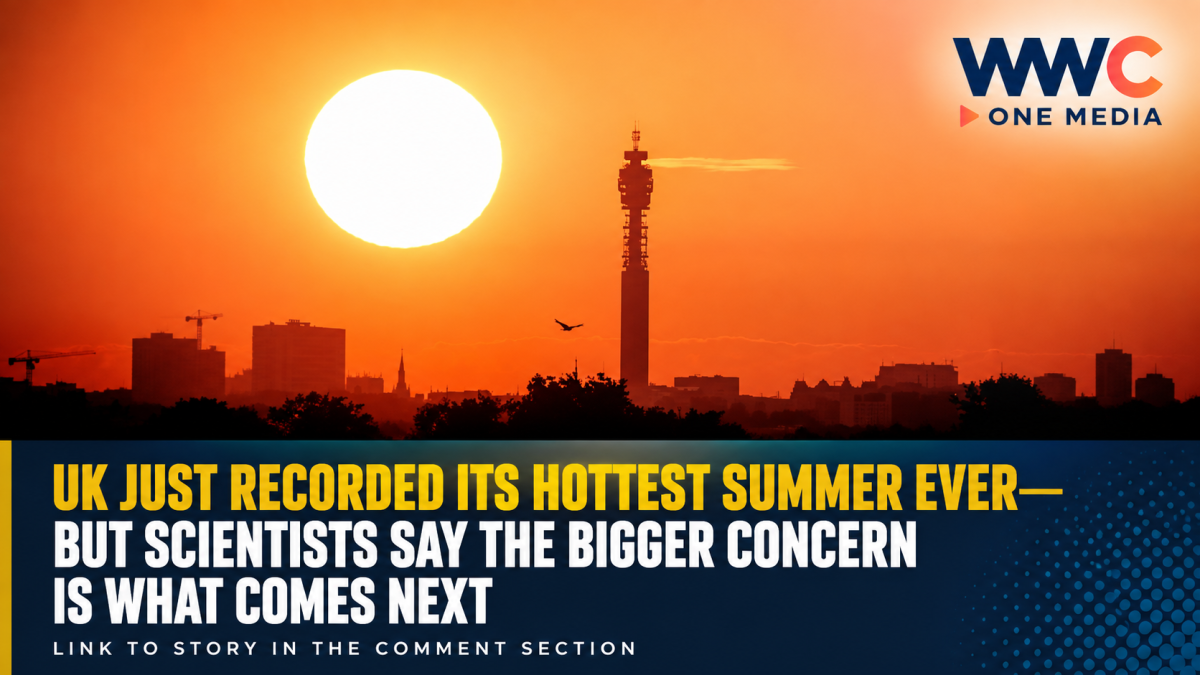
LONDON — Britain has just experienced its hottest summer since modern records began, with the Met Office warning that the extraordinary heat of 2026 is another sign of how rapidly the country’s climate is changing.
Provisional Met Office data released on September 1 showed that the United Kingdom recorded a mean summer temperature of 16.5°C between June and August, making summer 2026 the warmest in a temperature series dating back to 1884. It also means Britain has broken its previous summer record for the second consecutive year.
The latest figure surpasses the previous record of 16.12°C set in 2025 by roughly 0.4°C—a significant jump for a seasonal national average.
And this was not simply a summer of a few exceptionally hot afternoons.
Britain endured five widespread heatwaves, with prolonged periods of above-average temperatures, unusually warm nights, severe rainfall deficits and widespread drought conditions.
38.1°C peak was only part of the story
The UK’s highest temperature this summer reached 38.1°C at Kew Gardens in London on August 13.
That made it the UK’s fifth-hottest day on record, although it remained below Britain’s all-time temperature record of 40.3°C recorded at Coningsby, Lincolnshire, in July 2022.
What made 2026 particularly unusual was the persistence of the heat.
Temperatures reached at least 30°C on 40 separate days, breaking the previous record of 34 days set in 1995. Temperatures of 35°C or higher were recorded on 10 days—double the previous benchmark of five days—and 37°C or higher was reached on three separate days, another national record.
Drought became another major threat
The heat was accompanied by exceptionally dry conditions.
July was particularly severe. England recorded only 6.5mm of rainfall, equivalent to about 10% of its long-term July average, making it the driest July in England since records began in 1836.
Wales also experienced its driest July on record, while southern England received only about 1.9mm of rain—the driest month ever recorded for that region.
By the end of the summer, drought conditions had spread across much of England and all of Wales, increasing pressure on agriculture, water supplies and the natural environment.
The combination of prolonged heat and dryness also contributed to an elevated wildfire risk, while farmers faced mounting concerns over crops and water availability.
The climate-change connection is becoming harder to ignore
The Met Office’s attribution analysis found that human-caused climate change made the exceptional temperatures of summer 2026 around 130 times more likely.
Scientists stress that individual weather events are influenced by many factors, but the broader pattern is increasingly clear: a warming climate is raising the baseline temperature on which heatwaves occur.
The Met Office also noted that the UK’s summers are projected to continue becoming hotter.
Five of Britain’s warmest summers have now occurred since 2003, highlighting how quickly the country’s temperature record is shifting.
The human cost was already visible
Extreme heat was not simply a weather story.
The UK Health Security Agency estimated that the heatwaves in May and June were associated with 2,877 excess deaths in England, according to figures cited by CNA and other reports. That figure was almost twice the number recorded during the whole of summer 2025.
Health experts have repeatedly warned that extreme heat can place particular pressure on older people and those vulnerable to heat-related illness.
The summer also placed significant pressure on infrastructure, hospitals, agriculture and water resources.
And the record may be a warning, not an ending
The striking part of Britain’s 2026 summer is not that temperatures briefly approached 40°C.
It is that the country managed to break its seasonal temperature record again, just one year after setting the previous record.
The Met Office says the frequency with which UK climate records are being broken reflects the influence of human-induced climate change.
Scientists are therefore increasingly focused on a question that goes beyond whether Britain can break another temperature record.
How often will extreme summers like this become normal—and is the UK’s infrastructure ready for them?
For millions of people, the answer could determine whether future British summers mean little more than uncomfortable heat—or increasingly serious risks to health, food production, water supplies and the country’s economy.
WWC ONE MEDIA MJE




Leave a Reply