
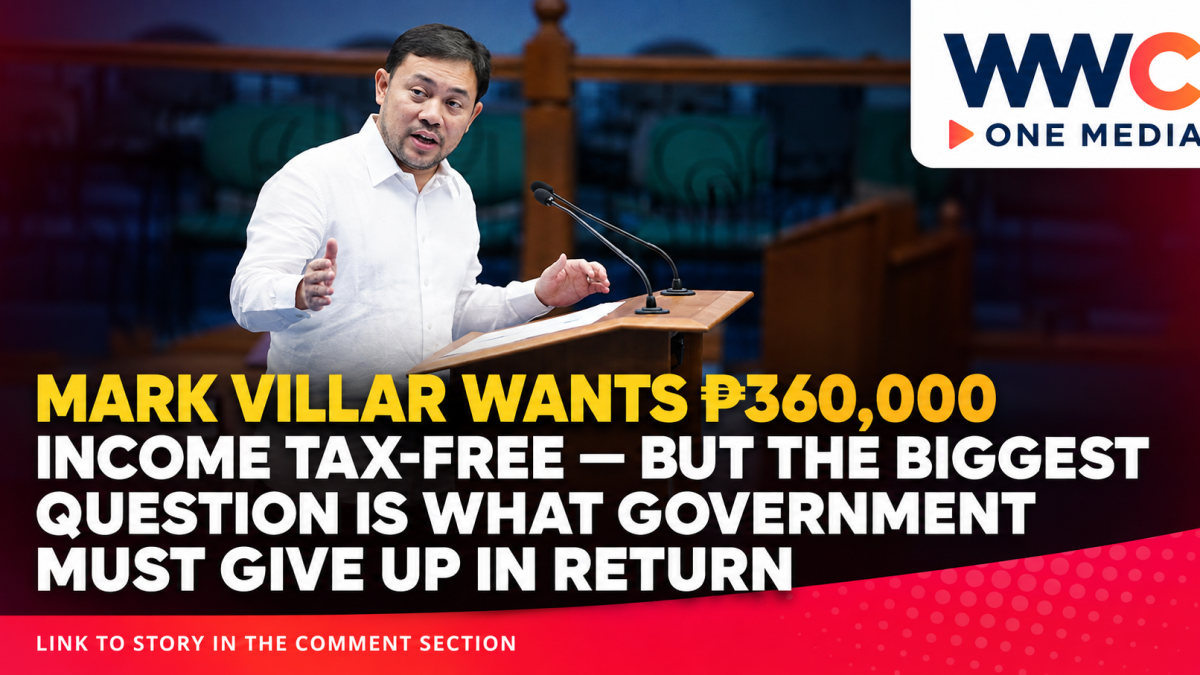
MANILA, Philippines — Millions of Filipino workers could eventually keep more of their salaries instead of surrendering part of their income to taxes, as Senator Mark Villar intensifies his push to raise the country’s personal income tax exemption threshold amid slowing household spending and persistent pressure on family budgets.
But while the proposal promises more money in workers’ pockets, one question is emerging at the center of the debate: How much revenue can the government afford to give up—and where will it recover the difference?
Villar is urging the Department of Finance and other economic agencies to seriously consider Senate Bill No. 2137, his proposal to increase the annual personal income tax exemption ceiling from the existing ₱250,000 to ₱360,000.
The Senate’s official legislative database shows Villar filed the measure on May 19, 2026. It was referred to committee the following day and remains pending at the committee level.
Under Villar’s proposal, an individual with annual taxable income of up to ₱360,000—or roughly ₱30,000 a month when expressed on a simple annualized basis—could fall within the zero-income-tax threshold. The measure would also adjust the graduated personal income tax brackets.
That is ₱110,000 higher than the current ₱250,000 tax-free threshold established under the TRAIN tax system.
Why Villar Says Workers Need Relief Now
Villar raised the proposal during discussions surrounding the proposed 2027 national budget, arguing that tax relief could provide a more direct way of supporting working Filipinos at a time when consumer spending has weakened.
Instead of collecting the money first and later returning assistance through government programs, Villar argues that leaving a larger portion of workers’ earnings in their paychecks would allow families to immediately spend it on food, electricity, transportation, schooling and other necessities.
The economic backdrop gives that argument additional weight.
The Philippine Statistics Authority reported that gross domestic product expanded by just 2.3 percent year-on-year during the second quarter of 2026. Household final consumption expenditure, traditionally one of the Philippines’ most important growth engines, increased by only 2.8 percent, while gross capital formation contracted by 9.2 percent.
Government construction was particularly weak. Separate reporting on the PSA figures showed public construction plunging by roughly 32.4 percent during the quarter.
That combination—slower consumption, weaker investment and lower infrastructure activity—has strengthened arguments for measures capable of putting spending power directly into consumers’ hands.
Villar describes the tax cut as a form of economic “pump-priming”: workers keep more of their earnings, spend part of that money in the economy, businesses receive additional sales, and government potentially recovers some of the foregone income-tax revenue through other taxes generated by greater economic activity.
Villar’s ₱360K Proposal Is Different From Marcos’ ₱350K Plan
There is an important distinction.
Villar’s Senate Bill 2137 proposes a ₱360,000 exemption threshold.
President Ferdinand Marcos Jr. and the Department of Finance are separately pushing a ₱350,000 threshold as part of the administration’s proposed Promoting Growth, Revenue, and Equity towards Socio-Economic Sustainability or ProGRESS tax package.
Marcos publicly pushed the higher exemption during his 2026 State of the Nation Address.
The administration estimates that raising its proposed threshold to ₱350,000 could increase the number of workers exempt from personal income tax from about 5.1 million to 6.3 million, including roughly 1.2 million additional taxpayers who would fall within the tax-free bracket.
And the benefits would not necessarily stop at workers earning below ₱350,000.
Because Philippine personal income taxes use graduated brackets, the DOF and Bureau of Internal Revenue have explained that taxpayers earning above the exemption ceiling may also receive tax savings if the succeeding brackets are adjusted.
Under the administration proposal discussed by Finance Secretary Frederick Go, workers earning ₱350,000 and above could see annual income-tax savings of as much as ₱17,500, depending on their taxable income and the final tax schedule approved by Congress.
Villar’s version, however, goes ₱10,000 further by setting the proposed zero-tax ceiling at ₱360,000.
The ₱60-Billion Question
Tax relief has a cost.
The Department of Finance has estimated that the administration’s separate ₱350,000 proposal could result in as much as ₱60 billion in foregone government revenue, according to Finance Secretary Go.
That estimate should not automatically be applied to Villar’s ₱360,000 bill because the two proposals have different thresholds and could ultimately contain different tax brackets.
But the figure illustrates the fiscal challenge Congress will have to confront.
The administration is already looking at compensating measures.
Go has indicated that excise taxes are among the potential sources of replacement revenue, while the broader ProGRESS discussions have included possible changes affecting products such as sweetened beverages and tobacco or vape products.
That creates a politically sensitive balancing act.
A higher exemption threshold could reduce the income taxes paid by millions of workers—but government may simultaneously seek additional revenue elsewhere.
House Is Already Moving on a Similar Proposal
The tax-relief campaign is also advancing in the House of Representatives.
House Bill No. 10345, filed by Speaker Faustino Dy III and Majority Leader Ferdinand Alexander “Sandro” Marcos, proposes raising the annual tax-free income threshold from ₱250,000 to ₱350,000 and restructuring the graduated income tax brackets.
The House Committee on Ways and Means approved the measure in August, subject to style, along with a separate proposal providing tax relief to micro and small businesses.
Economic Planning Secretary Arsenio Balisacan has also backed the basic economic logic behind increasing workers’ take-home pay, saying additional spending power could support household consumption.
Inflation Has Quietly Changed the Tax Debate
Supporters of a higher exemption ceiling also argue that the current ₱250,000 threshold no longer carries the same purchasing power it did when TRAIN took effect.
A worker may receive salary increases over time yet still find that much of those gains are absorbed by higher food, transportation, electricity, housing and other costs.
As incomes rise partly in response to inflation, some workers can also move deeper into taxable brackets without experiencing an equivalent improvement in their real standard of living.
Villar has framed his proposal partly as an inflation adjustment—an attempt to update the tax system to reflect how much ₱250,000 is actually worth today compared with when the threshold was introduced.
The argument has gained traction beyond Villar. Several lawmakers have filed their own proposals seeking even higher exemptions, demonstrating that the debate is increasingly shifting from whether the ₱250,000 threshold should change to how high the new ceiling should be.
What Happens Next?
For now, workers should not expect their withholding taxes to suddenly disappear.
The ₱360,000 threshold is still only a proposal.
Senate Bill No. 2137 remains pending in committee, while Congress is simultaneously considering the administration-backed ₱350,000 framework and other competing proposals.
The eventual law—if Congress passes one—could therefore look different from Villar’s original measure.
What appears increasingly clear is that income-tax relief has moved toward the center of the government’s economic debate as policymakers search for ways to revive consumption without abandoning fiscal discipline.
Giving workers a bigger paycheck may be the popular part.
Finding the billions of pesos needed to make up for the taxes government no longer collects could be the battle that ultimately determines how much relief Filipinos actually receive.
WWC ONE MEDIA MJE



Leave a Reply