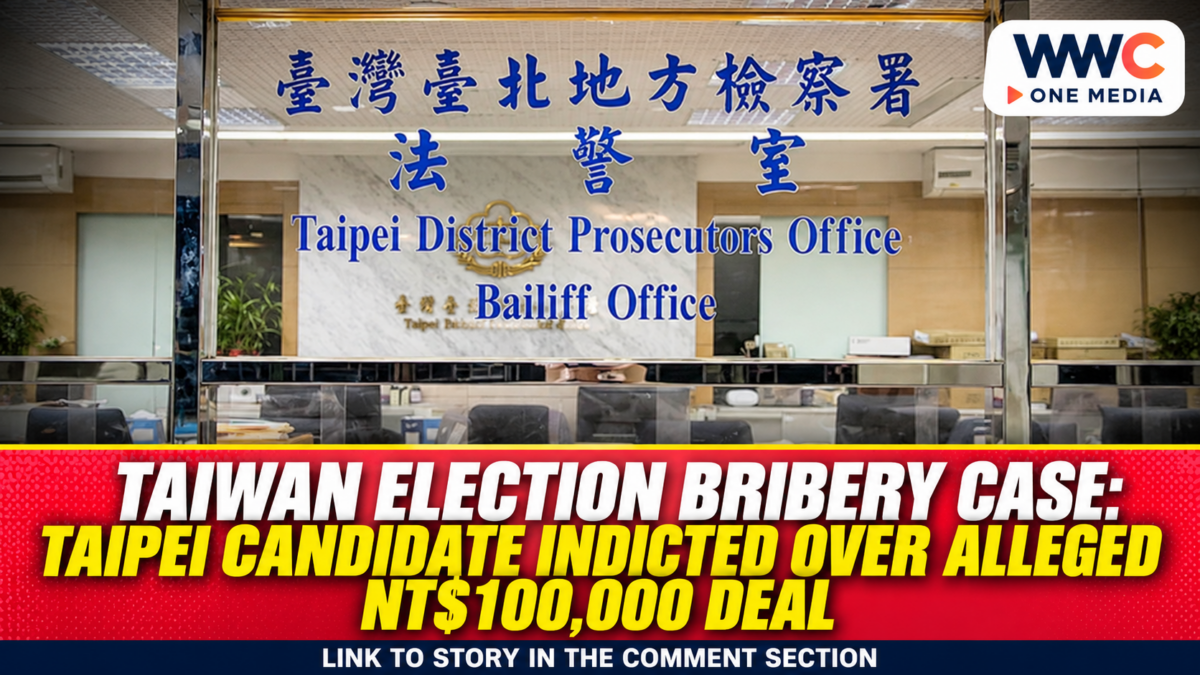
TAIPEI, Taiwan — A man surnamed Chang has been indicted over an alleged NT$100,000 offer to an incumbent neighborhood chief in exchange for not contesting a local election, with prosecutors asking a court to impose three years and six months in prison. The case was announced on November 23, just days before Taiwan’s November 28 local elections.
The allegation raises a broader question about the integrity of local elections: where does political negotiation end and criminal interference begin? Taiwan’s election law specifically addresses arrangements in which a candidate or an eligible candidate seeks a benefit in exchange for abandoning a campaign.
The case remains at the prosecution stage. An indictment and a request for a prison sentence are not a conviction; the court must determine whether the evidence proves the charge.
What prosecutors allege in the Taipei case
The indictment concerns two men identified by their surnames, Chang and Chen. Chang had previously run twice for neighborhood chief in Taipei’s Zhongzheng District without winning, while Chen was the incumbent preparing to seek another term.
Prosecutors allege that Chang approached Chen on August 25 and sought NT$100,000 in exchange for not registering as a candidate. The reported meeting took place on Section 1 of Hangzhou South Road, several days before the candidate-registration period scheduled for August 31 to September 4.
The prosecution’s account includes an audio recording of the conversation. Chen reportedly questioned the amount, while Chang allegedly continued discussing the proposed payment and whether he would enter the race if no arrangement was reached.
Chen did not accept the proposal and later provided the recording to police, according to the account of the indictment. Chang subsequently registered as a candidate in September and was questioned by police. Prosecutors later brought the case forward for trial.
The allegations, including the interpretation of the recorded conversation, must be assessed through the court process. The identities of the men have not been expanded beyond the surnames made public.
Why Taiwan’s election law covers a proposed withdrawal
Taiwan’s Public Officials Election and Recall Act addresses more than the physical exchange of cash. Article 97 covers offering, promising or delivering a bribe or other improper benefit to a candidate or eligible candidate in exchange for abandoning a campaign or undertaking specified campaign activity.
The same article also covers a candidate or eligible candidate who demands, agrees to or accepts such a benefit in return for withdrawing or taking part in a particular campaign activity.
The law provides for imprisonment of three to 10 years and a fine of NT$2 million to NT$20 million for the conduct described in the provision. It also provides a penalty for preparation to commit the specified offences and allows the confiscation of bribes prepared or used for the arrangement.
That framework is important in this case because the reported proposal allegedly concerned a promise not to run. Prosecutors’ position is that the alleged solicitation itself falls within the law, even though the incumbent reportedly refused and no payment was made.
The court will have to determine whether the evidence meets the legal requirements. The existence of a recording, by itself, does not remove the need for judicial review of its contents and context.
The difference between a prosecution request and a court sentence
Prosecutors are seeking a sentence of three years and six months. That is a recommendation made by the prosecution, not a punishment already imposed by a judge.
The distinction matters because the case has not been presented as a final conviction. The court must consider the admissible evidence, the legal elements of the alleged offence and the arguments raised during proceedings before reaching a judgment.
The statutory range also provides context. Article 97 sets imprisonment at three to 10 years, alongside a fine ranging from NT$2 million to NT$20 million. The requested prison term is therefore a prosecution recommendation within the law’s stated range, not an automatic outcome.
For readers following Taiwan’s wider political environment, this case is separate from disputes between political parties over candidate coordination. WWC has previously examined the breakdown in KMT-TPP cooperation in Hsinchu County, as well as a campaign-season dispute involving sheltered-workshop orders. Those controversies concern different issues and should not be conflated with the criminal allegation against Chang.
Why the case matters beyond one neighborhood
Local elections depend on voters having a genuine choice among candidates. A payment arrangement designed to remove a candidate from a contest, if proven, would affect that choice before ballots are cast.
The law’s inclusion of both the person offering a benefit and the candidate allegedly demanding one reflects the risk on either side of such an arrangement. It is not limited to a completed transfer of money; the relevant question is whether the conduct described in the statute can be established.
That principle is particularly relevant to neighborhood-level elections, where candidates may be competing for a relatively small electorate and where personal relationships can be prominent in local campaigning. It does not mean every discussion about withdrawing from a race is criminal. The legal issue is whether an improper benefit was sought or offered in exchange for the conduct specified by law.
The case also illustrates why allegations should be reported carefully. Calling the incident a proven bribery scheme before a court ruling would go beyond what an indictment establishes. The prosecution has stated its case; the defense must have the opportunity to respond, and the judiciary must decide the outcome.
What happens next
The case moves into the judicial process, where the prosecution must present evidence supporting the charge and the accused may challenge the allegations. The court will determine whether the alleged conduct violates Article 97 and, if guilt is established, what penalty is appropriate under the law.
The November 28 local elections are approaching, but the timing does not determine the outcome of the criminal case. The prosecution’s request for three years and six months remains a recommendation until a court issues a decision.
For now, the central issue is whether the alleged NT$100,000 proposal can be proved under Taiwan’s election law. The final judgment belongs to the court.
Frequently asked questions
What is the Taiwan election bribery case about?
A man surnamed Chang has been indicted over an alleged NT$100,000 offer to an incumbent neighborhood chief in exchange for not running in a local election in Taipei’s Zhongzheng District.
How much prison time are prosecutors seeking?
Prosecutors are asking the court to impose three years and six months in prison. This is a sentencing request, not a final court judgment.
What does Article 97 of Taiwan’s election law prohibit?
Article 97 prohibits offering or delivering a bribe or improper benefit to a candidate or eligible candidate in exchange for abandoning a campaign or undertaking specified campaign activity. It also covers a candidate who demands or accepts such a benefit for that purpose.
Was the NT$100,000 allegedly paid?
The prosecution’s reported account says the incumbent refused the proposal. It does not describe a completed payment.
Has Chang been convicted?
No conviction is established by the indictment. The court must decide whether the prosecution proves the charge.