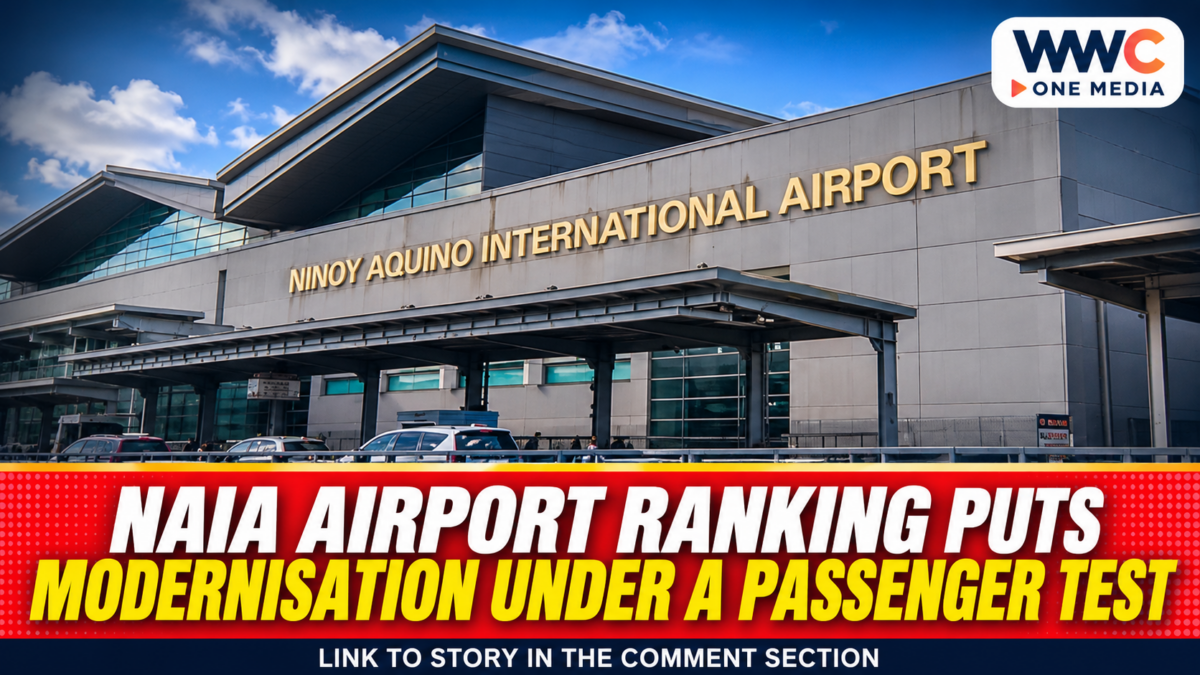
MANILA, Philippines — Ninoy Aquino International Airport (NAIA) has been placed 47th among 47 major airports in TIME’s inaugural World’s Best Airports ranking for 2027, a result the airport’s operator says it will use as a benchmark for further improvements.
The ranking, developed with Statista, evaluates passenger experience alongside flight-operational performance. For NAIA, the result arrives as the airport continues a major rehabilitation and expansion programme under New NAIA Infra Corp. (NNIC), making the ranking less a finish line than a public measure of how much work remains.
The distinction is important: NAIA appears in the major-airport category, but it occupies the final position in that group. The useful question for travellers and the aviation industry is what the ranking measures, what it does not measure, and whether ongoing investments can produce visible improvements.
What the NAIA airport ranking actually measures
TIME and Statista’s methodology combines two broad sets of information: passenger feedback and flight-performance data.
The passenger survey asked people to assess airports they had used during the preceding three years. It covered areas such as wayfinding, security, baggage handling, cleanliness, connectivity, facilities, lounges and the overall travel experience. The survey was conducted from July 27 to September 4, 2026, using an online access panel.
The second component came from flight data supplied by aviation data provider OAG. It covered more than 30 million flights between July 2025 and June 2026, including punctuality, cancellations, destinations and passenger volumes.
The methodology also divides airports by annual passenger traffic. A major airport is defined as one handling at least 50 million passengers a year. NNIC reported that NAIA served a record 52.02 million passengers in 2025, placing it above that threshold.
This is not simply a popularity contest. Passenger experience is combined with operational reliability, while passenger volume is factored into the final score on a compressed scale. A busy airport cannot rely on size alone to compensate for weaker performance.
One qualification deserves attention: the countries listed in the published survey methodology do not include the Philippines. The result should therefore not be described as a direct survey of Filipino passengers or as a measurement of the views of NAIA users alone. It combines the published survey and flight-data components of the ranking.
A busy airport operating beyond its original design capacity
NAIA’s passenger volume helps explain the pressure on its facilities. NNIC reported 52.02 million passengers in 2025, its highest annual total at the time of the announcement. That volume is substantially higher than the airport’s original design capacity of about 35 million passengers annually.
The gap between designed capacity and actual traffic is not just a statistic. It affects how terminals, check-in counters, security areas, baggage systems, boarding gates, road access and aircraft movements must function during peak periods.
The government’s public-private partnership project was designed to address these constraints. NNIC’s stated target is to increase annual passenger capacity to 62 million and raise aircraft movements from around 40–42 per hour to 48 per hour.
The concession agreement was signed on March 18, 2024, and NNIC assumed airport operations and maintenance responsibilities on September 14, 2024. The concession runs for an initial 15-year period, with a possible 10-year extension, subject to the agreement’s terms.
The airport remains government-owned. The private concessionaire is responsible for operating, maintaining, rehabilitating and expanding the facility during the concession period.
Modernisation is visible, but performance is the real test
NAIA’s operator has reported upgrades involving passenger-processing systems, terminal facilities, biometric technology and other airport infrastructure. In November 2025, NNIC announced that NAIA had received its first Airport Customer Experience Accreditation from Airports Council International.
The same announcement reported a passenger satisfaction score of 4.06 out of 5 in the latest ACI Airport Service Quality survey, above the 4.0 performance requirement under the concession agreement.
That accreditation and the TIME ranking are different assessments. ACI’s Airport Customer Experience Accreditation recognises an airport’s approach to managing and improving passenger experience. TIME’s ranking combines survey feedback with flight-operational data. They should not be treated as interchangeable awards or as evidence that every part of the airport is already performing well.
The difference matters because a passenger may encounter a cleaner terminal but still experience a delayed flight, a long queue or a slow baggage process. Infrastructure improvements need to translate into reliable end-to-end journeys.
WWC previously examined the operational preparations and terminal upgrades planned for NAIA’s Undas travel rush. High passenger volumes provide a practical test of whether new systems can keep queues, passenger flows and airport services manageable.
Airport capacity is also a national transport issue
NAIA does not operate in isolation. Manila’s aviation capacity affects airline schedules, tourism, business travel, cargo connections and the ability of passengers from across the country to reach international destinations.
Limited runway and airport capacity can create difficult choices about flight slots, aircraft types and route access. WWC has previously explored the debate over airline slot demand at NAIA and calls to restore selected regional turboprop services. The broader issue is how to allocate scarce airport capacity while balancing international connectivity and domestic access.
The development of other gateways is part of that conversation. Clark’s expanding cargo role and the proposed Sangley airport project illustrate how the country may distribute future passenger and logistics demand across more than one gateway. WWC has also reported on GMR’s interest in the proposed Sangley airport development and other Philippine aviation opportunities.
However, new airports and expanded regional facilities take time to develop. NAIA will remain a central gateway while those projects progress, making its performance especially important in the near term.
What happens next
NNIC has said it wants NAIA to place higher in the next edition of the ranking. That ambition will need to be supported by measurable results rather than announcements alone.
The indicators worth watching include passenger satisfaction, flight punctuality, cancellations, baggage handling, queue times, terminal conditions and the airport’s ability to manage peak passenger volumes. The public should also be able to distinguish between completed upgrades and projects that are still under construction or planned.
For travellers, a higher position would matter most if it reflects a more predictable and comfortable journey. For airlines and businesses, operational reliability and adequate capacity are central to planning routes, schedules and investments.
NAIA’s 47th-place result is a benchmark, not a verdict on every passenger experience or a guarantee of future performance. The airport’s next challenge is to turn its modernization programme into improvements that travellers can consistently see.
Frequently asked questions
What rank did NAIA receive in TIME’s World’s Best Airports list?
NAIA’s official account said it placed 47th among the 47 airports in the major-airport category of TIME’s inaugural ranking for 2027.
How does TIME determine the world’s best airports?
The ranking combines passenger-experience survey results with flight-operational data, including punctuality and cancellations. Passenger volume is also factored into the scoring model.
Why is NAIA classified as a major airport?
TIME and Statista define major airports as those handling at least 50 million passengers annually. NNIC reported that NAIA handled 52.02 million passengers in 2025.
Who operates NAIA?
New NAIA Infra Corp. operates, maintains and modernises NAIA under a public-private partnership concession. The airport remains government-owned.
Will NAIA’s ranking automatically improve as upgrades continue?
No. A higher ranking would depend on how passenger experience and operational performance measure up in the next assessment. Construction and equipment upgrades alone do not guarantee a better result.