
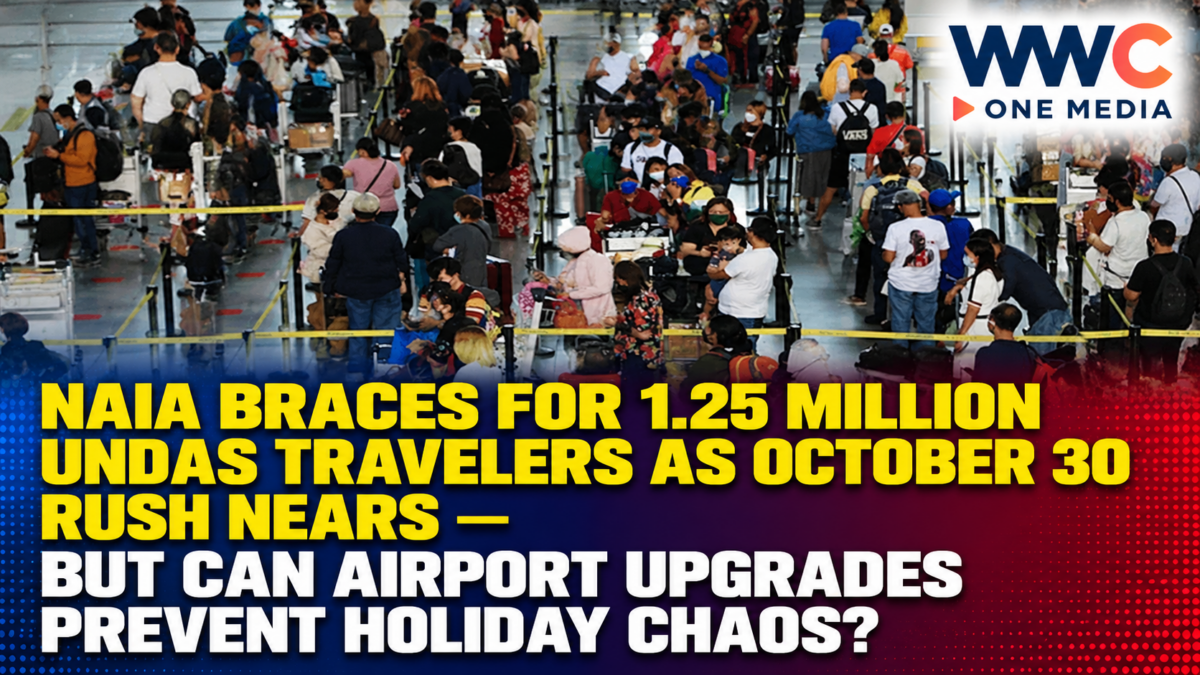
MANILA, PHILIPPINES — The Ninoy Aquino International Airport (NAIA) is preparing for one of its busiest holiday travel periods of the year, with approximately 1.25 million passengers expected to pass through its terminals during the nine-day Undas rush.
Airport operator New NAIA Infra Corp. (NNIC), led by San Miguel Corporation, expects passenger traffic to reach its highest level on Friday, October 30, when around 149,000 travelers are projected to use the country’s main international gateway.
The forecast covers October 27 to November 4, as Filipinos travel across the country and abroad for All Saints’ Day and All Souls’ Day on November 1 and 2.
To handle the expected crowds, NNIC is deploying additional security personnel, traffic marshals, baggage support teams and passenger assistance staff while coordinating with airlines and government agencies.
The travel surge will also put NAIA’s ongoing modernization efforts to the test, including newly installed automated immigration gates, upgraded terminal facilities and expanded passenger services.
But even with additional preparations, travelers could still face congestion, long queues and potential flight disruptions.
The biggest question is whether the airport’s improvements can deliver a smoother holiday experience when passenger demand reaches its peak.
NAIA EXPECTS 1.25 MILLION PASSENGERS DURING UNDAS 2026
According to NNIC’s announcement, approximately 1.25 million passengers are expected at NAIA between October 27 and November 4.
The projected traffic represents an increase of about 1% from the 1.24 million passengers recorded during the same period in 2025.
Although the growth rate appears modest, the total volume represents a significant operational challenge.
Airport facilities must accommodate departing and arriving travelers, baggage handling, aircraft movements, passenger screening and ground transportation within limited spaces.
Crowding can become particularly difficult when many flights depart or arrive within similar time windows.
NNIC is therefore coordinating closely with airlines, ground handlers, transport providers and government agencies to manage passenger flows and respond to possible disruptions.
However, the 1.25-million figure remains a forecast.
The actual passenger total will only be established after the travel period concludes.
OCTOBER 30 COULD BE NAIA’S BUSIEST DAY
Airport authorities expect October 30 to be the peak of the Undas travel rush.
Approximately 149,000 passengers are projected to move through NAIA on that day alone.
The timing is significant because many travelers are expected to leave Metro Manila before the November 1 and 2 observances.
Some passengers will return to their provinces to visit cemeteries and reunite with relatives.
Others will use the holiday period for domestic vacations or international travel.
The concentration of passengers on a single day could put pressure on check-in areas, airport entrances, boarding gates and baggage facilities.
While NNIC has planned additional support, passengers should not assume that all queues will disappear.
Travelers are encouraged to prepare their documents, check flight information and allow enough time for the journey to the airport.
TERMINAL 2 COMMAND CENTER TO OPERATE AROUND THE CLOCK
One of the airport operator’s central preparations is its 24-hour command center at NAIA Terminal 2.
The facility is intended to coordinate responses to operational problems throughout the holiday period.
Airport teams will monitor flight movements, passenger congestion, baggage handling and other activities.
Government agencies and airline representatives can coordinate responses when unexpected disruptions occur.
For example, the command center may help organize assistance during aircraft delays, equipment problems or unusually heavy passenger traffic.
Its purpose is to improve communication and shorten the time required to resolve problems.
However, a command center cannot eliminate every cause of flight disruption.
Airline scheduling, weather conditions, air traffic management and technical issues may still affect operations.
The effectiveness of the system will depend on timely information and coordination among the organizations involved.
SECURITY TIGHTENED ACROSS NAIA TERMINALS
NNIC has also announced heightened security measures throughout the airport.
Police patrols will be increased around terminal entrances, passenger loading areas, parking facilities and other public locations.
K-9 units will support security operations.
Access controls and security screening will also be strengthened during peak travel periods.
The measures are being implemented in coordination with agencies including the Philippine National Police–Aviation Security Group and the Office for Transportation Security.
Additional screening personnel may be deployed to respond to heavier passenger volumes.
The objective is to maintain security while preventing unnecessary congestion.
However, stricter checks can require additional time.
Passengers should therefore avoid arriving at the airport shortly before boarding and should follow official instructions regarding baggage and prohibited items.
IMMIGRATION, CUSTOMS AND QUARANTINE COUNTERS TO BE EXPANDED
International travelers can also expect adjustments to passenger processing arrangements.
NNIC said immigration, customs and quarantine counters will be staffed according to passenger demand.
Additional counters may be opened during busy periods to reduce congestion.
The Bureau of Immigration, Bureau of Customs and Bureau of Quarantine are among the agencies coordinating with the airport operator.
Their responsibilities differ.
Immigration officers manage entry and departure clearance under applicable rules.
Customs personnel administer baggage and goods-related border requirements.
Quarantine authorities handle relevant health and border-control procedures.
Expanding staffing can help process passengers more efficiently.
However, the actual time required for clearance depends on the passenger’s travel documents, eligibility, flight arrival patterns and any necessary additional screening.
78 AUTOMATED IMMIGRATION GATES FACE A MAJOR HOLIDAY TEST
One of NAIA’s most visible upgrades involves automated immigration gates.
NNIC has installed 78 biometric e-gates across Terminals 1 and 3.
The systems are designed to allow eligible travelers to complete automated immigration processing in approximately 20 seconds under suitable conditions.
The technology can potentially reduce the time required for routine immigration clearance.
However, the 20-second figure refers to the automated processing stage.
It does not include time spent waiting in line, walking through the terminal or undergoing additional checks.
Not every passenger is eligible to use the system.
The Bureau of Immigration determines which travelers qualify and retains authority over immigration screening requirements.
The e-gates are therefore an important improvement, but not a guarantee that every international passenger will complete airport procedures within seconds.
AIRPORT MODERNIZATION GOES BEYOND SECURITY AND IMMIGRATION
NAIA has undergone a series of upgrades under NNIC’s management.
These include improved passenger waiting areas, updated flight information displays and additional food and retail establishments.
The operator has also introduced new airport amenities designed to improve convenience.
In December 2025, NNIC announced the phased rollout of biometric immigration gates and new food halls at Terminal 3.
The improvements are intended to make terminal operations more efficient while providing a better experience for travelers.
However, renovations and new amenities do not automatically resolve every capacity constraint.
Flight schedules, aircraft parking availability, terminal layouts and access roads continue to influence the overall travel experience.
Undas 2026 will provide another opportunity to assess how the improvements perform under heavy demand.
ADDITIONAL TRAFFIC MARSHALS TO HELP EASE ROAD CONGESTION
Congestion outside the airport is another major concern.
Heavy passenger traffic often means more private vehicles, taxis, ride-hailing cars and other transport services approaching terminal entrances.
These movements can create delays along airport access roads and passenger drop-off areas.
NNIC plans to deploy additional traffic marshals and coordinate with relevant road authorities.
Taxi and shuttle operations will also be adjusted according to passenger demand.
Inter-terminal shuttle services are expected to respond to changes in passenger volumes.
However, the effectiveness of these measures will depend on traffic conditions beyond airport property.
Major road congestion around Metro Manila can still affect how quickly travelers reach their terminals.
Passengers should account for traffic when deciding when to leave home.
MORE BAGGAGE CARTS, PORTERS AND PASSENGER ASSISTANCE
NNIC is increasing passenger support services during the holiday period.
Additional baggage carts and porters will be made available to help travelers manage luggage.
Public Assistance Desks will operate 24 hours a day at arrival and departure areas of Terminals 1, 2 and 3.
These desks can help passengers seeking directions, travel information, medical assistance and other support.
The services may be especially useful for senior citizens, passengers with disabilities and travelers unfamiliar with NAIA’s terminal arrangements.
However, specialized assistance should still be coordinated with airlines when required.
Passengers needing wheelchair services or other accommodations are encouraged to contact their airlines before departure.
AIRLINES AND GROUND HANDLERS PREPARE FOR HEAVIER FLIGHT DEMAND
The airport operator is also working with airlines and ground-handling companies to manage aircraft and baggage operations.
Aircraft parking arrangements will be coordinated to accommodate additional or unscheduled flights when possible.
Airport teams will monitor activity around check-in counters, boarding gates and baggage facilities.
The objective is to identify congestion early and respond before it creates larger disruptions.
However, flight delays can result from factors outside the operator’s control.
Weather, air traffic restrictions, aircraft maintenance and airline scheduling problems may still affect travel.
Passengers should verify their flight status directly with their airline rather than relying exclusively on general airport announcements.
PHILIPPINE AIRPORTS FACE A BROADER UNDAS PASSENGER SURGE
The expected NAIA traffic forms part of a wider increase in travel across Philippine airports.
The Philippine Star reported on October 23 that the Civil Aviation Authority of the Philippines expected passenger traffic across airports under its monitoring to reach approximately four million during the Undas travel period, compared with 3.7 million in 2025.
That separate forecast reflects a broader airport system and should not be confused with NAIA’s 1.25-million estimate.
The Bureau of Immigration has also prepared additional personnel for busy travel days.
Rapid-response teams are expected to support immigration operations if heavier traffic causes bottlenecks.
The preparations demonstrate that Undas travel pressure extends beyond a single airport.
Domestic terminals, provincial airports and ground transportation hubs must also handle increased demand.
BUS TERMINALS ALSO UNDERGO SAFETY INSPECTIONS
The holiday rush is affecting land transportation as well.
GMA News reported on October 27 that authorities had begun conducting drug and alcohol testing among provincial bus drivers and roadworthiness inspections at Metro Manila bus terminals.
These activities are intended to reduce transport risks as large numbers of passengers travel to the provinces.
The Land Transportation Office reported that 51 of 52 inspected buses passed a particular set of checks, with one vehicle requiring corrective action.
The results relate to that inspection group, not every bus operating nationwide.
For travelers, the wider transportation preparations highlight the importance of planning the entire journey.
Arriving safely at a destination depends not only on airport operations but also on road travel, local transportation and compliance with safety requirements.
UNDas 2026 TRAVEL REMINDERS: WHAT PASSENGERS SHOULD DO
NNIC has issued several recommendations for travelers.
For international flights, passengers are advised to arrive at least three hours before their scheduled departure.
For domestic flights, the recommended arrival time is at least two hours before departure.
These are general recommendations, and passengers should follow longer lead times when required by their airlines or travel circumstances.
Travelers should also verify their flight status before leaving home.
Terminal assignments should be checked using official airline or airport information because passengers going to the wrong terminal may experience unnecessary delays.
Online check-in can reduce time spent at airline counters when the service is available.
Passengers should also prepare valid identification, boarding documents and any destination-specific travel requirements.
Baggage allowances and restrictions should be confirmed directly with the airline.
ETRAVEL REGISTRATION IS FREE — BEWARE OF FAKE WEBSITES
Eligible international travelers are reminded to complete their required eTravel registration within 72 hours before arrival in or departure from the Philippines.
The official platform is:
Registration is free.
Travelers can also use the official eGovPH application where supported.
The government warns against fraudulent websites that charge registration fees or attempt to collect personal information.
Not every traveler is subject to identical eTravel requirements, so passengers should check the rules applicable to their nationality and travel status.
The official website provides updated guidance.
Travelers should avoid entering passport or personal information into unfamiliar third-party websites.
UNDAS REMAINS ONE OF THE PHILIPPINES’ MOST IMPORTANT TRAVEL PERIODS
All Saints’ Day and All Souls’ Day are significant observances for many Filipino families.
During Undas, people traditionally visit cemeteries and memorial parks, reunite with relatives and honor deceased loved ones.
The occasion often triggers heavy travel between Metro Manila and provincial destinations.
Airlines, buses, ferries and other transportation providers must accommodate passengers traveling within a relatively short period.
For many families, travel expenses and scheduling difficulties can add to the challenge.
The expected NAIA passenger volume demonstrates the continuing importance of aviation in connecting Filipino communities.
But it also highlights the need for reliable transport infrastructure and coordination during peak periods.
THE BIGGER QUESTION: CAN NAIA DELIVER A SMOOTHER HOLIDAY RUSH?
The projected 1.25 million passengers will provide another major test of NAIA’s operations under San Miguel-led management.
The airport has introduced new facilities, automated immigration gates and additional passenger services.
NNIC has also committed to expanded security, continuous operational monitoring and closer coordination with government agencies.
These measures could help reduce disruptions and improve passenger assistance.
But success cannot be measured only by the number of staff members deployed or facilities installed.
The most meaningful indicators will be actual waiting times, flight reliability, baggage handling performance, safety and passenger experience.
The 149,000 travelers expected on October 30 will be especially important.
For millions of Filipinos traveling to honor their departed loved ones, the priority is a safe journey and a reliable flight—not another stressful encounter with congestion and uncertainty.
And as NAIA prepares for the busiest day of the holiday period, one question remains:
Will the airport’s new technology, additional personnel and 24-hour command center finally deliver a smoother Undas travel experience — or will the October 30 passenger surge expose the remaining weaknesses in the Philippines’ busiest aviation gateway?










