
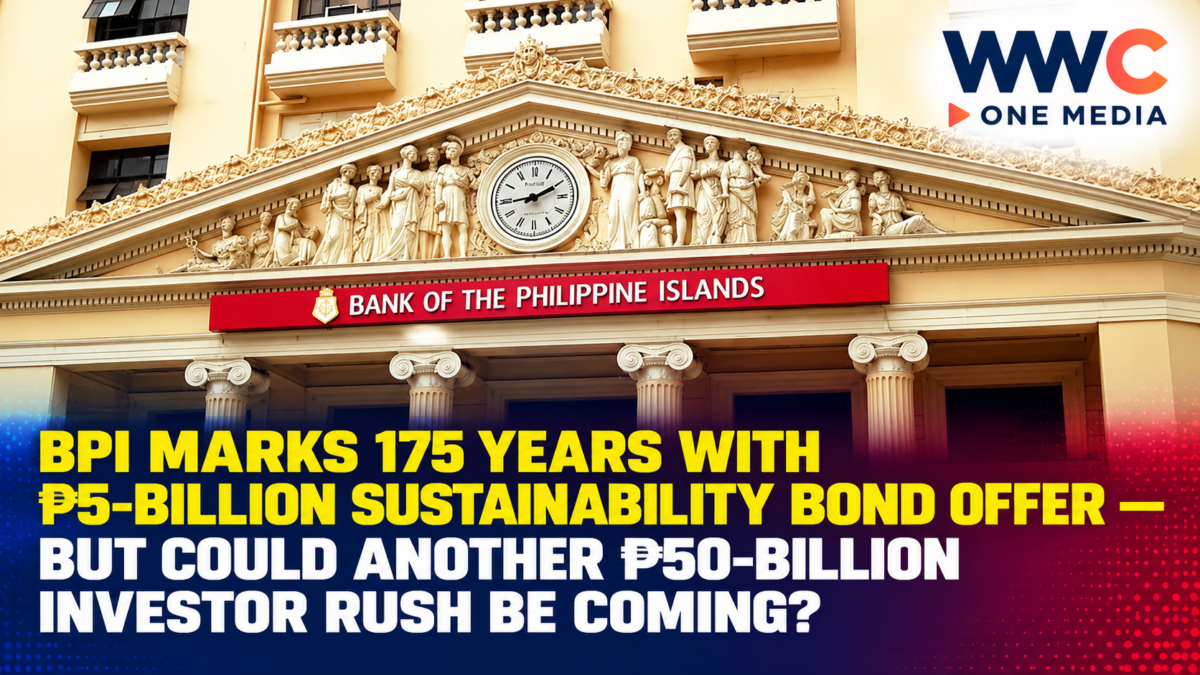
MANILA, PHILIPPINES — The Bank of the Philippine Islands (BPI) is celebrating 175 years of banking by preparing another multibillion-peso bond offering, bringing sustainable finance into focus after a previous debt sale attracted ten times its original fundraising target.
The Ayala-led lender announced plans to raise at least ₱5 billion through its new Sustainable Impact Building Our Legacy, or SIBOL, bonds.
The offering has a distinctive feature: the securities will mature after one year and nine months, equivalent to 1.75 years, symbolically reflecting BPI’s 175th anniversary.
But the significance goes beyond the milestone.
The bank intends to channel the proceeds into financing or refinancing eligible environmental and social projects, making the transaction part of its broader sustainability funding strategy.
The proposed issuance follows BPI’s record ₱50-billion SIGLA social bond sale in February 2026, when exceptionally strong demand prompted the lender to increase the offering from its initial ₱5-billion target.
That earlier success has raised expectations for the new bonds.
However, BPI has not announced the SIBOL bonds’ final interest rate, and there is no guarantee that the upcoming sale will attract the same level of demand.
BPI ANNOUNCES ₱5-BILLION SIBOL SUSTAINABILITY BONDS
According to InsiderPH’s October 26 report, BPI plans to issue at least ₱5 billion in peso-denominated, fixed-rate SIBOL bonds due in 2028.
The bank may increase the final issue size depending on investor subscriptions and its funding requirements.
This is known as an upsizing option.
The issuance will represent the third tranche under BPI’s ₱200-billion Bond and Commercial Paper Program.
That broader program provides a framework for multiple fundraising transactions.
It should not be confused with the size of the new offering.
The October announcement concerns an initial ₱5-billion issuance, not an immediate sale of ₱200 billion in securities.
The bank is returning to the local capital market as Philippine investors continue evaluating fixed-income products amid changing interest rates and economic conditions.
WHY THE BONDS HAVE A 1.75-YEAR MATURITY
The bond tenor is designed to commemorate BPI’s 175th anniversary.
Instead of choosing a conventional two-year maturity, the bank selected one year and nine months.
The 1.75-year period mirrors its 175 years of operations.
BPI, founded in 1851, is widely recognized as the oldest existing bank in the Philippines.
The anniversary therefore carries historical importance for the country’s banking sector.
However, the maturity also has financial implications.
The one-year-and-nine-month period determines how long the principal is intended to remain outstanding before repayment, subject to the final terms.
For investors, the tenor affects the length of their exposure to the issuer and the possibility of changes in the security’s market price.
It is important to distinguish between the symbolic maturity and the bond’s return.
A 1.75-year tenor does not mean the investment pays 1.75% interest.
The final coupon rate is a separate figure that has not yet been announced.
PROCEEDS WILL SUPPORT GREEN AND SOCIAL PROJECTS
BPI said the net proceeds will be used to finance or refinance eligible green and social projects under its Sustainable Funding Framework.
Green projects generally involve activities intended to produce environmental benefits.
Depending on the framework’s eligibility criteria, these may involve areas such as renewable energy, energy efficiency, clean transportation or other qualifying environmental initiatives.
Social projects generally seek benefits such as improved access to essential services, housing, financing or economic opportunities for underserved groups.
The specific eligible categories and conditions are defined by the bank’s framework and applicable bond standards.
Importantly, BPI has not yet publicly identified the individual projects or borrowers that will receive proceeds from this particular offering.
The bank’s stated use of proceeds establishes the intended funding purpose, not proof that the money has already been allocated.
The actual sustainability impact will depend on the projects eventually financed or refinanced and the results achieved.
SEC AUTHORIZES ASEAN SUSTAINABILITY BOND LABEL
On October 20, 2026, the Securities and Exchange Commission authorized BPI’s SIBOL bonds to carry the ASEAN Sustainability Bond label.
The label indicates that the securities are structured to align with the relevant regional sustainability bond standards.
The framework is intended to improve transparency and consistency in the use of funds raised for environmental and social projects.
For investors concerned about sustainability, the designation provides information about the intended purpose and applicable standards of the offering.
However, the label should not be interpreted as a government guarantee of investment returns.
It also does not mean that every project ultimately financed will deliver an identical or predetermined environmental benefit.
The effectiveness of the financing depends on project eligibility, allocation, reporting and implementation.
BPI’s own announcement further clarifies that the securities are exempt from registration under a specific provision of the Securities Regulation Code, even though the SEC has authorized their sustainability label.
Those are distinct regulatory matters.
OFFER PERIOD SET FOR NOVEMBER 23 TO DECEMBER 4
BPI plans to open the public offer on November 23, 2026.
The subscription period is scheduled to end on December 4.
The bank expects to issue and list the bonds on the Philippine Dealing & Exchange Corporation on December 16, 2026.
These dates remain subject to adjustment.
BPI and the joint lead arrangers may revise the offer timetable with appropriate notice.
Investors should confirm the final schedule before submitting an application.
The announcement does not yet establish that subscriptions have opened.
As of October 29, the transaction remains a planned future offering.
INTEREST RATE HAS NOT YET BEEN ANNOUNCED
Perhaps the most important missing detail is the final coupon rate.
BPI has confirmed that the SIBOL bonds will be fixed-rate securities.
However, it has not disclosed the annual interest rate that investors would receive.
That figure is essential when evaluating whether the bonds offer an attractive return.
The rate will influence expected coupon income and the comparison with other fixed-income products.
Investors should not assume that the new bonds will pay the same rate as BPI’s previous SIGLA issuance.
Nor should they treat the 1.75-year maturity as an interest-rate figure.
The final pricing will be determined under the transaction’s applicable terms and announced separately.
Until then, any exact coupon projection would be speculative.
FEBRUARY’S ₱50-BILLION SIGLA SALE SETS A HIGH BAR
The latest SIBOL offering follows BPI’s successful SIGLA social bond issuance earlier this year.
In February 2026, the bank raised ₱50 billion through its Supporting Individuals Grow, Lead, and Achieve bonds.
The initial offering size had been ₱5 billion.
Investor demand was strong enough for BPI to increase the final issuance tenfold.
The transaction became the bank’s largest peso-denominated bond issuance at the time.
The bonds carried a fixed annual coupon of 5.4050%, with quarterly interest payments.
They were issued and listed on the Philippine Dealing & Exchange Corporation on February 13, 2026.
The deal also represented the second tranche under the bank’s ₱200-billion program.
It showed that investors were willing to commit substantial funds to a sustainability-linked fundraising purpose.
However, the previous transaction’s popularity does not guarantee another tenfold upsizing.
Interest rates, investor liquidity and prevailing market conditions can change.
WHY SIGLA AND SIBOL ARE NOT THE SAME
The two issuances share BPI’s broader sustainable finance strategy but have different structures and purposes.
SIGLA bonds were classified as ASEAN Social Bonds.
Their proceeds were intended for eligible social projects.
SIBOL bonds are being marketed as ASEAN Sustainability Bonds, allowing the proceeds to support both eligible green and social projects.
The maturities are also different.
SIGLA had a two-year tenor, while SIBOL will have a 1.75-year tenor.
The earlier bonds were already priced and issued.
The newer SIBOL bonds are still awaiting final pricing and the scheduled offer period.
Investors should evaluate each issuance using its own offering circular, pricing supplement and risk disclosures.
BPI CONSIDERS MORE FREQUENT FUNDRAISING
The bank’s repeated offerings reflect a broader interest in using domestic capital markets as a source of funding.
Following the successful February sale, BPI President and Chief Executive Officer Jose Teodoro K. Limcaoco indicated that the lender could pursue more frequent bond issuances when market conditions were favorable.
Manila Bulletin reported that management had considered opportunities for more regular offerings, potentially even monthly transactions.
However, this was an expression of strategic interest, not a binding schedule for monthly bond sales.
The timing of future transactions depends on the bank’s funding requirements and market demand.
The SIBOL bonds demonstrate that BPI remains active in the peso debt market, but any further offerings would require their own announcements.
BPI REPORTS ₱48.9 BILLION IN NINE-MONTH PROFIT
The bond announcement also comes shortly after BPI released its financial results for the first nine months of 2026.
The bank reported net income of ₱48.9 billion.
That was approximately 3% lower than the ₱50.5 billion recorded during the corresponding period in 2025.
The decline occurred despite stronger revenue and lending activity.
Total revenue increased 9.8% to ₱156.3 billion.
Net interest income rose 11% to ₱121.1 billion.
Total loans grew 13.6% to approximately ₱2.7 trillion.
These figures suggest that the bank continued expanding its core business.
However, profitability was affected by higher operating expenses and provisions for credit losses.
For investors considering BPI’s bonds, both earnings and financial resilience are relevant factors.
RISING LOAN-LOSS PROVISIONS DESERVE ATTENTION
BPI reported ₱19.9 billion in provisions for credit losses during the first nine months of 2026.
That was 69.2% higher than a year earlier.
The bank’s nonperforming loan ratio stood at 2.50%.
Credit-loss provisions reflect expected losses on lending exposures and are part of prudent bank risk management.
An increase can indicate greater caution regarding the recoverability of loans.
However, it does not automatically mean that all the provisioned amounts have already become realized losses.
The bank also reported a capital adequacy ratio of 14.7%, above applicable regulatory requirements.
These figures provide important context.
BPI remains a large, profitable banking institution, but its bond investors still face issuer credit risk.
Financial results should therefore be assessed in their entirety rather than through the size of the bank or the popularity of its previous bond sales alone.
WHO WILL ARRANGE AND SELL THE BONDS?
BPI Capital Corporation and ING Bank N.V., Manila Branch will serve as joint lead arrangers and selling agents.
These institutions will help structure and distribute the offering.
Interested investors may inquire at BPI branches or through the designated selling agents.
However, the participation of established financial institutions does not guarantee that the bonds will retain their original market value.
Investors should obtain the final offering documents before subscribing.
Those documents should clarify the final interest rate, payment schedule, minimum subscription, redemption provisions and other terms.
As of the October 26 announcement, the bank had not publicly specified every detail necessary for an individual investment decision.
BPI SIBOL BONDS ARE NOT PDIC-INSURED DEPOSITS
One of the most important warnings appears in BPI’s official announcement.
The new securities are bonds, not bank deposit instruments.
They are not insured by the Philippine Deposit Insurance Corporation.
That distinction matters even though BPI itself is a regulated bank.
A savings account or eligible time deposit may benefit from statutory deposit insurance within applicable limits.
A bond represents a debt security issued by the bank.
Its repayment depends on the issuer meeting its contractual obligations.
Bondholders may also face market-price risk if they need to sell their securities before maturity.
The availability of secondary-market trading does not guarantee that an investor can sell at the original purchase price.
Investors should not confuse a sustainability bond label with principal protection or a guaranteed investment return.
WHAT FILIPINO INVESTORS SHOULD WATCH
Before considering the offering, potential buyers should monitor the final coupon rate.
They should also review the minimum investment, interest-payment frequency, tax treatment and any early redemption provisions.
The longer-term value of the investment will depend on several factors.
These include the after-tax income received, the bank’s credit quality and whether the investor can hold the bond until maturity.
Interest-rate changes can also affect secondary-market prices.
A fixed-rate bond may lose market value when prevailing yields rise.
Conversely, falling market yields may support the value of existing bonds, subject to credit and liquidity conditions.
Investors should assess whether the securities suit their financial circumstances rather than relying solely on the bank’s reputation.
INDEPENDENT REPORTING CONFIRMS THE OFFER DETAILS
The Philippine Star reported on October 27 that BPI was preparing the ₱5-billion offering, with an option to increase its size.
The publication also confirmed the 1.75-year maturity, planned November-to-December offer period and intended use of proceeds.
Context.ph separately reported the sustainability label and confirmed the transaction was the third tranche under the ₱200-billion program.
Daily Tribune likewise covered the proposed issuance on October 26.
BPI’s own announcement provides the primary confirmation of the transaction’s terms.
Meanwhile, the Philippine Dealing System and BusinessWorld independently reported the completed ₱50-billion SIGLA offering in February.
Together, these sources establish the difference between the earlier completed deal and the upcoming SIBOL sale.
THE BIGGER QUESTION: CAN BPI REPEAT ITS RECORD BOND SUCCESS?
BPI’s anniversary offering brings together corporate history, sustainable finance and investor demand for fixed-income securities.
The bank has chosen a symbolic 1.75-year tenor to commemorate its 175th year.
It is also continuing to use capital-market financing to support projects with stated environmental and social objectives.
The earlier ₱50-billion SIGLA issuance demonstrated that large investor demand is possible.
But the SIBOL transaction will take place under a different set of market conditions.
Its final rate has not yet been announced.
The amount ultimately raised will depend on subscriptions and the bank’s decisions.
And its sustainability impact will depend on how proceeds are allocated and reported.
For BPI, the offering could strengthen its sustainable financing program. For investors, the decision will ultimately come down to the final interest rate, issuer risk and the terms of the securities.
As the bank prepares to open subscriptions in November, one question remains:
Will BPI’s 175th-anniversary SIBOL bonds repeat the remarkable ₱50-billion demand seen earlier this year — or will changing interest rates and investor caution make its next multibillion-peso offering a tougher test?










