MANILA, Philippines — November 12, 2026 — A growing controversy over the possible return of turboprop flights to Ninoy Aquino International Airport (NAIA) has exposed a difficult question facing Philippine aviation authorities: Should limited runway slots be used to restore direct flights to popular island destinations such as Siargao, or should the country’s busiest international gateway prioritize larger aircraft carrying more passengers?
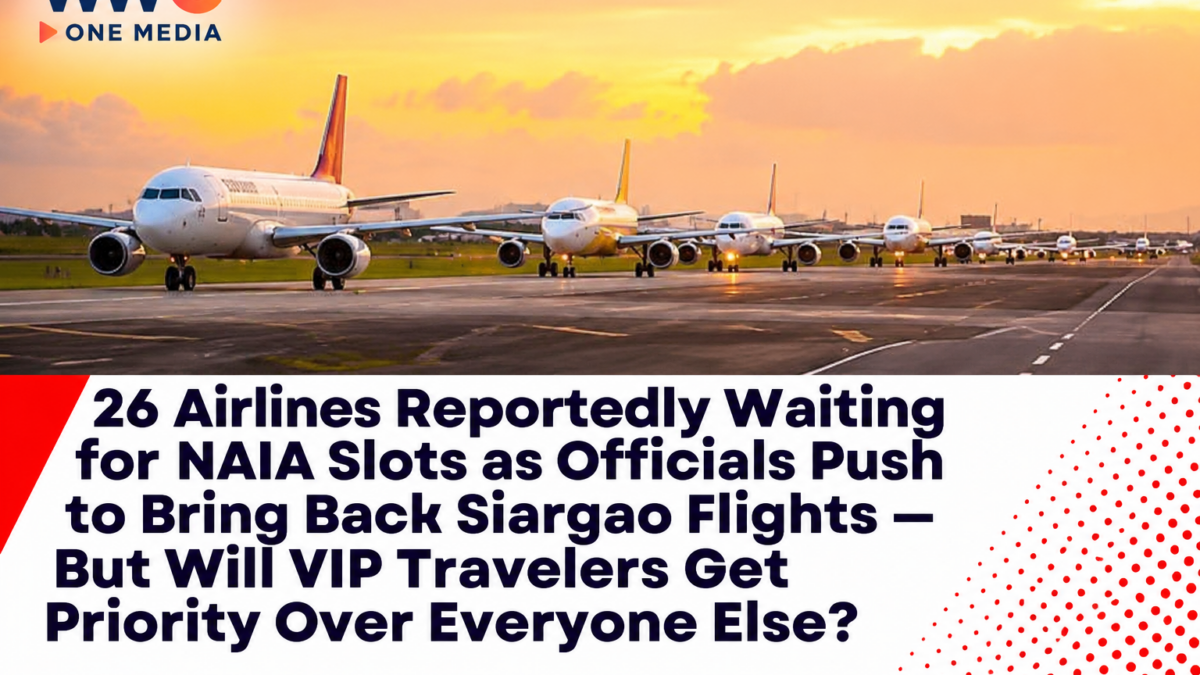
The debate intensified after an InsiderPH column published on November 12 reported that NAIA has a waiting list of 26 takeoff and landing slot applications from foreign airlines, even as government officials and tourism advocates push to bring smaller turboprop aircraft back to Manila.
The column, written by journalist Daxim L. Lucas, also raised an unverified allegation that pressure to restore certain flights may be partly driven by a small group of influential travelers seeking more convenient access to Siargao.
No individuals were publicly identified in the report, and the allegation has not been independently established.
Nevertheless, the controversy comes at a critical time for Philippine aviation.
Tourism officials argue that forcing passengers to travel to Clark International Airport or connect through other regional hubs has made domestic trips more expensive and inconvenient.
Airport operators, meanwhile, face the challenge of maximizing the use of limited runway capacity while accommodating growing demand from international carriers.
The central question is no longer simply whether Siargao deserves direct flights from Manila. It is whether restoring those services would require other passengers and airlines to surrender scarce airport slots—and who should decide which travelers receive priority.
26 Foreign-Airline Slot Applications Reportedly Await NAIA Approval
According to InsiderPH, information reaching the publication indicates that NAIA has a backlog of 26 applications for takeoff and landing slots from foreign airlines.
The report did not identify the airlines, specify their requested schedules or establish whether the applications involve new routes, additional frequencies or other schedule changes.
That distinction is significant.
A pending slot application does not necessarily represent a separate airline, and it does not guarantee that the proposed service will eventually operate.
Nevertheless, the reported backlog highlights the intense demand for capacity at Manila’s principal international airport.
Since San Miguel Corporation-led New NAIA Infra Corporation (NNIC) assumed operations in September 2024, the airport has undergone changes intended to improve passenger processing, terminal management and runway efficiency.
InsiderPH reported that NAIA’s operational ceiling is currently set at 40 aircraft movements per hour, counting takeoffs and landings.
That limitation means accommodating additional flights is not simply a matter of assigning more space at a terminal.
Aircraft must also receive runway slots that can be safely incorporated into existing schedules.
When those slots are already committed, adding new services may require reallocating capacity, improving scheduling efficiency or creating operational room through other measures.
This is why the renewed push to allow turboprop flights presents such a difficult policy choice.
Why Turboprop Flights Were Removed From NAIA
The controversy began with the government’s decision to progressively transfer commercial turboprop operations away from NAIA.
Turboprops are aircraft powered by propeller-driven turbine engines.
They are commonly used to serve smaller regional airports where runway length, infrastructure or passenger demand may make larger commercial jets less suitable.
In the Philippines, these aircraft have provided important connections to island destinations and provincial communities.
However, smaller aircraft generally carry fewer passengers than larger commercial jets.
At a heavily congested airport, a turboprop may use a runway movement that could otherwise accommodate an aircraft carrying substantially more people.
To address capacity constraints, the Manila Slot Coordination Committee approved the phased transfer of turboprop operations to other gateways.
The policy began affecting selected services in March 2025 and reached its final implementation stage on March 29, 2026.
As a result, airlines adjusted several domestic routes previously operated from Manila.
Philippine Airlines moved its turboprop services to Siargao and Busuanga, the gateway to Coron, to Clark.
Cebu Pacific’s regional subsidiary Cebgo and other affected operations also underwent schedule and airport changes.
The government intended the measure to free up scarce NAIA capacity for higher-capacity aircraft and improve the airport’s overall efficiency.
But the decision has generated complaints from passengers and tourism stakeholders who argue that the benefits of airport decongestion have come at the expense of regional accessibility.
Zubiri Warns That the Policy Is Hurting Domestic Tourism
Senate Majority Leader Juan Miguel “Migz” Zubiri has joined calls to reconsider the restrictions.
In a November 11 statement, Zubiri argued that moving turboprop flights away from Manila has made travel to domestic destinations more expensive and difficult.
The senator pointed to destinations such as Siargao, Coron and El Nido, whose tourism industries depend heavily on convenient air connections.
Travelers departing from Metro Manila may now need to reach Clark or use connecting flights through Cebu and other airports.
For passengers coming from southern Metro Manila, Cavite, Laguna and other areas south of the capital, traveling to Clark can involve substantial additional road transportation.
Zubiri argued that these extra expenses and logistical challenges discourage Filipinos from traveling within their own country.
His position reinforces concerns previously raised by Tourism Secretary Dita Angara-Mathay, who has called for a review of the turboprop restrictions.
The tourism argument is understandable.
A destination may become less attractive when getting there requires additional transportation, longer travel times or higher total costs.
However, those concerns must also be weighed against the consequences of reintroducing smaller aircraft at an airport already struggling with capacity.
Siargao Becomes the Center of the Debate
Siargao has become one of the most prominent destinations in the dispute.
Known internationally for surfing, beaches, island-hopping and a growing hospitality industry, Siargao has attracted both domestic and foreign travelers.
Its airport, Sayak Airport in Del Carmen, serves as the island’s principal aviation gateway.
Because of the airport’s operating characteristics, smaller turboprop aircraft have played an important role in connecting Siargao with other Philippine destinations.
After the NAIA policy changes, travelers from Metro Manila have increasingly relied on Clark departures or connections through Cebu and other regional airports.
These alternatives remain available, but the overall journey can be less convenient for some passengers.
The island’s growing popularity also makes air connectivity particularly important for local businesses.
Hotels, resorts, restaurants, tour operators and transportation providers can be affected when visitors face more complicated travel arrangements.
As previously covered by WWC ONE MEDIA in its report on Boracay, Palawan and Siargao’s international tourism recognition, Siargao ranked seventh among Asia’s top islands in Condé Nast Traveler’s 2025 Readers’ Choice Awards.
That international recognition strengthens the case for maintaining convenient connections to the island.
However, strong tourism appeal does not automatically establish that NAIA should provide direct services at the expense of other destinations.
The challenge is designing an aviation network that supports Siargao while maintaining fair access for other communities and travelers.
InsiderPH Raises Questions About Influential Travelers
The most controversial portion of the InsiderPH column concerns an allegation about the motivations behind the push to restore turboprop operations.
The publication reported receiving information suggesting that some pressure for the return of Manila-Siargao flights may be associated with a handful of influential travelers who prefer direct access from the capital.
The report did not identify the individuals or present public documentary evidence establishing their involvement.
It is therefore important not to treat the allegation as a confirmed finding of political interference.
The publicly documented campaign to reconsider the restriction includes tourism-related arguments advanced by government officials and lawmakers.
Those arguments can be examined independently of the unverified claims about private travelers.
The distinction matters because domestic aviation policy affects millions of passengers, commercial airlines, tourism businesses and provincial communities.
Any decision to restore specific routes should be based on transparent criteria rather than unsupported speculation about who might benefit.
If preferential treatment is alleged, evidence would be necessary to establish whether any improper influence occurred.
For now, the reported VIP angle remains an allegation attributed to InsiderPH.
Which Existing NAIA Flights Would Have to Give Way?
The central operational issue is how to allocate limited runway capacity.
InsiderPH reported that the airport operator has questioned which existing Philippine Airlines or Cebu Pacific flights should surrender slots if turboprops are restored.
The report also asked whether pending foreign-airline applications would have to remain unaccommodated.
There is no publicly confirmed plan identifying any particular scheduled flight that would be removed to make room for Siargao services.
Nevertheless, the policy trade-off is substantial.
A narrowbody passenger jet may carry considerably more travelers than a small turboprop aircraft.
If both require a runway slot, airport authorities must consider the value of each movement relative to competing demands.
But passenger numbers should not be the only factor.
Air connectivity also supports regional development, emergency access, government services, business travel and communities with limited alternatives.
A route with fewer passengers may still have significant economic or social importance.
For that reason, deciding which flights deserve scarce runway capacity requires balancing operational efficiency with public-service considerations.
An effective approach would require clearly defined rules covering passenger demand, route necessity, available alternatives, airline commitments and the economic importance of regional connectivity.
Without those standards, exceptions for one destination could trigger similar requests from others.
Why Other Provincial Destinations Could Demand Equal Treatment
Siargao is not the only destination affected by changes in turboprop operations.
Other provincial communities have historically depended on smaller aircraft operating through Manila.
These include destinations such as Naga, Basco and Masbate.
Some regional airports have limited capacity to accommodate larger jets, making turboprop operations particularly important.
If authorities restore direct Manila services for Siargao, other destinations may reasonably ask why they should not receive similar consideration.
Residents traveling for medical appointments, family obligations, business activities or government services can face the same difficulties as tourists.
That creates a broader policy dilemma.
Should direct access to Manila depend primarily on the popularity of a destination, the size of its passenger market or the needs of the communities it serves?
A consistent policy would need to address those competing priorities.
Otherwise, the government risks creating a system in which individual routes receive exemptions without a clear national aviation strategy.
Clark Airport Offers Capacity, But Ground Access Remains a Challenge
Clark International Airport has emerged as one of the main alternatives for turboprop services displaced from NAIA.
Located in Pampanga, the airport offers modern passenger facilities and serves a growing network of domestic and international destinations.
For travelers from northern Metro Manila, Central Luzon and nearby provinces, Clark can provide a practical alternative to NAIA.
However, passengers traveling from southern Metro Manila and surrounding regions may face longer road journeys.
Travel time between Metro Manila and Clark varies depending on the starting point, traffic and transportation mode.
Some journeys can take two to three hours or longer.
This additional ground transportation can increase the total cost of travel, particularly for families or groups.
The difficulty illustrates a fundamental problem with developing a multi-airport aviation network.
Redistributing flights between airports can improve runway utilization, but passengers also need efficient transportation links between major population centers and the airports serving them.
Without reliable and affordable ground connections, the benefits of airport decongestion may be offset by increased inconvenience.
As previously examined by WWC ONE MEDIA in its report on GMR Group’s proposed involvement in the ₱150-billion Sangley airport project, the Philippines is pursuing major infrastructure investments to create additional aviation capacity around Greater Manila.
Projects involving Clark, Sangley and other planned gateways could eventually reduce dependence on NAIA.
However, infrastructure expansion requires financing, construction and efficient transport integration.
It cannot immediately resolve every scheduling and connectivity problem facing domestic passengers.
Cebu Could Benefit From the Shift Away From Manila
The movement of turboprop flights out of NAIA has also strengthened the importance of alternative regional gateways.
Mactan-Cebu International Airport provides connections to several destinations across the Visayas and Mindanao, including Siargao.
For some travelers, connecting through Cebu may be more practical than traveling by road to Clark.
Cebu’s central geographic location also makes it a natural transfer point for passengers visiting destinations in the southern Philippines.
However, connecting itineraries can introduce their own challenges.
Travelers may face longer overall journey times, additional ticket costs or the risk of missing an onward flight.
Airlines and airport operators must therefore ensure that domestic connections are convenient and reliable.
As WWC ONE MEDIA reported in its analysis of Cebu’s tourism growth and expanding international connectivity, Cebu’s position as a regional gateway could become increasingly important as more passengers travel directly to destinations outside Metro Manila.
The challenge for national aviation planners is ensuring that regional hubs complement NAIA rather than creating unnecessary barriers for travelers.
NAIA’s Capacity Problem Goes Beyond Siargao
The controversy comes as NAIA continues undergoing modernization under its private-sector concessionaire.
NNIC assumed control of the airport in September 2024 with commitments to improve facilities, increase operational efficiency and expand passenger-handling capacity.
The airport continues to serve as the country’s busiest international aviation gateway.
Its role extends beyond tourism.
NAIA also supports overseas Filipino workers, international business travel, cargo operations and domestic passenger connections.
Demand for its limited capacity is therefore intense.
The reported 26 pending foreign-airline slot applications, if confirmed by the relevant authorities, illustrate the challenge of accommodating additional services.
Restoring turboprop flights may support some domestic travelers, but it could also affect the airport’s ability to handle other operations.
The government must consider the consequences for passengers across the aviation network rather than treating each route as an isolated issue.
Recent developments have also shown how quickly available flight capacity can become constrained by major events.
In a separate report, WWC ONE MEDIA covered plans to cancel or reschedule more than 300 flights during the November 2026 ASEAN Summit, highlighting the operational difficulties involved in coordinating aircraft movements, security and passenger schedules.
The summit-related adjustments are temporary and separate from the turboprop policy.
Nevertheless, they demonstrate why airport slot planning is an important national transportation issue.
Can Airport Authorities Find a Compromise?
The dispute does not necessarily require an all-or-nothing solution.
A policy review could examine whether limited turboprop operations might be accommodated without significantly undermining NAIA’s broader capacity strategy.
Possible approaches include reviewing off-peak slot availability, examining alternative schedules and assessing whether particular routes meet defined public-service criteria.
Authorities could also evaluate ways to improve ground transportation to Clark and make connections through regional airports more convenient.
However, these are potential policy options, not confirmed government decisions.
Any proposed change would require operational assessment and coordination with airlines, airport authorities and air traffic managers.
Safety and runway capacity must remain fundamental considerations.
A transparent review would also need to explain how affected airlines and destinations would be treated.
For example, if Siargao receives a limited exemption, what criteria would determine whether Coron, Basco, Naga or Masbate qualifies for similar treatment?
The government would need to demonstrate that its decision reflects consistent aviation policy rather than the preferences of particular groups.
What This Means for Philippine Tourism
The controversy exposes a larger challenge facing the Philippine tourism industry.
The country competes with other Southeast Asian destinations for both domestic and international travelers.
Travel costs and convenience play an important role in destination choices.
When tourists face additional airport transfers, lengthy ground journeys or inconvenient schedules, they may choose other destinations.
At the same time, international visitors also benefit from airports that operate efficiently and offer reliable connections.
That means Philippine aviation authorities must balance two legitimate objectives.
The first is improving access to provincial destinations.
The second is ensuring that the country’s main gateway can accommodate high passenger volumes and maintain competitive international connectivity.
Prioritizing one objective without considering the other risks creating new problems.
The most sustainable approach would likely involve stronger regional airports, improved airport-to-airport transportation and carefully managed flight capacity.
What Happens Next for NAIA’s Turboprop Restrictions?
As of November 12, 2026, the existing policy removing commercial turboprop flights from NAIA remains the relevant operating framework.
Public calls to reconsider the restrictions have not established that Manila-Siargao turboprop services will resume.
No confirmed list of existing flights to be displaced has been announced.
The reported 26 pending slot applications also require official confirmation before they can be treated as a verified count of airline demand.
For now, passengers planning to visit Siargao, Coron and other affected destinations should check their departure airport and itinerary directly with their airline.
Travelers should not assume that previous Manila departure arrangements have been restored.
The wider policy debate is likely to continue as tourism officials, lawmakers and airport operators assess the costs and benefits of the current restrictions.
The Bottom Line: Who Should Get Priority at NAIA?
The controversy over Siargao turboprop flights has become a test of how the Philippines allocates one of its most valuable transportation resources: access to NAIA’s limited runway capacity.
Tourism officials and lawmakers argue that relocating smaller aircraft has made domestic travel more inconvenient and expensive.
Airport operators must also account for international demand, larger passenger aircraft and the operational limits of the country’s busiest gateway.
InsiderPH’s report of 26 pending foreign-airline slot applications adds another dimension to that conflict.
Its allegation of pressure from influential travelers raises questions about fairness, but remains unverified and should not be treated as proof of improper conduct.
Ultimately, Philippine aviation policy must protect both airport efficiency and reasonable access to regional communities.
Restoring direct flights to Siargao may benefit travelers and tourism businesses, but the government must explain how scarce runway slots would be allocated—and whether other destinations would receive equivalent consideration.
With foreign airlines reportedly competing for NAIA slots and calls mounting to bring back smaller aircraft, the biggest question remains: Will airport authorities adopt transparent rules that benefit the traveling public, or will the fight over Siargao expose deeper problems in how Philippine aviation priorities are decided?