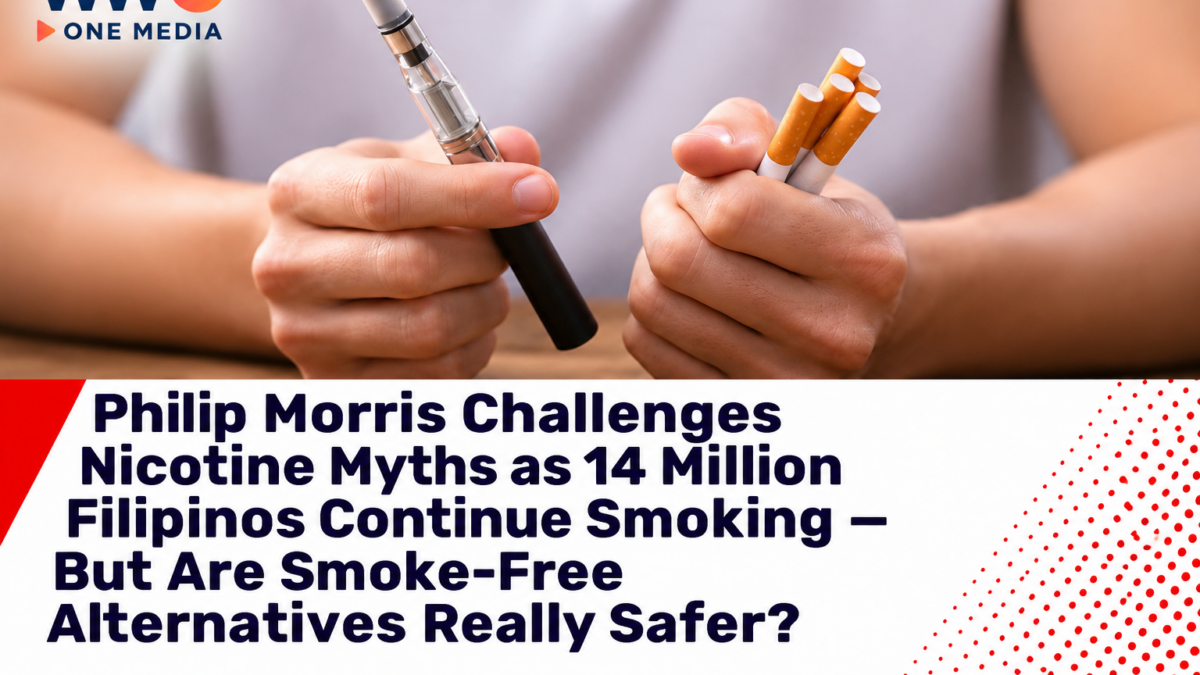
MANILA, Philippines — November 12, 2026 — Tobacco giant Philip Morris International (PMI) is challenging widespread misconceptions about nicotine as it accelerates a multibillion-dollar shift toward smoke-free products in the Philippines, where approximately 14 million people continue to smoke cigarettes.
At its first Technovation summit in Manila on November 10, PMI and its Philippine affiliate, PMFTC Inc., presented heated-tobacco devices and oral nicotine products as alternatives to conventional cigarettes, arguing that reducing exposure to toxic chemicals produced by burning tobacco could help address smoking-related harm.
The company has invested more than $16 billion globally in smoke-free research, development and commercialization since 2008, while smoke-free products accounted for more than 40% of its net revenues during the third quarter of 2026.
But the initiative is also reopening a contentious public-health debate.
Although nicotine is not considered the principal cause of smoking-related cancers and lung disease, it is highly addictive. Meanwhile, independent health authorities warn that reduced exposure to harmful chemicals does not necessarily mean a product has been proven to reduce long-term disease risk.
The question facing Philippine regulators is increasingly complicated: Can smoke-free products play a role in reducing smoking-related harm without encouraging nicotine dependence, youth uptake or misleading perceptions of safety?
PMI Challenges the Biggest Misconception About Nicotine
During the Technovation: Smoke-Free by PMFTC summit at the Manila Marriott Hotel in Pasay City, company executives emphasized the distinction between nicotine and the toxic substances generated when tobacco burns.
PMI argues that public discussion often treats nicotine as though it were the main cause of smoking-related diseases.
Scientific evidence supports an important distinction.
According to the U.S. Food and Drug Administration (FDA), nicotine is primarily responsible for tobacco dependence, while many of the severe health consequences associated with cigarette smoking arise from exposure to thousands of chemicals in tobacco smoke.
These include substances associated with cancer, cardiovascular disease and chronic lung conditions.
However, recognizing that distinction does not make nicotine harmless.
Nicotine can affect cardiovascular function, has important developmental risks for adolescents and unborn babies, and can sustain addiction.
PMI’s position is that adult smokers who do not quit may potentially reduce exposure to certain toxic substances by completely replacing combustible cigarettes with appropriately evaluated noncombustible products.
The critical word is potentially.
Evidence of reduced chemical exposure is not automatically evidence of a proportional reduction in disease risk.
Philip Morris Says the Philippines Is Central to Its Smoke-Free Strategy
PMFTC president Zhenya Ivanov described the Philippines as an important market in the company’s efforts to move its business away from conventional cigarettes.
The Manila conference was part of PMI’s international Technovation initiative, which brings together industry representatives, researchers and other participants to discuss nicotine science, product development and regulation.
The November 10 gathering marked the conference’s Philippine debut.
PMI president for East and Southeast Asia, Pacific and Global Travel Retail Vassilis Gkatzelis argued that access to alternatives, consumer information, regulation and enforcement should work together to support the transition away from combustible cigarettes.
His remarks reflected the company’s position that regulatory frameworks should distinguish between different categories of nicotine products.
That approach has significant commercial implications.
Rules governing taxation, product availability, advertising and consumer information can influence the growth of the emerging smoke-free market.
However, the company’s proposals should be understood as industry policy advocacy rather than independent proof that its preferred regulatory approach produces better public-health outcomes.
14 Million Filipino Smokers Highlight the Scale of the Challenge
PMI estimates that approximately 14 million Filipinos continue to smoke.
The company also estimates that around 200,000 adults in the Philippines use its smoke-free products.
These figures highlight the difference between the size of the existing cigarette market and the reported adoption of PMI’s alternatives.
At the same time, they represent company estimates rather than a newly published government prevalence survey.
Smoking remains a major public-health concern because combustible cigarettes expose users to toxic substances associated with preventable illness and premature death.
For adults who smoke, quitting entirely provides the clearest health benefit.
For those who have difficulty quitting, healthcare professionals can provide evidence-based cessation support, including behavioral counseling and approved medications.
The challenge for policymakers is determining whether additional commercial nicotine products help reduce cigarette consumption at the population level or create other risks.
That assessment requires monitoring complete switching, continued cigarette use, dual use, youth initiation and long-term health outcomes.
What’s the Difference Between Cigarettes, Heated Tobacco, Vapes and Nicotine Pouches?
The different product categories are often discussed together, but they do not work in the same way.
Conventional cigarettes burn tobacco and produce smoke containing thousands of chemicals, including numerous toxic and cancer-causing substances.
Heated-tobacco products heat processed tobacco to generate an inhalable aerosol. They generally produce lower levels of some harmful substances than cigarette smoke, but still expose users to nicotine and potentially harmful chemicals.
Electronic cigarettes or vapes use a heating element to aerosolize a liquid, often containing nicotine. Their emissions are not harmless water vapor.
Nicotine pouches deliver nicotine through the mouth without burning tobacco or requiring inhalation. They avoid combustion-related smoke exposure but still carry addiction risks, and their long-term health effects require further study.
PMI’s smoke-free portfolio includes heated-tobacco products such as IQOS and oral nicotine pouches such as ZYN.
However, the existence of different product designs does not mean that every product has been independently proven to reduce smoking-related disease.
PMI Claims Some Products Reduce Harmful Chemical Exposure by Up to 95%
In separate comments reported by The Philippine Star, PMI vice president for communications and engagement Tommaso di Giovanni said certain smoke-free products could produce 90% to 95% lower levels of selected harmful compounds than conventional cigarettes.
Those percentages reflect company-referenced comparisons and depend on the particular product and chemical measurements involved.
They should not be interpreted as proof that users face 90% to 95% less cancer risk, cardiovascular risk or overall health risk.
The distinction is crucial.
Lower emissions of selected chemicals may be scientifically measurable, but establishing a reduction in actual disease requires additional research, including long-term evidence.
The World Health Organization has warned that reduced exposure to harmful chemicals in heated-tobacco products does not automatically establish reduced health risk.
The U.S. FDA has authorized specific IQOS systems to carry carefully limited reduced-exposure information.
However, that authorization does not establish that IQOS is safe or that it has been proven to reduce the risk of smoking-related disease.
For consumers, the most important distinction is between reduced chemical exposure and demonstrated long-term health benefits.
These are not interchangeable claims.
Public Health Experts Say Quitting Remains the Best Option
The U.S. Centers for Disease Control and Prevention warns that heated-tobacco products still expose users to addictive nicotine and potentially harmful substances.
It also notes that research remains insufficient to establish whether completely switching to heated-tobacco products reduces long-term disease risks.
Another concern is dual use.
Some consumers may adopt alternative nicotine products while continuing to smoke conventional cigarettes.
If a person continues smoking, the expected reduction in exposure from completely replacing cigarettes may not occur.
This is particularly important because product switching and smoking cessation are not necessarily the same outcome.
Heated-tobacco devices have not been established by the CDC as effective smoking-cessation treatments.
For people seeking to quit, recognized cessation approaches, including counseling and medically approved treatments, remain important options.
The public-health objective should be to reduce smoking, prevent nicotine initiation and ultimately reduce tobacco-related disease.
Philippine Tobacco Industry Faces a Major Business Transformation
PMI is not alone in expanding beyond conventional cigarettes.
Japan Tobacco International has also been developing newer nicotine product categories as the tobacco industry responds to regulation, changing consumer preferences and long-term pressure on cigarette consumption.
As previously reported by WWC ONE MEDIA in its coverage of JTI’s leadership change and ₱2.1-billion Philippine manufacturing investment, major tobacco manufacturers are balancing conventional cigarette operations with investments in products such as heated tobacco and nicotine pouches.
The commercial stakes are substantial.
Smoke-free products represent an expanding revenue stream for manufacturers seeking to diversify their businesses.
PMI reported that these products accounted for more than 40% of its global net revenues in the third quarter of 2026.
The company also reported more than 43 million adult users of its smoke-free products worldwide.
These figures indicate the scale of PMI’s business transformation.
However, commercial growth is not, by itself, evidence that population-level smoking-related disease has fallen because of the products.
That would require independent public-health research.
Philippine Regulations Must Balance Innovation and Consumer Protection
The Philippines regulates vaporized nicotine and non-nicotine products, as well as novel tobacco products, under Republic Act No. 11900.
The law establishes requirements covering product standards, sale, distribution, marketing and consumer safeguards.
It also prohibits sales of covered products to persons below 18 years old.
PMI has called for regulatory frameworks that recognize differences among product categories.
But policymakers must also consider potential risks involving youth access, nicotine dependence, product promotion and inaccurate health claims.
These concerns become especially important when products are marketed as technologically advanced or positioned as alternatives to cigarettes.
Consumers should not be led to believe that a product is medically approved for smoking cessation merely because it does not burn tobacco.
Nor should lower measured chemical emissions be presented as conclusive proof of long-term safety.
Effective regulation requires both accurate scientific information and enforcement of existing consumer-protection rules.
Baguio’s Smoke-Free Campaign Shows Another Approach
While tobacco manufacturers are promoting alternatives to combustible cigarettes, local governments are also pursuing stronger tobacco-control measures.
Baguio City received a Gold Award at the 2026 ASEAN Smoke-Free Awards for its tobacco-control initiatives.
As WWC ONE MEDIA reported in its coverage of Baguio’s ASEAN recognition, the award recognized local efforts to enforce smoke-free policies and protect residents from tobacco smoke.
The city’s work demonstrates that reducing exposure to tobacco smoke remains a major public-health objective.
Baguio has also intensified inspections targeting unauthorized cigarette and vape sales.
According to WWC ONE MEDIA’s report on Baguio’s enforcement campaign, local authorities have strengthened monitoring of retail compliance and smoking restrictions.
These efforts highlight a different but complementary policy question.
Even as industry discussions focus on potentially lower-exposure products for adults who already smoke, governments must continue preventing youth access and enforcing protections against unwanted tobacco and nicotine exposure.
Illegal Tobacco Trading Adds Another Challenge
Regulation is also complicated by the illegal tobacco trade.
Unregulated products can evade taxes, licensing requirements and other consumer safeguards.
The Philippines has faced major enforcement challenges involving smuggled cigarettes and illicit tobacco distribution networks.
In a separate investigation, WWC ONE MEDIA examined how the Philippines and southern Malaysia became important routes for illicit tobacco trading.
The report documented industry warnings about cross-border networks moving untaxed and unregulated products through Southeast Asia.
The issue creates additional challenges for lawmakers seeking to enforce tobacco and nicotine regulations.
Measures against illicit trade can protect tax collection and strengthen regulatory oversight.
However, combating smuggling should not be confused with establishing the health benefits of commercial nicotine products.
The objectives are related to tobacco policy but require different forms of evidence.
Can Smoke-Free Products Actually Reduce Smoking-Related Disease?
This is the central question behind PMI’s latest campaign.
There is a well-established scientific basis for distinguishing the harms of burning tobacco from the addictive properties of nicotine.
There is also evidence that some noncombustible products generate lower levels of particular toxic compounds than conventional cigarettes.
But the strength of evidence varies by product and by the outcome being measured.
A product that reduces exposure to some harmful chemicals does not necessarily eliminate exposure to others.
Likewise, a reduction in chemical exposure does not prove that long-term cancer, cardiovascular or respiratory disease risks have fallen by a particular percentage.
The potential benefits also depend on how products are used.
Complete substitution for cigarettes presents a different exposure scenario from using a smoke-free product while continuing to smoke.
Public-health authorities therefore emphasize the need for independent research, careful regulation and protection against misleading claims.
The strongest established health recommendation remains to stop smoking and, where possible, discontinue nicotine use.
The Bigger Business Question for Philip Morris
PMI’s smoke-free strategy represents a major commercial transformation.
The company has invested billions of dollars in research, product development and new technologies while expanding its presence in alternative nicotine categories.
Its smoke-free business now represents a substantial share of global revenue.
For shareholders, the question is whether this business can sustain growth as governments tighten regulation and consumers reassess tobacco use.
For regulators, the issue is more complicated.
They must evaluate scientific evidence without allowing commercial objectives to replace public-health priorities.
For consumers, the essential question is whether companies are providing complete and accurate information about the risks associated with their products.
The market may continue expanding, but public-health success should ultimately be measured by reductions in smoking-related harm and disease—not simply by sales of alternative nicotine products.
The Bottom Line: Science, Addiction and a $16-Billion Business Transformation
Philip Morris International’s latest campaign in the Philippines highlights a genuine scientific distinction: Nicotine sustains addiction, while many of the most serious dangers of cigarette smoking arise from the toxic chemicals produced by tobacco combustion.
But recognizing that difference does not settle the debate over smoke-free products.
Heated tobacco and other nicotine alternatives are not harmless, and evidence of reduced chemical exposure should not be overstated as proof of reduced long-term disease risk.
The company’s investment of more than $16 billion reflects how aggressively it is reshaping its business around noncombustible products.
With approximately 14 million Filipinos still smoking, the potential public-health implications are significant.
Yet the Philippines must also protect young people, prevent new nicotine dependence, support smoking cessation and ensure that industry claims withstand independent scrutiny.
The question now is whether PMI’s smoke-free transformation can contribute to a measurable decline in smoking-related disease—or whether the growing nicotine alternatives market will create a new generation of public-health challenges.