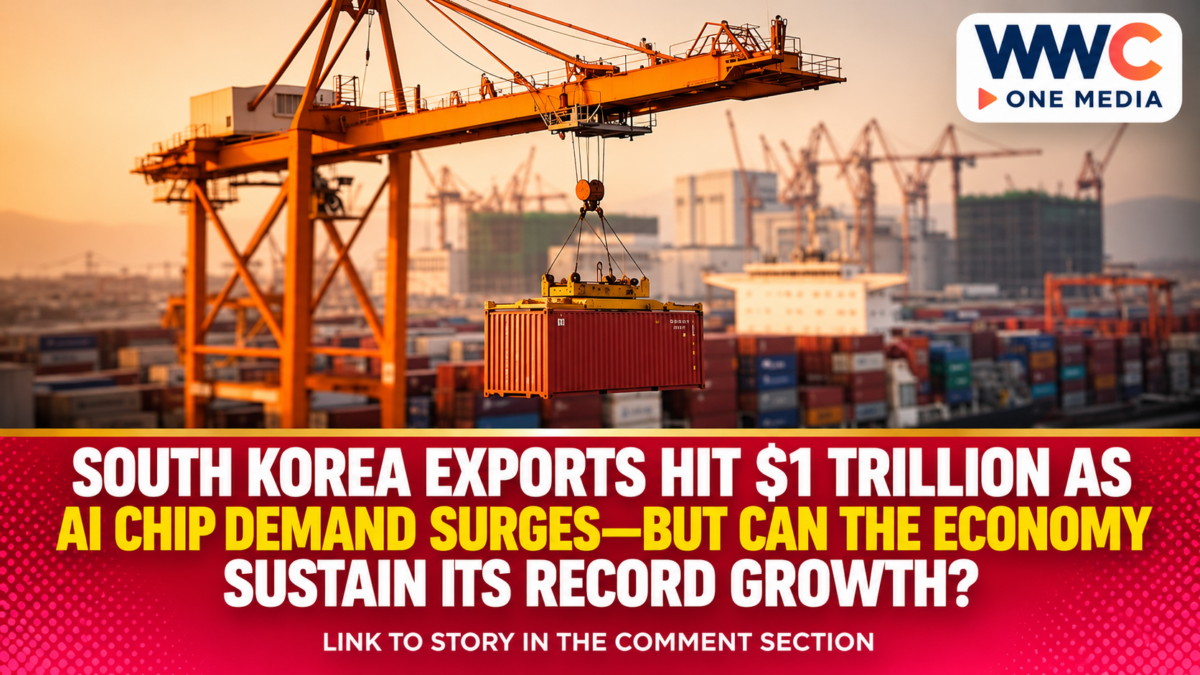
South Korea exports surpassed US$1 trillion for the first time on Nov. 19, 2026, marking a historic achievement for the Asian manufacturing economy. Preliminary customs statistics released on Nov. 23 showed that cumulative merchandise exports had subsequently reached US$1.007603 trillion through Nov. 20, representing a 63.2% increase from the corresponding period last year.
The milestone comes amid strong international demand for artificial intelligence infrastructure, particularly the memory components required by advanced computing systems.
However, the record also presents South Korea with an increasingly important economic challenge: converting an extraordinary technology investment cycle into industrial growth that can withstand changing market conditions.
South Korea exports extend gains beyond the $1 trillion milestone
The Korea Customs Service recorded US$77.4 billion in merchandise exports during the first 20 days of November, an increase of 101.5% from the same period in 2025.
Imports reached approximately US$50.3 billion, leaving a merchandise trade surplus of about US$27.1 billion.
The latest figures provide a more comprehensive picture of the country’s performance following its record-breaking announcement on Nov. 19.
Cumulative imports through Nov. 20 stood at US$685.503 billion, resulting in a year-to-date merchandise trade surplus of US$322.1 billion.
These figures measure the value of goods moving through international trade. They should not be interpreted as corporate profits, government revenue or the amount of income received directly by South Korean households.
Nevertheless, the increase illustrates the strength of international demand for the country’s manufactured products.
The government identified South Korea as the fourth country to achieve US$1 trillion in annual exports, following Germany, the United States and China.
Semiconductor demand creates both opportunity and exposure
Semiconductors generated US$38.5 billion in exports during the first 20 days of November, equivalent to nearly half of the country’s total merchandise exports for that period.
That concentration makes the technology industry’s performance particularly important to South Korea’s broader trade outlook.
A semiconductor manufacturer can benefit from rising sales volumes, stronger selling prices or a combination of both. However, these conditions do not necessarily remain favourable throughout an investment cycle.
If customers begin delaying infrastructure projects or manufacturers expand production faster than demand increases, pricing conditions could change even when the underlying technology remains commercially important.
The economic implications extend beyond individual chipmakers. Equipment providers, component manufacturers, construction businesses and industrial service companies may also experience changes in demand.
WWC’s previous examination of Asia’s AI investment boom and its profitability challenge explores this broader relationship between technology spending and sustainable business returns.
For South Korea, the immediate opportunity is substantial. The longer-term question is whether the country’s industrial ecosystem can retain its competitiveness when market conditions become less favourable.
Smaller exporters provide another measure of industrial strength
South Korea’s export performance is not exclusively a semiconductor story.
Government figures show that exports by small and medium-sized enterprises reached US$107.6 billion between January and October, increasing 9.9% from the corresponding period in 2025.
Mid-sized enterprises also recorded US$103.7 billion in exports during the first three quarters, an increase of 11.5%.
These businesses provide an additional perspective on the country’s economic transformation.
A manufacturing economy becomes more resilient when companies of different sizes can compete internationally, develop specialised products and establish relationships with overseas customers.
Growth among smaller enterprises could help distribute the benefits of international trade more widely. However, export figures alone cannot establish whether wages, employment opportunities or domestic business profitability have increased at comparable rates.
The distinction is especially important when evaluating investments in manufacturing infrastructure.
WWC’s earlier coverage of South Korea’s semiconductor megacluster development examines the importance of building industrial capabilities beyond factory construction.
Why geographic diversification matters
South Korea’s trade expansion has also extended across several major markets.
Between January and October, exports to China increased 88%, while shipments to the United States rose 77%. Exports to ASEAN increased 69%, and those to India grew 38%.
From a business perspective, expanding into different markets can reduce dependence on individual customers or destinations.
Geographic diversification, however, does not necessarily eliminate product concentration.
If customers across multiple countries are purchasing similar technology products for the same investment cycle, a widespread reduction in demand could affect exporters across several markets simultaneously.
This distinction matters when assessing economic resilience. A country can have an extensive international trading network while remaining exposed to changes in a particular industry.
For policymakers, developing new products and strengthening existing industries may therefore be just as important as expanding access to additional overseas markets.
What the export milestone could mean for the Philippines
South Korea’s experience offers a relevant industrial development discussion for the Philippines.
Rather than measuring economic success solely through export earnings or announced investment commitments, policymakers could also consider how manufacturing activity contributes to domestic technical capabilities.
Potential indicators include the development of engineering skills, local suppliers, research facilities and opportunities for businesses to participate in more sophisticated production processes.
Increasing exports is valuable, but building the capacity to create and commercialise higher-value products could provide additional economic benefits.
These questions are particularly relevant to Philippine industrial development initiatives, including the opportunities discussed in WWC’s coverage of Pax Silica and potential semiconductor investments in Clark.
South Korea’s milestone does not guarantee that other Asian economies will experience comparable growth. Each country faces different investment conditions, industrial capabilities and infrastructure requirements.
Nevertheless, it provides a useful example of why long-term manufacturing competitiveness deserves attention alongside immediate export performance.
What happens next
South Korea’s trade ministry has identified export-price volatility, protectionist policies and intensifying international competition as continuing challenges.
Its stated policy direction includes improving established industries through AI adoption while developing additional growth opportunities in areas such as biotechnology and robotics.
The next major test will be whether export growth remains resilient as businesses adjust their investment programmes and international market conditions evolve.
November’s complete trade statistics and subsequent annual results should provide further information about the durability and composition of the expansion.
South Korea has already achieved its historic export milestone. The challenge now is building an industrial economy capable of sustaining its success beyond the current technology investment cycle.
Frequently asked questions
When did South Korea exports reach $1 trillion?
South Korea surpassed US$1 trillion in cumulative merchandise exports on Nov. 19, 2026.
How much did South Korea export through Nov. 20?
Preliminary customs figures placed cumulative 2026 merchandise exports at US$1.007603 trillion.
How important are semiconductors to South Korea’s exports?
Semiconductors accounted for approximately 49.7% of merchandise exports during the first 20 days of November 2026.
What risks could affect South Korea’s future exports?
Potential risks include declining semiconductor prices, slower technology investment, international trade restrictions and stronger industrial competition.
Has South Korea’s final annual export total been confirmed?
No. The latest figures cover shipments through Nov. 20, 2026, and remain preliminary. The complete annual total will depend on subsequent trade activity.