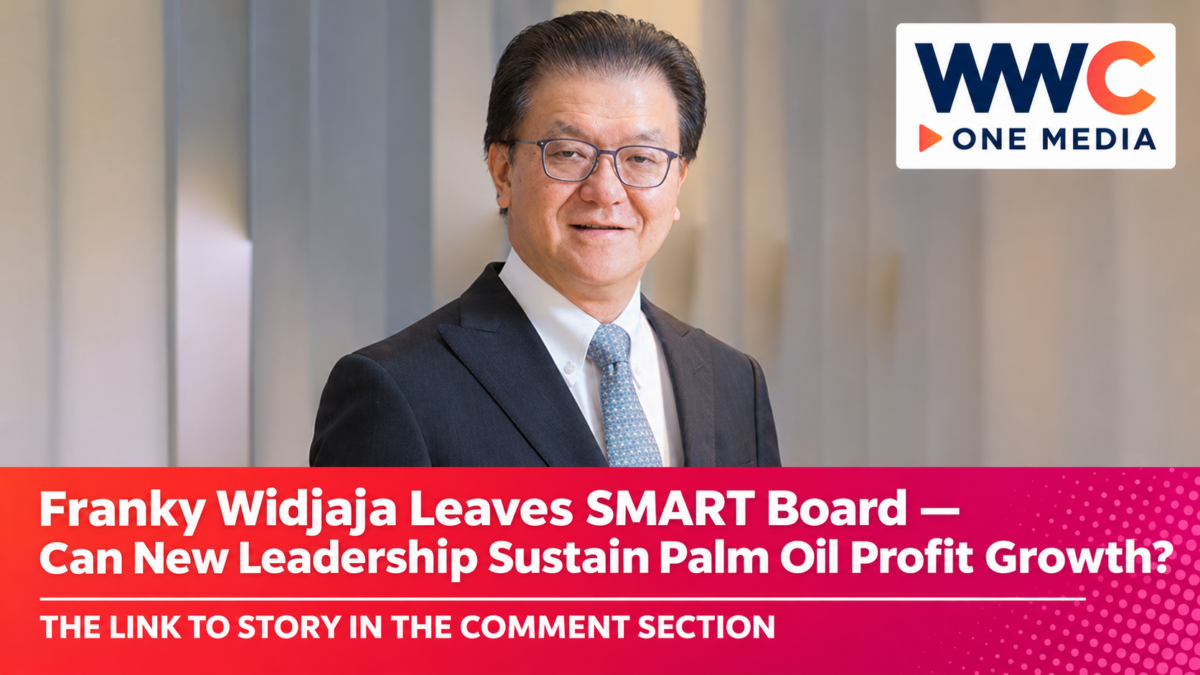
JAKARTA — Shareholders of Indonesian palm-oil producer PT Sinar Mas Agro Resources and Technology Tbk (SMART) approved Franky Oesman Widjaja’s resignation as president commissioner at an extraordinary general meeting on Nov. 17, 2026. The Franky Widjaja resignation was part of a wider supervisory-board reshuffle that appointed David Fernando Audy to replace him, while the company’s latest financial report showed sharply higher earnings.
The departure changes oversight at a publicly traded Indonesian subsidiary of Golden Agri-Resources, rather than establishing that Widjaja has left the wider palm-oil group. The official meeting minutes document the appointments but give no personal reason for the resignations or basis for assuming an ownership change.
Franky Widjaja Resignation: What Shareholders Approved
SMART’s official meeting summary records the resignation of three commissioners: Widjaja as president commissioner, Rafael Buhay Concepcion Jr. as vice-president commissioner, and Lukmono Sutarto as commissioner. All three resignations became effective upon closure of the Nov. 17 meeting.
Shareholders appointed David Fernando Audy as president commissioner and Dicky Bayu Atmadja as vice-president commissioner. Their appointments cover the remaining term through the close of the 2030 annual general meeting. Teddy Pawitra, Susiyati B. Hirawan, Ardhayadi and Ketut Sanjaya continue among the commissioners identified in the new board composition.
The meeting began at 10:26 a.m. Jakarta time and ended at 11 a.m. Shareholders or their representatives held 2,793,463,273 voting shares, representing 97.2589% of the company’s valid voting shares. The board-change resolution received unanimous support among votes represented at the meeting.
That vote confirms approval of the changes; it does not explain the individual decisions to step down.
Why a Commissioner Is Different From a Chief Executive
Under SMART’s governance structure, the board of commissioners supervises and advises management rather than carrying out the board of directors’ day-to-day operating responsibilities. A new president commissioner therefore changes the leadership of corporate oversight, not automatically the executive running plantations, mills, processing facilities and sales.
SMART’s corporate profile identifies the company as a Golden Agri-Resources subsidiary founded in 1962 and listed on the Indonesia Stock Exchange in 1992 under ticker SMAR. It describes an integrated palm-based business extending from agricultural production to downstream products.
Golden Agri-Resources’ official leadership page continued to identify Widjaja as its chairman and chief executive when reviewed on Nov. 18. He has served as a director and chief executive of that Singapore-listed group since 1996 and as chairman since 2000.
Analysis: Investors should separate his departure from the SMART commissioner role from any change at the parent company. A group-wide retirement, sale or replacement of the Golden Agri chief executive would require separate official evidence.
SMART’s Profit Grew Despite Lower Sales Volume
SMART’s October financial update supplies a business benchmark for the board transition. Net sales for the first nine months of 2026 reached Rp68.887 trillion, up 5% from Rp65.654 trillion a year earlier. The company said stronger average selling prices offset lower sales volume.
Net profit attributable to owners of the parent rose to Rp4.062 trillion from Rp1.598 trillion, an increase of 154%. EBITDA climbed 79% to Rp7.231 trillion, while operating income reached Rp5.413 trillion compared with Rp2.229 trillion a year earlier.
The company reported that refined products, including biodiesel and oleochemicals, accounted for 93% of sales, compared with 83% in the corresponding period of 2025. Crude palm oil and other unrefined products made up the remaining 7%.
The figures describe the nine months ended Sept. 30, before the board meeting. They do not establish that the appointments caused the improvement or predict the company’s fourth-quarter result.
Plantation Output and Costs Remain Business Tests
SMART’s plantation statistics showed approximately 133,600 hectares of planted estates at Sept. 30, including 113,400 mature hectares and 20,200 immature hectares. Fresh fruit bunch production fell 5% to 1,543,937 tonnes, while crude palm oil output increased 6% to 400,632 tonnes.
Higher oil extraction helped lift finished production even though harvested fruit volumes declined. The company attributed part of the lower fruit harvest to land preparation for replanting.
It also identified higher export taxes, levies and transport costs among factors that increased operating expenses. Those costs matter for profitability whether or not the supervisory-board leadership changes.
For the Philippines, supply-chain conditions in Indonesia are relevant because of the country’s reliance on imported palm oil. Yet a corporate board change alone does not establish a change in Philippine import prices or supply contracts.
Governance Questions Go Beyond the New Names
The extraordinary meeting also approved changes to SMART’s articles of association. One aligned the description of business activities with Indonesia’s 2025 industrial-classification rules without changing the scope or types of company activities. Another clarified annual-report signing obligations for directors and commissioners.
These are distinct resolutions from the appointments. None of the meeting decisions establishes a merger, a disposal of plantations or a change in the company’s principal shareholder.
The wider industry continues to face environmental oversight. WWC’s report on Singapore’s regional haze scrutiny describes inquiries into corporate links with Indonesian land concessions. Such information-gathering processes should not be presented as findings of wrongdoing against a specific company.
Regional trading conditions are another separate issue: Malaysia’s palm-oil export tax debate concerns policies affecting a competing supplier, not a disclosed consequence of SMART’s governance vote.
Analysis: The practical governance test is whether the new supervisory leadership maintains clear reporting, examines operational risks and communicates material decisions. The minutes support a change in personnel, not speculation about private motives or hidden conflicts.
What Happens Next
The company authorised its directors to formalise the resolutions through notarial and governmental procedures. Investors can watch subsequent company disclosures, the 2026 annual report and Golden Agri-Resources’ own leadership updates for any separately documented consequences.
For now, the verified facts are narrower than a family-business upheaval: three commissioners left SMART, two named successors took office, and Golden Agri’s website still lists Widjaja as chairman and chief executive.
Frequently Asked Questions
Did Franky Widjaja resign from SMART?
Yes. The Nov. 17 extraordinary shareholders’ meeting approved his resignation as SMART’s president commissioner, effective at the close of the meeting.
Who replaced Franky Widjaja?
David Fernando Audy became SMART’s president commissioner. Dicky Bayu Atmadja was appointed vice-president commissioner.
Did Widjaja leave Golden Agri-Resources?
The Golden Agri-Resources leadership page still listed him as chairman and chief executive on Nov. 18. The SMART filing does not announce his departure from those roles.
How did SMART perform in the first nine months of 2026?
The company reported Rp68.887 trillion in net sales and Rp4.062 trillion in net profit attributable to owners of the parent, up 5% and 154%, respectively.
Why did the commissioners resign?
The official meeting summary confirms their resignations but does not state their individual reasons. No motive is established by the records reviewed.