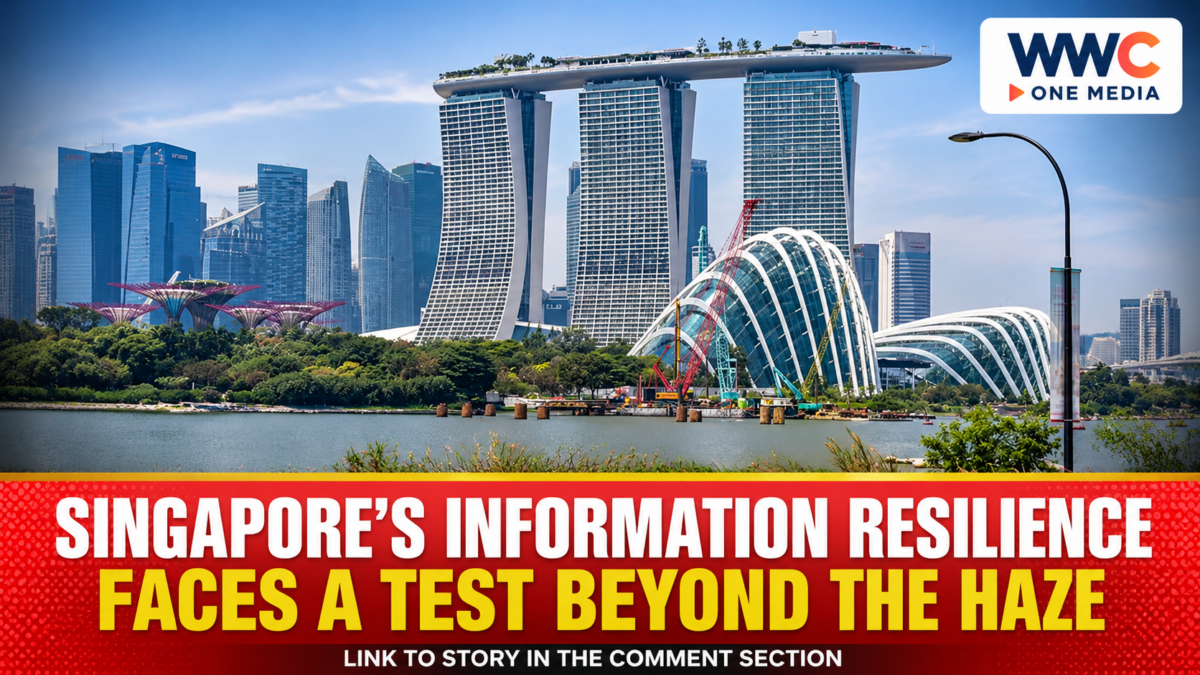
Singapore’s 2026 haze response has required more than environmental monitoring: government agencies have also stepped up public communication as the risk of transboundary smoke increased. The country’s official records show that this effort sits alongside a broader framework for countering foreign interference and helping residents assess information they encounter online.
The distinction matters. False or misleading claims can spread during a regional crisis, but the existence of suspicious posts does not by itself prove who created them, whether they were centrally coordinated or whether a foreign government directed them. Singapore’s public documents provide a basis for examining the country’s safeguards without treating unverified online allegations as established fact.
Singapore information resilience starts with trusted public updates
The Ministry of Sustainability and the Environment said in an Aug. 5 parliamentary reply that Singapore had increased public communication ahead of the 2026 dry season.
Since May, agencies had rolled out media releases, social media content and educational videos to explain haze risks and available protective measures. The National Environment Agency was also expected to continue working with the media so schools, employers and the wider public could receive timely air-quality information and health advisories. Ministry of Sustainability and the Environment
The communication effort accompanied a real environmental risk. In the same reply, the ministry said the southern ASEAN region had entered its dry season and that El Niño conditions were expected to bring drier and warmer weather. On Aug. 3, the ASEAN Specialised Meteorological Centre activated Alert Level 2 for the Southern ASEAN region, indicating an increased risk of transboundary haze.
The government’s response included preparations by agencies under the Haze Task Force, sufficient national mask stockpiles and air purifiers in schools, preschools, residential facilities and care facilities. Ministry of Sustainability and the Environment
This is important because crisis communication is not simply about correcting rumours after they appear. It also means giving people consistent, usable information before uncertainty becomes a reason to rely on unverified posts.
WWC has followed the environmental side of the issue, including Singapore’s earlier haze improvement as weather conditions changed. That coverage illustrates why timely official updates matter: air quality and smoke movement can change with rainfall, wind direction and fire activity.
What Singapore’s foreign-interference law covers
Singapore’s Foreign Interference (Countermeasures) Act, or FICA, provides the government with powers to detect, prevent and counter foreign interference in domestic politics and society.
The Ministry of Home Affairs says Parliament passed the law on Oct. 4, 2021, and the President assented to it on Oct. 29, 2021. Provisions dealing with hostile information campaigns came into force on July 7, 2022. Ministry of Home Affairs
The ministry describes hostile information campaigns as activities that may use digital tools and coordinated information operations to advance a foreign country’s interests. Under FICA, the Minister for Home Affairs can issue directions to specified online services and other entities to help investigate and counter hostile communications activity of foreign origin. Ministry of Home Affairs
That legal framework should not be confused with proof that every controversial post or criticism of Singapore is foreign interference. The ministry’s description focuses on foreign-origin activity and the relevant legal tests. Open debate, criticism and ordinary political disagreement are not automatically evidence of a hostile campaign.
The distinction is especially important when public discussion involves neighbouring countries. Haze, trade, investment and diplomacy can generate strong reactions on both sides of a border. Reporting should separate documented events from interpretations, allegations and speculation about who may be behind online content.
A public rebuttal shows how false claims can cross into economic debate
A separate example appeared in a parliamentary reply published by the Ministry of Finance on Nov. 3.
The question referred to a social media post published by a former Indonesian minister on Oct. 20. It concerned allegations that Singapore’s GIC and Temasek had pressured global index provider MSCI to consider downgrading the market classification of the Indonesian Stock Exchange.
Second Minister for Finance Jeffrey Siow described the allegations as “baseless and false” and said both investment entities had publicly refuted them. Ministry of Finance (MOF)
The episode shows how claims involving public institutions, investment organisations and international markets can become part of a wider online discussion. But it does not establish that the MSCI allegations and haze-related posts were part of one coordinated operation.
The Ministry of Finance also explains that GIC and Temasek have distinct roles in managing Singapore’s reserves. The Government’s assets are mainly managed by GIC, while Temasek owns the assets on its own balance sheet; the ministry says the Government does not direct or influence their individual investment decisions. Ministry of Finance (MOF)
For readers, the practical lesson is to check what an allegation actually says, who is making it and whether the relevant institution has issued a response. WWC has also examined Singapore’s investigation into companies potentially connected to Indonesia’s fires, a separate issue where the distinction between an investigation and proven responsibility is essential.
Media literacy is part of the response
Singapore’s approach does not rely only on legislation. In an Aug. 7, 2024 parliamentary reply, the Ministry of Home Affairs said the Government had undertaken information-literacy campaigns and public education.
One example was the National Library Board’s S.U.R.E. 2.0 campaign. The acronym stands for Source, Understand, Research and Evaluate, with the aim of helping people assess the reliability of information. The ministry also cited briefings, dialogues and workshops for public servants, full-time National Servicemen and students. Ministry of Home Affairs
The ministry did not publish operational details or statistics on the success rate of its foreign-interference interventions, citing operational reasons. That limits what the public can independently assess about the scale and effectiveness of those measures. Ministry of Home Affairs
Its public guidance gives residents a practical three-step approach: stop before sharing unverified information, check the claim against other sources and report suspected foreign interference to the relevant authorities. Ministry of Home Affairs
These steps are straightforward, but they become more important when a story combines genuine events with claims about political motives, corporate interests or diplomatic disputes.
Why this matters beyond Singapore
The issue is relevant across Southeast Asia, where environmental events, commercial relationships and cross-border diplomacy often involve several governments and competing public narratives.
The haze itself is a regional problem. Singapore’s official response shows that agencies need to communicate about air quality, public-health precautions and the actions being taken. But the same information environment can also contain unverified claims about responsibility, government decisions or the conduct of businesses.
For the Philippines and other neighbouring countries, the lesson is not to adopt another government’s position uncritically. It is to strengthen access to reliable public information, maintain independent verification and avoid amplifying allegations before evidence is available.
WWC’s coverage of Indonesia’s latest haze commitments and enforcement questions provides another example of why official commitments, investigations and final findings should be reported as separate stages.
What happens next
The next test for Singapore is whether its public communication channels remain timely, clear and trusted when another haze episode or regional dispute develops. The government’s published framework already combines legal powers, public education and official channels for environmental updates.
The unresolved question is how effectively those measures identify and limit coordinated foreign-origin activity while preserving space for legitimate criticism and debate. The public records reviewed here do not provide enough operational detail to measure that effectiveness.
For readers, the immediate responsibility is more direct: verify a claim before sharing it, look for the original statement or document, and distinguish a confirmed event from an allegation about its cause.
Frequently asked questions
What does information resilience mean?
It refers to the ability of individuals, organisations and public institutions to assess information, withstand manipulation and respond effectively when the information environment is disrupted.
What is Singapore’s FICA law?
The Foreign Interference (Countermeasures) Act gives Singapore’s government powers to detect, prevent and counter foreign interference, including hostile information campaigns of foreign origin. Ministry of Home Affairs
What is the S.U.R.E. 2.0 campaign?
It is a National Library Board information-literacy initiative. S.U.R.E. stands for Source, Understand, Research and Evaluate. Ministry of Home Affairs
Did Singapore’s government confirm who organised the recent haze-related online claims?
The official records reviewed for this article do not identify an organiser or establish that a foreign government directed the posts. Claims about responsibility should not be treated as proven without supporting evidence.
Where can residents check official haze information?
Singapore’s Ministry of Sustainability and the Environment directs the public to the National Environment Agency website, haze microsite, myENV app and NEA social media channels for updates