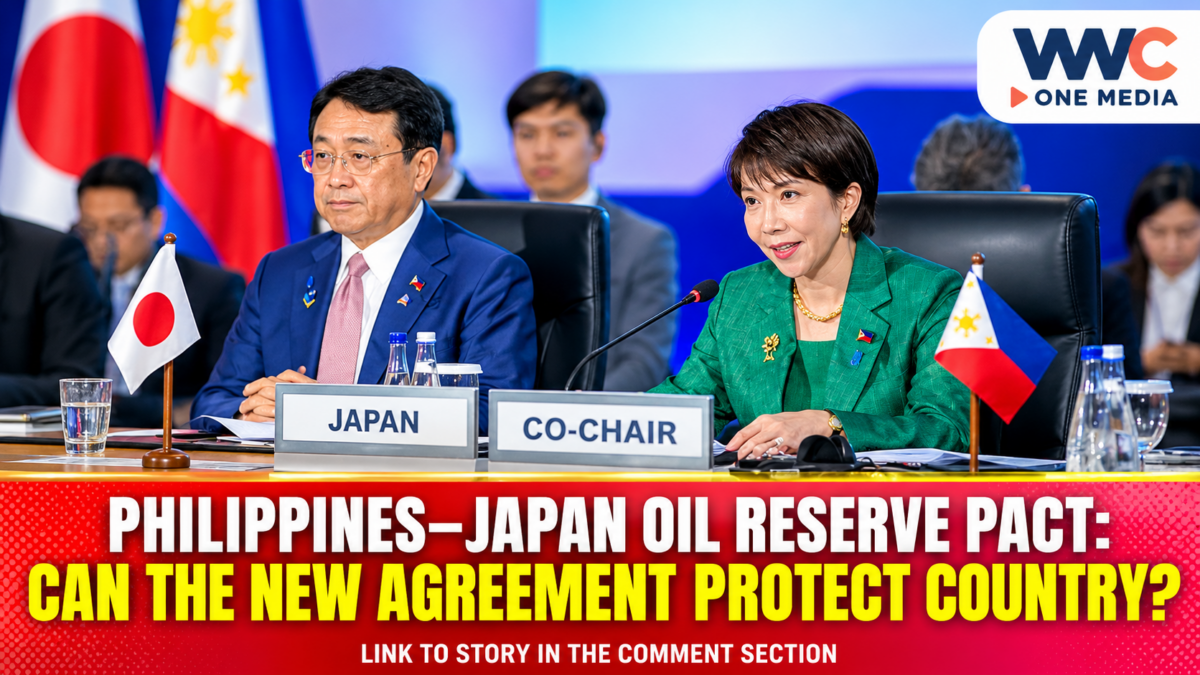
The Philippines and Japan signed a three-year cooperation agreement on Nov. 16, 2026, to help develop the country’s strategic petroleum reserves, establishing a framework for oil storage, stockpile management and emergency releases. The agreement is an important step towards a national fuel buffer, but it does not mean the Philippines already has a fully operational strategic reserve or that fuel prices will automatically fall.
Energy Secretary Sharon S. Garin and Japan’s Minister of Economy, Trade and Industry Ryosei Akazawa signed the Memorandum of Cooperation in Manila. The Department of Energy said the arrangement will support feasibility work, possible storage infrastructure, financing options and technical assistance. Department of Energy Philippines
The more immediate development is that the cooperation now has a concrete project pathway in the Philippines. The Philippine National Oil Company (PNOC) has listed a request for expressions of interest for an environmental impact assessment for a proposed initial one-million-barrel Strategic Petroleum Reserve facility in Bataan. The procurement notice was posted on Nov. 13, with an approved budget of ₱7 million and a submission deadline of Nov. 20, 2026. PNOC
That notice is an important step, but it must be understood correctly: it is for an environmental assessment, not evidence that the facility has already been built or filled with oil. Environmental review, project approval, financing, construction and procurement of petroleum stocks are separate stages.
Why the Bataan project matters
A strategic petroleum reserve is different from the commercial inventories that oil companies maintain for their regular operations. It is intended to provide an additional supply buffer that the government can use under defined emergency conditions.
PNOC’s procurement notice identifies Bataan as the proposed location for the initial one-million-barrel facility. The next questions are whether the environmental assessment supports the project, what infrastructure will be required, how the facility will be financed and who will manage the stored petroleum.
The distinction between storage capacity and actual reserves is particularly important. A tank may be capable of holding a specified volume, but that does not mean it already contains that amount of usable fuel. The government must still establish arrangements for purchasing, storing, maintaining and releasing the petroleum.
Japan is also building a wider regional framework
The bilateral agreement is part of a broader effort to strengthen oil security across Asia.
On Nov. 17, Japan and the International Energy Agency announced plans to work towards an IEA-Japan Oil Security Hub for Asia. The proposed hub will focus on technical assistance for stockholding systems, energy-market analysis and information sharing, and frameworks for emergency cooperation. It will be hosted by the Japan Organization for Metals and Energy Security in Tokyo, drawing on expertise from the IEA and its regional cooperation centre in Singapore. Ministry of Foreign Affairs of Japan
Japan also announced an Asia Oil Security Task Force to work with the IEA and the Economic Research Institute for ASEAN and East Asia. Its role will include gathering and analysing information on national oil stocks and considering coordination for emergency responses. Ministry of Foreign Affairs of Japan
Another proposal involves the possible use of idle oil storage tanks in Japan for participating Asian countries. The concept is intended to complement regional stockpiling initiatives, including the Philippines-led ASEAN arrangement. However, the official document describes this as potential cooperation, not an already operational system giving the Philippines immediate access to Japanese stocks. Ministry of Foreign Affairs of Japan
What the agreement does—and does not—guarantee
The three-year Memorandum of Cooperation gives Manila and Tokyo a framework for technical and institutional work. Its term begins only after the required domestic procedures have been completed and written notifications have been exchanged through diplomatic channels. The agreement can be extended through mutual written consent. Department of Energy Philippines
It does not set out a guaranteed volume of oil that Japan must supply, a fixed amount of financing, or a date when the proposed Bataan facility will begin operating.
Nor does the agreement guarantee lower pump prices. Strategic reserves are primarily an emergency supply measure. Their purpose is to help manage physical supply disruptions; retail prices remain affected by international oil markets, exchange rates, taxes, distribution costs and other factors.
For Filipino households and businesses, the value of the programme will depend on whether the government can turn the diplomatic framework into functioning storage facilities, adequately funded stocks and transparent rules for releasing fuel during emergencies.
What happens next
The immediate milestones are the completion of the PNOC environmental assessment procurement process, the necessary feasibility and approval work, and follow-up discussions between the Philippine Department of Energy and Japan’s Ministry of Economy, Trade and Industry.
The government will also need to clarify how the proposed national reserve will operate alongside existing commercial inventories and the broader ASEAN stockpiling initiative.
The agreement creates a path towards a stronger fuel-security system. Whether it becomes a dependable national buffer will depend on what happens after the signing ceremony: financing, construction, actual oil purchases, management and clear emergency-release rules.