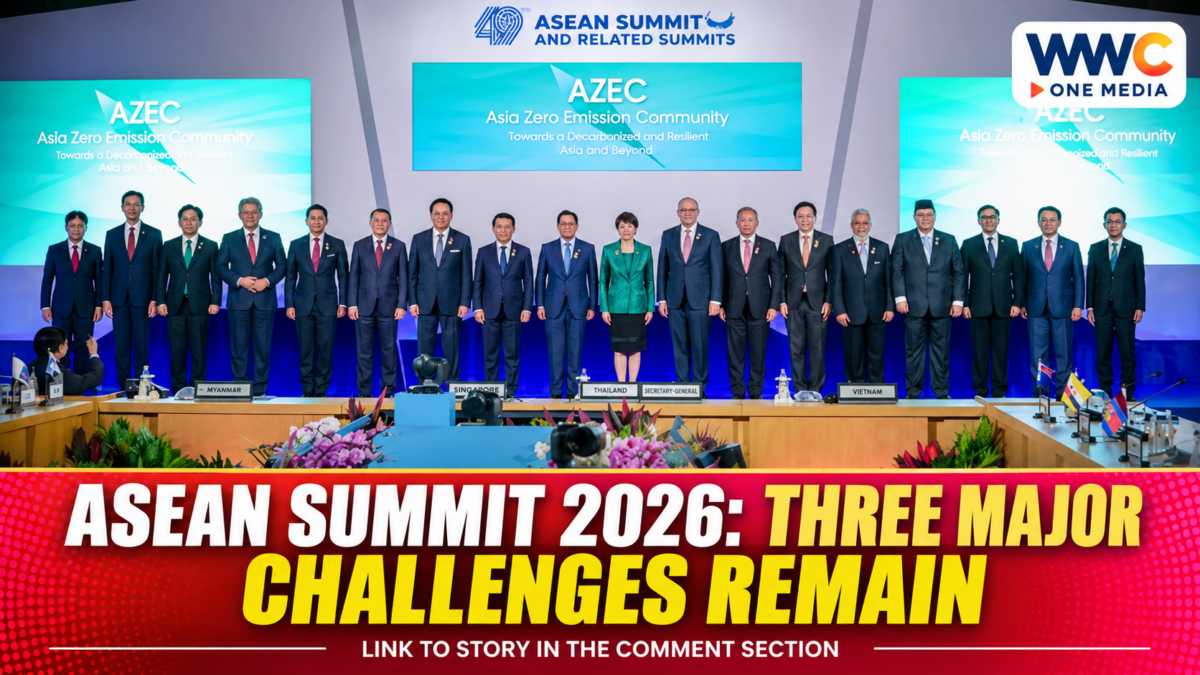
The 49th ASEAN Summit in Manila produced more than 100 outcome documents, including a landmark digital economy agreement and renewed regional commitments on security and cooperation. But as the Philippines handed the ASEAN chairship to Singapore on Nov. 17, three difficult issues remained central to the region’s agenda: the South China Sea Code of Conduct, Myanmar’s continuing crisis and the implementation of regional economic commitments.
The summit, held from Nov. 15 to 17, marked the conclusion of the Philippines’ 2026 chairship under the theme “Navigating Our Future, Together.” President Ferdinand Marcos Jr. organised the country’s priorities around peace and security, economic connectivity and people empowerment. The next challenge is ensuring that the agreements reached in Manila translate into action after the diplomatic meetings have ended. Philippine Commission on Oceans+1
The outcome is significant, but the number of documents adopted is not the same as the number of commitments already delivered. Several initiatives require further negotiations, national implementation or sustained cooperation among ASEAN member states.
1. South China Sea Code of Conduct remains unfinished
One of the most closely watched issues during the Philippine chairship was the proposed Code of Conduct (COC) for the South China Sea, intended to establish clearer expectations for conduct and help manage tensions among parties in the disputed waters.
The Philippines had made progress on the negotiations a priority. However, a Nov. 15 Palace press briefing placed the negotiations at 77% completion and expressed hope that the agreement could still be concluded before the end of 2026. That statement indicated that substantial work remained even as the Manila summit was taking place. Presidential Communications Office+1
The percentage should not be mistaken for an adopted agreement. Negotiators still need to settle the outstanding provisions and reach an acceptable final text.
For the Philippines, the issue carries direct importance because of its maritime interests and the need to protect the rights recognised under international law, including the 1982 United Nations Convention on the Law of the Sea.
A completed document would still need to be judged by its substance, legal consistency and practical value. The real test is whether it can help prevent incidents, manage disagreements and establish predictable conduct.
2. Myanmar’s crisis remains a test of ASEAN unity
The summit also reviewed the implementation of ASEAN’s Five-Point Consensus, the regional framework adopted to address Myanmar’s political crisis.
In its Nov. 15 decision, ASEAN leaders expressed deep concern over continuing conflict and the humanitarian situation. They called for concrete action to halt indiscriminate violence, protect civilians and civilian infrastructure, and create conditions for humanitarian assistance and inclusive political dialogue. ASEAN Main Portal+1
The decision also maintained Myanmar’s non-political representation at ASEAN summits and foreign ministers’ meetings until meaningful progress is made in implementing the consensus.
This does not mean Myanmar has been removed from ASEAN. The leaders’ decision states that the country’s participation in other ASEAN sectoral ministerial bodies and mechanisms should remain unrestricted at all levels. It also leaves open the possibility of gradually restoring full political representation if Myanmar demonstrates sustained and concrete progress. ASEAN Main Portal
The distinction matters. ASEAN is maintaining channels for regional participation while withholding political representation at its highest-level meetings.
The document also directs ASEAN foreign ministers to continue monitoring progress and report to the next summit. This means the issue will remain part of the regional agenda beyond the Philippines’ chairship.
3. Digital economy agreement moves to implementation
One of the clearest economic milestones was the signing of the ASEAN Digital Economy Framework Agreement (DEFA) on Nov. 14 in Manila, during the 28th ASEAN Economic Community Council Meeting.
The ASEAN Secretariat described the agreement as a step towards an open, secure, interoperable, competitive and inclusive regional digital economy. It is expected to enter into force in early 2027. ASEAN Main Portal+1
For businesses, the agreement could help establish a more coordinated environment for digital trade and cross-border economic activity. Its relevance extends to online commerce, digital services and the systems that allow businesses and consumers to transact across national borders.
However, signing is only one stage of the process. The agreement’s expected entry into force in early 2027 means the next phase will involve the necessary national steps and practical implementation.
Small businesses will particularly need clear rules and accessible systems if the benefits of regional digital integration are to extend beyond large companies.
The Philippines also identified the completion of all 19 priority economic deliverables under its chairship by the end of 2026. President Marcos included DEFA among the initiatives contributing to that target. The timeline shows that some chairship commitments extend beyond the leaders’ meeting itself. Philippine Commission on Oceans
4. Singapore inherits a continuing regional agenda
The Philippines formally handed over the ASEAN chairship to Singapore during the closing ceremony on Nov. 17. Singapore will assume the chairmanship on Jan. 1, 2027, coinciding with ASEAN’s 60th anniversary. Its announced theme is “Deeper Integration, Wider Partnerships.” ASEAN Main Portal
The transition does not erase the commitments made during the Philippine chairship. Negotiations, regional agreements and political-security initiatives require continuity across successive leadership terms.
Singapore will inherit an agenda that includes the South China Sea negotiations, continued engagement over Myanmar, digital economic integration and broader regional cooperation.
For the Philippines, the end of its chairship also does not mean the end of its responsibility. It remains an ASEAN member and will continue to participate in decisions affecting regional trade, security and development.
Why the results matter beyond the summit
For ordinary Filipinos, regional agreements become meaningful when they affect everyday economic and social conditions.
A functioning digital economy framework could create more consistent rules for businesses operating across borders. Progress on maritime cooperation could contribute to regional stability. Better coordination on humanitarian issues and disaster response could strengthen the region’s ability to manage crises.
But these benefits cannot be assumed simply because leaders have signed declarations or attended meetings.
Governments must still implement commitments, coordinate agencies, provide resources and report measurable progress. Businesses also need clear guidance on how new regional arrangements affect their operations.
The Manila summit therefore represents both a conclusion and a transition: the Philippines has completed its year as chair, but many of the commitments made during that period still require work.
What happens next
The next milestones will include progress on the South China Sea Code of Conduct negotiations, continued ASEAN monitoring of the Five-Point Consensus, and the steps needed to bring DEFA into force.
Singapore will formally begin its chairmanship on Jan. 1, 2027. The Philippines will remain involved in the negotiations and implementation work as a member of the regional bloc.
The measure of the Manila summit will ultimately be whether its agreements lead to practical cooperation—not simply how many documents were adopted.