Singapore is preparing a major upgrade to its digital-payment infrastructure, with the Monetary Authority of Singapore (MAS) and the Association of Banks in Singapore (ABS) setting out a roadmap on Nov. 18, 2026, to make QR payments more interoperable across the country.
The plan includes a new SGQR+ payment switch, with a limited rollout scheduled for 2027 and a wider expansion in 2028. The intended change is straightforward for consumers: residents and tourists should be able to use their preferred payment applications at more participating merchants without first checking which QR payment scheme a business accepts. Monetary Authority of Singapore+1
The initiative could reduce one of the everyday inconveniences of cashless shopping: having the right application but encountering a merchant QR code that does not support it. For retailers, it could also make payment acceptance easier to manage as Singapore connects more domestic and overseas payment networks.
Singapore QR payments enter a new phase
The MAS and ABS roadmap forms part of the second phase of PayNow Generation 2, a programme intended to improve the country’s instant-payment infrastructure.
The authorities said the roadmap was developed after consultations with e-commerce users, small merchants, Singapore residents and inbound tourists. Industry workshops also involved banks, payment providers, technology firms, marketplaces and government agencies. Monetary Authority of Singapore
The most consumer-facing change is QR interoperability through SGQR+.
Under the planned arrangement, a customer should be able to use a preferred payment application at a participating merchant without needing to determine whether the merchant accepts a particular QR scheme. Tourists are also expected to benefit.
The authorities said work on the SGQR+ switch has begun. A limited rollout is planned for 2027, followed by an expansion in scope in 2028. This is a phased programme, not a declaration that every payment application and merchant will become compatible immediately. Monetary Authority of Singapore
What SGQR+ means for shoppers and merchants
Singapore’s existing SGQR system already brings multiple payment schemes together under a single standardised label. The Monetary Authority of Singapore and the Infocomm Media Development Authority jointly own the scheme.
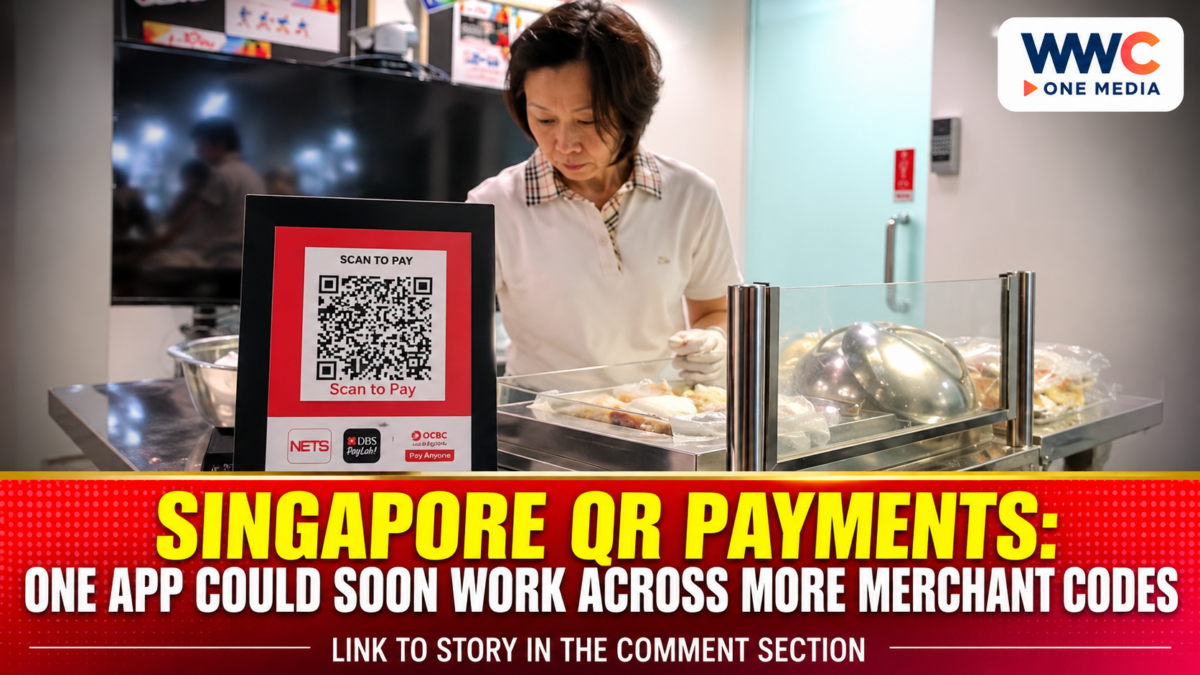
Consumers can inspect the payment options displayed on a merchant’s SGQR label, open a supported application, scan the code, check the merchant name and enter the amount. The payment is completed through the selected supported scheme. Monetary Authority of Singapore
SGQR+ is designed to take interoperability further.
Rather than simply displaying several payment options, the system is intended to make it easier for merchants to accept a wider range of payment schemes through a single merchant-acquiring arrangement. That could reduce the need for businesses to manage separate payment relationships for every scheme they want to support.
For small retailers, food businesses and service providers, fewer payment-system complications could make cashless acceptance more practical. However, the actual benefits will depend on merchant participation, technical implementation and the payment providers connected to the system.
NETS already supports QR payments through several applications
NETS is an established part of Singapore’s payment network, and its current consumer QR service supports applications including DBS PayLah!, OCBC, UOB TMRW, Standard Chartered Mobile, Maybank2u SG and the NETS App.
Its published instructions describe a scan-based process: customers use a supported application to scan a NETS QR code, enter the purchase amount and complete the payment. NETS also explains that QR codes can appear on SGQR labels, payment terminals and online checkout pages. NETS
The NETS App’s official App Store listing describes additional functions, including NETS Wallet payments, vehicle-related electronic road-pricing services and Family Wallet features. The family function allows users to manage dependants’ spending through sub-wallets and set spending limits. App Store
These existing features show how payment applications are becoming broader consumer platforms. But they should not be confused with the planned SGQR+ interoperability switch: the latter is a wider industry infrastructure project involving MAS, the Singapore Payments Network, Banking Computer Services and other partners.
Tourists could benefit from wider payment connections
The roadmap has implications beyond Singapore residents.
MAS said broader SGQR+ connectivity could allow more merchants in Singapore to receive payments from a wider pool of foreign payment networks. It could also help Singaporeans use local applications to pay through more overseas QR networks.
This matters in a region where domestic payment systems have developed around different applications and national QR standards.
Singapore already has cross-border QR payment connections with neighbouring markets. For example, the Singapore-Malaysia linkage allows customers of participating financial institutions to make retail payments by scanning NETS QR and DuitNow QR codes. Monetary Authority of Singapore
A broader SGQR+ system could build on that direction, although the roadmap does not mean every overseas wallet will automatically be accepted at every Singapore business.
For visitors, the practical question will remain whether their particular bank or wallet is supported at the merchant they are visiting.
The payment roadmap also targets online shopping and refunds
QR interoperability is only one part of PayNow Generation 2.
The MAS and ABS roadmap also identifies deep-linking for online payments. This is intended to let customers move from an e-commerce checkout directly into their preferred payment application, rather than saving a QR-code image, opening a separate app and retrieving the code to complete payment.
The authorities said common technical standards and a central facility are targeted for development by the end of 2027, with connections added progressively over 2028. Monetary Authority of Singapore
Another planned improvement concerns higher-value government payments. A limited rollout with one government agency is targeted for late 2027, followed by a targeted rollout to other agencies from 2028.
The roadmap also calls for clearer rules covering person-to-merchant payment disputes, refunds, fraud and scams. These safeguards are expected to be introduced in stages over 2028, with the Singapore Payments Network providing scheme governance and oversight. Monetary Authority of Singapore
Those measures matter because convenience is only one part of a reliable payment system. Consumers and merchants also need consistent processes when a transaction is disputed, incorrectly processed or suspected to be fraudulent.
Why the upgrade matters for the wider digital-payments market
Singapore’s plans reflect a broader shift in how consumers expect to pay.
Digital wallets are increasingly competing not only on the number of merchants they reach, but also on how easily they connect with other payment networks. The experience of using a preferred application can become frustrating when different merchants support different schemes.
Other payment providers are also developing new ways to reduce friction. WWC previously examined GCash’s proposed contactless payment feature for situations where customers have limited mobile connectivity. That development involves a different payment approach, but it highlights the industry’s interest in making transactions easier to complete.
Cross-border QR services are another part of the same market shift. DBS PayLah!’s expansion into China’s QR payment networks illustrates how local applications can connect users with payment systems beyond their home market.
For Singapore businesses, the infrastructure transition is taking place alongside other changes to the NETS payment ecosystem. WWC has also explained the NETS CashCard withdrawal and the alternatives motorists must prepare for, a separate development that demonstrates how payment providers are updating services across retail and transport.
What happens next
The next major milestone is the limited SGQR+ switch rollout planned for 2027. The programme is expected to expand in 2028 as more payment schemes and networks are connected.
The MAS and ABS roadmap also sets out work on online-payment deep-linking, higher-value government transactions, merchant dispute processes and richer payment information.
For consumers, the most important test will be practical compatibility: whether their preferred applications work at the businesses they visit, and whether the payment process remains reliable.
For merchants, the value will depend on how easily they can connect to the system and manage transactions across participating payment networks.
Singapore has outlined the next stage of its QR-payment infrastructure. The challenge now is turning the roadmap into a system that works consistently for residents, tourists and businesses.
Frequently asked questions
1. What is SGQR+ in Singapore?
SGQR+ is designed to improve interoperability between different QR payment schemes, allowing merchants to accept payments from a wider range of applications through a single merchant-acquiring arrangement.
2. When will Singapore introduce the SGQR+ payment switch?
MAS and ABS said a limited rollout is planned for 2027, with expansion in scope during 2028.
3. Will tourists be able to use their home payment applications in Singapore?
The roadmap says tourists are expected to benefit from wider QR interoperability and connections to more foreign payment networks. Actual acceptance will depend on participating schemes and merchants.
4. Is SGQR+ already the same as the existing SGQR system?
No. SGQR is the existing standardised QR label that combines multiple payment options. SGQR+ is designed to improve interoperability across payment schemes and merchant-acquiring arrangements.
5. Will PayNow payments become easier for online shopping?
The roadmap includes deep-linking, which is intended to take customers from an online checkout directly to their preferred payment application. Development of common technical standards and a central facility is targeted by the end of 2027, with connections added progressively over 2028.