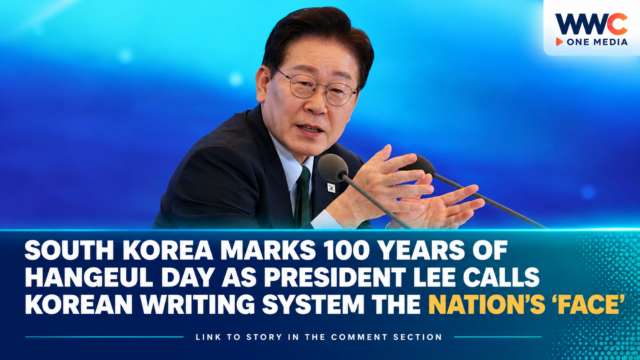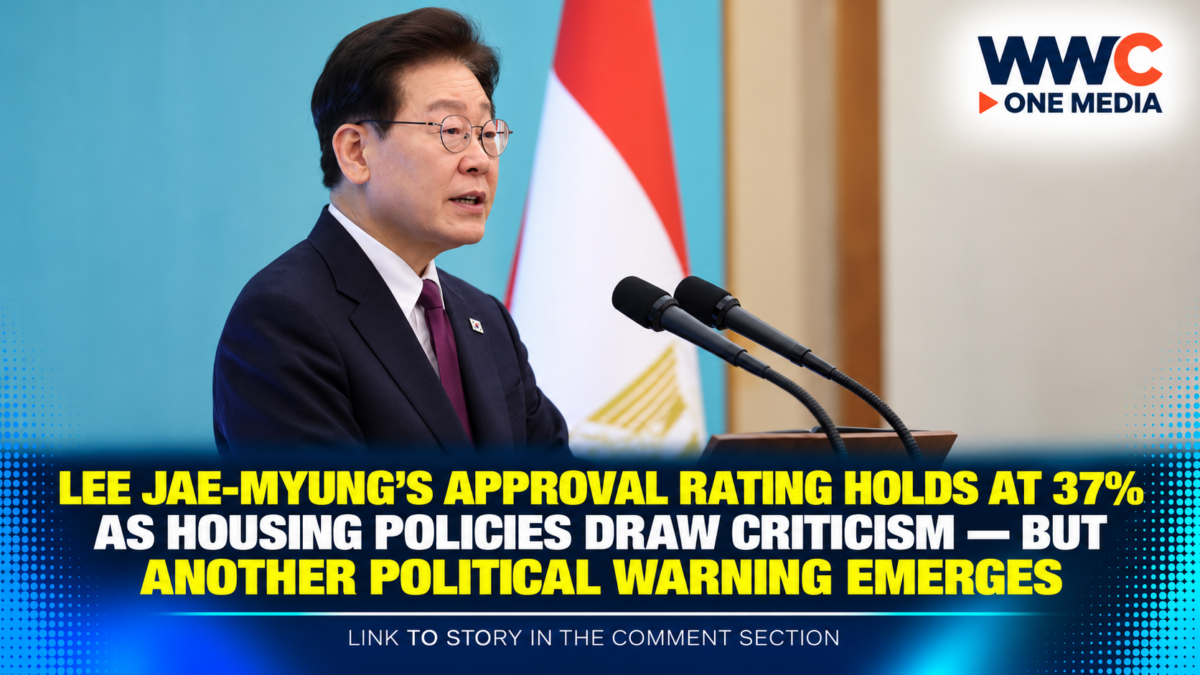
South Korean President Lee Jae-myung’s approval rating remained at 37% in the latest Gallup Korea poll, while public dissatisfaction with his administration eased. At the same time, support for his ruling Democratic Party of Korea dropped to its lowest level since his administration began, adding a new dimension to the political challenges facing his government.
The survey, reported by The Korea Times on October 9, 2026, found that 37% of respondents approved of Lee’s job performance, unchanged from the previous survey three weeks earlier. His disapproval rating fell five percentage points, from 56% to 51%.
The findings present a mixed picture for the president: his approval rating has yet to recover, but the decline in disapproval suggests that negative assessments have eased somewhat.
Meanwhile, the ruling party’s falling support raises questions about whether the administration can translate its policy agenda into stronger public confidence.
Real Estate Policy Remains the Biggest Source of Dissatisfaction
Housing affordability and real estate policy emerged as the leading reasons respondents gave for disapproving of Lee’s performance.
Among those who viewed his performance negatively, 18% cited real estate policies, followed by 15% who pointed to defense, security and North Korea policy. The findings underline the importance of housing and national security in shaping public perceptions of the administration.
For the government, housing policy remains a particularly sensitive issue because it affects household finances, homeownership prospects and the cost of securing a place to live.
The poll does not establish that every respondent who disapproved of Lee did so because of housing. Instead, it identifies the most frequently cited reasons among those expressing a negative assessment.
Foreign Affairs Emerges as Lee’s Strongest Point
Foreign policy was the leading reason respondents gave for approving of Lee’s performance.
Among those who viewed his presidency positively, 24% cited foreign affairs, while 14% pointed to economic and livelihood issues.
The results suggest that international engagement is an important part of the administration’s positive public image, even as domestic policy concerns continue to weigh on its overall standing.
However, the survey does not indicate that foreign policy alone will be enough to lift Lee’s approval rating. The president’s broader standing will also depend on how people assess the government’s handling of everyday economic pressures, housing and security.
Ruling Democratic Party Suffers a Significant Drop
The latest findings also reveal a challenge for Lee’s political party.
Support for the ruling Democratic Party of Korea fell five percentage points to 35%, its lowest level since Lee took office in June 2025. The main opposition People Power Party also lost ground, slipping one percentage point to 26%.
The results show that both major parties faced weaker support in this survey, although the ruling party experienced the larger decline.
The figures should not be interpreted as a direct prediction of future election results. Party support and presidential job approval measure different things, and a single poll cannot establish how voters will behave in a future election.
What the Latest Poll Means for Lee’s Presidency
The Gallup Korea survey was conducted from October 6 to 8 among 1,000 South Korean adults aged 18 and older. It has a margin of error of plus or minus 3.1 percentage points at the 95% confidence level.
That margin of error is important when interpreting small differences in polling figures. The results represent a snapshot of public opinion during the survey period, rather than a definitive judgment on the administration’s performance.
For Lee, the central challenge is balancing the areas receiving positive public assessments with those generating dissatisfaction. Foreign affairs is currently the most frequently cited reason for approval, while real estate policy remains the leading source of criticism.
The next surveys will help show whether the decline in disapproval continues, whether the president’s approval rating changes and whether the ruling party can regain support.
For now, Lee’s approval rating remains at 37% — and the gap between public approval, dissatisfaction and support for his party remains a key indicator to watch in South Korean politics.
WWC ONE MEDIA G,A