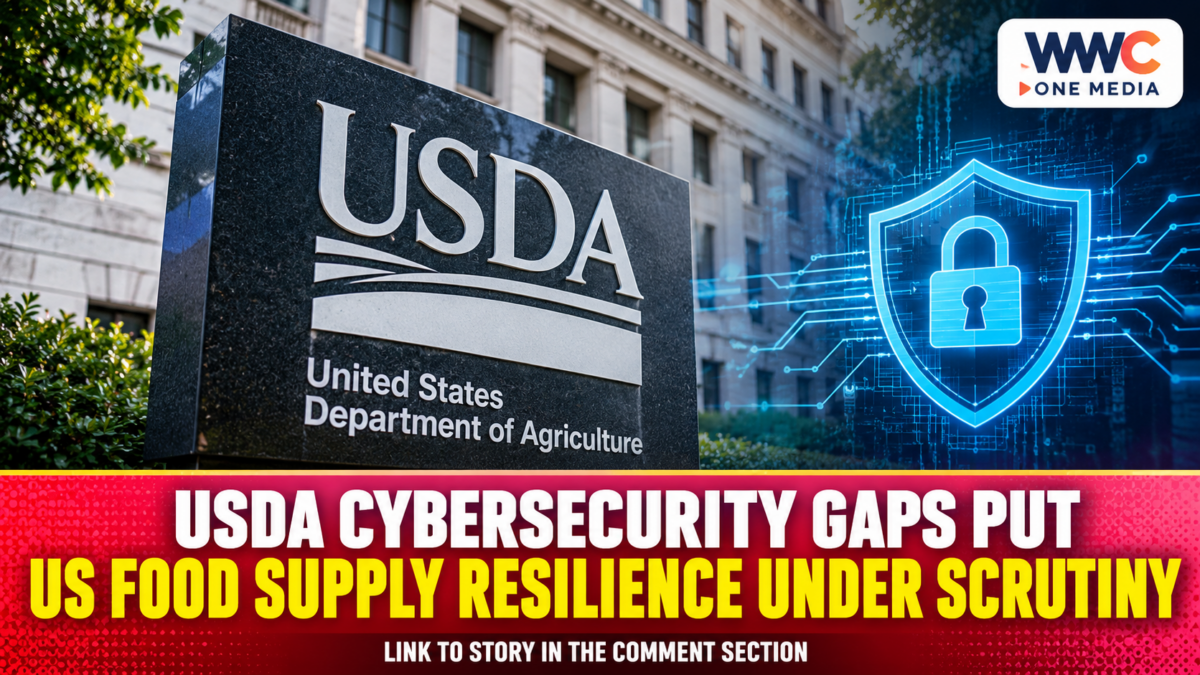
The United States Government Accountability Office (GAO) has warned that important weaknesses remain in federal efforts to protect the country’s food and agriculture sector from cyberattacks, identifying gaps in threat information-sharing and emergency preparedness in a report released on Nov. 19, 2026.
The assessment places the US Department of Agriculture (USDA) under renewed scrutiny because the agency shares responsibility with the Food and Drug Administration (FDA) for coordinating cybersecurity protection across a sector that includes farms, food processors, storage facilities and distribution networks. GAO Files+1
The report does not confirm a newly discovered intrusion into USDA’s internal systems or establish that the FBI’s National Crime Information Center was compromised. Instead, it documents a broader and independently significant problem: federal agencies responsible for protecting food-sector infrastructure have not fully met several cybersecurity requirements, while limited staffing and resources continue to constrain their work.
For consumers and businesses, the concern extends beyond stolen information. A successful attack against agricultural technology or food-production systems could interrupt operations, delay deliveries and, in certain circumstances, affect food safety.
USDA cybersecurity gaps extend beyond government networks
The GAO report, titled Further Action Needed to Enhance Cybersecurity of the Food and Agriculture Sector, examined how USDA and FDA have carried out their responsibilities under federal critical-infrastructure protection requirements.
The review covered 16 requirements grouped into six areas: sector coordination, risk management, risk assessment, information-sharing, incident management and emergency preparedness.
Although the agencies met most of the cybersecurity-related requirements, GAO found that five requirements in information-sharing and emergency preparedness were only partially met or not met. Both agencies also reported that resource and staffing limitations affected their ability to complete important cybersecurity activities. GAO Files+1
The distinction is important. The findings do not mean that USDA and FDA have no cybersecurity programmes. The report recognises that both agencies have established coordination activities, developed resources and responded to incidents.
The problem is that existing measures do not fully provide the continuous threat awareness and preparation needed to protect a complex national supply chain.
For a sector that increasingly depends on connected equipment and digital records, gaps in monitoring and preparedness can create risks that extend well beyond the government offices responsible for oversight.
Why a cyberattack on agriculture can affect consumers
Modern agriculture relies on digital systems at several stages of production and distribution.
Farmers use GPS-guided equipment and sensors to manage crops and livestock. Food manufacturers rely on automated processes, while distributors use information systems to track products, manage inventories and coordinate deliveries.
These technologies improve efficiency, but they also create potential entry points for malicious activity when security controls are weak.
GAO warned that attackers who gain access to poorly protected systems could manipulate information involving food quality, contamination testing or product traceability. It also described how compromised agricultural equipment and production systems could disrupt farming operations and contribute to supply-chain delays. GAO Files+1
The report cited historical incidents to illustrate the potential consequences. A ransomware attack affecting Dole in February 2023 disrupted operations, temporarily shut down production plants and affected food supplies to US grocery stores. The incident cost the company US$10.5 million, based on the information included in the report. GAO Files
These examples show why agricultural cybersecurity cannot be treated as a narrow information-technology issue. Disruptions can affect production schedules, transportation, storage and the availability of goods.
For consumers, the possible consequences include delayed deliveries and reduced availability of certain products. These are potential outcomes of serious disruptions, not evidence that a current attack has caused shortages.
Five requirements remain incomplete
GAO identified shortcomings in the agencies’ ability to share timely threat information and prepare for cyber emergencies.
USDA and FDA partially met the requirement to provide the Cybersecurity and Infrastructure Security Agency (CISA) and sector participants with awareness of ongoing threats, vulnerabilities and mitigation measures.
The agencies shared alerts and cybersecurity information, but GAO found they did not provide continuous, real-time awareness of threats and vulnerabilities. It also noted that FDA lacked a structured mechanism for continuously collecting cybersecurity data from the sector. GAO Files+1
Emergency preparedness presented another concern.
USDA had developed a food-defence exercise package that included a ransomware scenario. The agency had also drafted a cybersecurity situational report template, but procedures for implementing it were put on hold following the change in administration.
Both USDA and FDA had participated in the 2024 Cyber Storm IX exercise, which included 30 food and agriculture sector participants. However, GAO said the agencies had not conducted or facilitated further exercises and simulations specifically addressing cyber incidents within the sector. GAO Files
Exercises matter because an organisation’s ability to restore systems depends on preparation before an incident occurs. Agencies and businesses need to know who will coordinate the response, how information will be shared and which services must be restored first.
Without regular testing, weaknesses in those arrangements may only become apparent during an actual emergency.
Staffing and funding are part of the problem
The report also identified institutional constraints that make cybersecurity improvements more difficult.
USDA officials told GAO that the department’s Office of Homeland Security had no full-time equivalent employees assigned to its sector risk management agency responsibilities and did not receive appropriations specifically for those duties.
Officials also described limited expertise and resources for analysing cybersecurity threats and addressing incidents affecting private-sector organisations in the food and agriculture sector. GAO Files
This does not mean USDA has no personnel protecting its own computer networks. The report distinguishes the agency’s internal cybersecurity operations from its wider responsibility to coordinate protection across private-sector food and agriculture organisations.
That difference is central to understanding the findings. Securing a department’s own systems is not the same as helping protect thousands of independent businesses that produce, process, store and transport food.
The report estimated that the US food and agriculture sector includes 1.9 million farms, more than 220,000 registered facilities involved in food manufacturing, processing and storage, and over 700,000 restaurants. GAO Files
A coordination system covering an industry of that scale requires consistent information-sharing, technical expertise and clear incident-response arrangements.
USDA disagrees with two recommendations
GAO issued five recommendations: two directed to USDA and three to the Department of Health and Human Services, which oversees FDA.
The recommendations for USDA call for stronger information-sharing about cybersecurity threats and vulnerabilities with CISA, as well as improved coordination of cybersecurity preparedness exercises and simulations. Both include assessing whether resources should be reprioritised or additional support requested. GAO Files
USDA disagreed with its two recommendations and asked GAO to remove them or redirect them to the department’s Chief Information Officer.
The department’s position, as described in the report, was that its Office of Homeland Security lacked the funding, authority and specialised expertise needed to fulfil the requirements. It also argued that the Chief Information Officer was responsible for coordinating cybersecurity operations within USDA’s own network.
GAO maintained that the recommendations were appropriately directed to the Office of Homeland Security because that office had been designated to carry out the department’s sector risk management responsibilities. GAO Files
The disagreement highlights a question of responsibility: whether the office assigned to coordinate sector-wide protection has sufficient resources and authority to carry out that role.
For readers following similar developments in the Philippines, WWC has also examined reported cybersecurity incidents involving Philippine government agencies. The cases are separate, but they underline the importance of distinguishing an alleged intrusion, an official breach notification and a confirmed compromise.
Why the findings matter to the Philippines
The US food system is connected to international markets through agricultural trade, food processing, shipping and commodity distribution. Disruptions affecting a major producer or exporter can create complications for trading partners, although the effect on Philippine prices or supplies would depend on the product, the duration of the disruption and alternative sources of imports.
The GAO report does not predict a specific impact on Philippine food prices or identify a current supply disruption affecting the country. Its findings instead provide a reminder that cybersecurity has become part of food-security planning.
The same principle applies to Philippine institutions and businesses that depend on digital systems for payments, logistics, inventory management and public services.
WWC has previously reported on the confirmed LTFRB Electronic Support System security breach and the data-security risks involving Philippine government agencies. Those developments demonstrate why organisations need to protect both the information they hold and the services that depend on their systems.
The wider lesson from the US assessment is that cybersecurity failures can become operational and economic problems. Protecting digital infrastructure is therefore not simply a technical responsibility; it is also part of maintaining reliable public services and essential supply chains.
What happens next
The immediate test is whether USDA and FDA address the gaps identified by GAO and establish clearer arrangements for sharing threat information and preparing for cyber emergencies.
The two USDA recommendations remain disputed, while GAO has maintained that the department’s designated sector risk management office should be responsible for implementing them. The report does not establish a deadline for completing the recommended changes. GAO Files
For businesses in the food and agriculture sector, the findings reinforce the importance of maintaining secure systems, preparing for service interruptions and coordinating incident responses with relevant authorities.
The report also makes clear that cyber resilience cannot depend on a single government agency. Food production and distribution involve interconnected organisations, meaning a weakness in one part of the system can create consequences elsewhere.
The central issue is whether the agencies and industries responsible for keeping food moving can strengthen their defences before a serious disruption occurs.
Frequently asked questions
Did hackers breach the US Department of Agriculture in November 2026?
The GAO report released on Nov. 19, 2026, identifies cybersecurity weaknesses in the food and agriculture sector but does not confirm a new intrusion into USDA’s internal systems. The report focuses on the agencies’ cybersecurity responsibilities and preparedness.
What cybersecurity weaknesses did GAO identify?
GAO found that five cybersecurity-related requirements involving information-sharing and emergency preparedness were partially met or not met by USDA and FDA. The agencies also reported limited resources and staffing.
Could a cyberattack disrupt the US food supply?
Yes. GAO explained that attacks against agricultural technology, food-production systems and distribution networks could interrupt operations, affect product traceability and create supply-chain delays. These are potential consequences, not confirmation of a current food shortage.
Why did USDA disagree with GAO’s recommendations?
USDA argued that its Office of Homeland Security lacked sufficient funding, authority and specialised expertise to fulfil the recommendations. GAO maintained that the office was the designated unit responsible for the department’s sector risk management duties.
What should food businesses do to reduce cyber risks?
Businesses should maintain secure access controls, update systems, monitor suspicious activity, back up critical information and prepare incident-response procedures. They should also coordinate with relevant authorities and industry cybersecurity organisations when threats emerge.