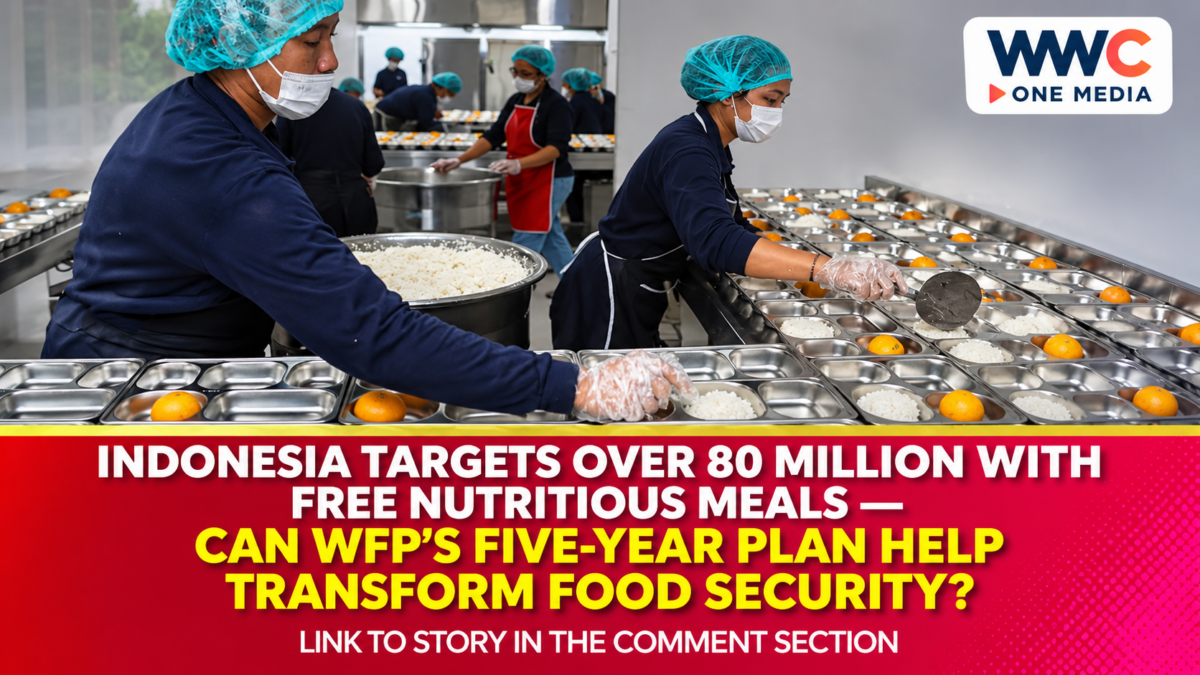
JAKARTA, INDONESIA — Indonesia is pursuing an ambitious transformation of its national food and nutrition systems, with the United Nations World Food Programme (WFP) supporting a five-year strategy that combines improved nutrition, stronger food security and disaster preparedness through 2030.
At the centre of this initiative is Indonesia’s Free Nutritious Meals Programme, locally known as Makan Bergizi Gratis (MBG), which aims to reach more than 80 million children and other nutritionally vulnerable beneficiaries by 2029.
The initiative comes as Indonesia continues to address childhood malnutrition, unequal access to nutritious food and the growing threat of climate-related disruptions to agricultural production and food distribution.
Indonesia Food Security Enters a Critical Five-Year Period
The WFP Indonesia Country Strategic Plan for 2026–2030 establishes two principal areas of cooperation: supporting the national free nutritious meals programme and improving preparedness for weather-related emergencies.
Rather than relying primarily on direct international food assistance, Indonesia’s partnership with WFP concentrates on strengthening domestic institutions and developing sustainable national programmes.
The approach places greater emphasis on technical expertise, government coordination and the ability of local institutions to deliver nutrition and emergency assistance.
The strategy also addresses difficulties in identifying vulnerable populations and delivering services to geographically isolated communities.
Indonesia’s experience demonstrates that national economic development alone does not automatically eliminate malnutrition or guarantee equal access to healthy diets.
Free Nutritious Meals Programme Targets Over 80 Million Beneficiaries
Indonesia launched its MBG programme in January 2025 as part of its national nutrition and development agenda.
The original strategic planning framework envisages approximately 83 million recipients by 2029, with schoolchildren accounting for around two-thirds of the intended beneficiaries.
The programme also seeks to support other nutritionally vulnerable population groups.
WFP’s technical assistance is designed to help Indonesia improve several aspects of implementation, including meal composition, procurement from local producers, distribution efficiency and the use of fortified foods.
However, the original beneficiary target represents a long-term ambition rather than confirmation that all intended recipients have already received meals.
Reaching communities in remote areas remains an important implementation challenge, particularly as Indonesia expands its network of meal preparation facilities.
This issue was previously examined in WWC ONE MEDIA’s coverage of Indonesia’s plans to open additional free-meal kitchens in remote and disadvantaged communities.
Nearly One in Five Indonesian Children Under Five Experienced Stunting in 2024
Indonesia has achieved substantial improvements in childhood nutrition, although significant challenges remain.
The prevalence of stunting among children younger than five declined from 31% in 2018 to 19.8% in 2024.
The improvement represents a reduction of 11.2 percentage points over six years.
Nevertheless, the 2024 figure means that approximately one in five Indonesian children under five experienced impaired growth associated with chronic nutritional deprivation and other contributing factors.
The country also faces overlapping nutritional challenges involving undernutrition, inadequate micronutrient intake and excessive weight gain.
Addressing these conditions requires more than increasing the quantity of food available. Meal quality, dietary diversity, healthcare, sanitation and household access to nutritious food remain important considerations.
The national nutrition programme must therefore be evaluated not only by how many meals it distributes but also by whether it contributes to measurable improvements in health and nutrition.
Food Safety Becomes an Important Test of MBG Expansion
Indonesia’s National Nutrition Agency is continuing to develop alternative meal distribution arrangements as part of the MBG programme.
On Nov. 20, 2026, the agency confirmed that its buffet-style meal serving model had expanded from 66 to 200 implementations following an initial pilot phase.
Approximately 1,600 registrations had also been recorded.
Operators seeking to introduce the buffet-style arrangement must notify the agency and complete appropriate training before implementation.
These requirements are intended to maintain food hygiene, meal quality and compliance with operating procedures.
The latest expansion follows continuing public attention surrounding food safety, an issue explored in WWC ONE MEDIA’s earlier coverage of investigations involving Indonesia’s free school meals.
The agency’s latest operating requirements and expansion were also examined in its coverage of Indonesia’s buffet-style MBG programme and food safety standards.
The central challenge is ensuring that expansion does not compromise the standards intended to protect beneficiaries.
Indonesia Strengthens Rice Reserves and Household Food Assistance
Indonesia’s nutrition strategy is developing alongside wider government efforts to strengthen agricultural production and household food access.
National rice production reached 34.69 million tonnes in 2025, while government rice reserves reached 4.61 million tonnes as of Sept. 19, 2026.
Estimated national rice availability in September stood at 26.91 million tonnes.
The government has also introduced agricultural measures involving subsidised fertiliser distribution and production support.
On Sept. 30, authorities confirmed plans for fourth-quarter rice assistance targeting 33,244,408 beneficiary families, supported by an estimated budget of Rp17.5 trillion.
The assistance is intended to protect household purchasing power and help eligible families meet their essential needs during the final three months of 2026.
These developments highlight the distinction between national food availability and household food security.
A country may maintain substantial rice reserves while individual families continue to experience difficulty accessing affordable and nutritionally balanced diets.
Climate Risks and Disaster Preparedness Remain Major Priorities
Indonesia’s food security ambitions must also account for environmental hazards and disruptions to agricultural supply chains.
During a Sept. 7 cabinet meeting, President Prabowo Subianto and government officials discussed preparations for potential El Niño conditions alongside the effects of volcanic activity on communities and economic operations.
The government also monitored disruptions affecting transport and cargo distribution.
Under the five-year WFP strategy, Indonesia intends to improve early-warning arrangements, emergency planning and the capacity of local authorities to act before foreseeable disasters cause severe harm.
This approach, known as anticipatory action, seeks to reduce the consequences of emergencies rather than relying exclusively on assistance after disasters occur.
The issue is particularly relevant to broader Southeast Asian efforts to strengthen essential supplies, including ASEAN parliamentary initiatives supporting regional food and energy security.
From Humanitarian Assistance Recipient to International Donor
Indonesia’s evolving relationship with WFP also reflects the country’s changing role in international development.
WFP began its cooperation with Indonesia following the Mount Agung volcanic disaster in the 1960s.
By 2016, the partnership had moved away from direct domestic food distribution towards strengthening national institutions.
Indonesia has subsequently contributed to humanitarian initiatives beyond its borders, including a US$3.5 million contribution in 2025 to support WFP school meal programmes in Afghanistan.
The country now combines domestic food security initiatives with international humanitarian cooperation and the exchange of development expertise.
What Happens Next for Indonesia’s Food Security Strategy?
The period leading to 2030 will be important in determining whether Indonesia can translate ambitious nutrition policies into lasting improvements.
Progress will depend on the quality of meal delivery, the accessibility of services in underserved communities, responsible public spending and the effectiveness of disaster preparedness measures.
The MBG programme’s beneficiary target provides an indication of its intended scale, but nutritional outcomes remain a more meaningful measure of long-term success.
For Indonesia, the objective extends beyond delivering millions of meals. It involves developing a national food system capable of providing safe, nutritious and accessible food while remaining resilient during economic and environmental disruptions.
Frequently Asked Questions
What is the WFP Indonesia Country Strategic Plan 2026–2030?
It is a five-year cooperation framework supporting Indonesia’s national nutrition programme, food security systems and preparedness for climate-related emergencies.
How many people could Indonesia’s free meals programme reach?
The programme’s strategic planning framework targets more than 80 million beneficiaries by 2029.
What is Indonesia’s childhood stunting rate?
Stunting affected 19.8% of Indonesian children under five in 2024, down from 31% in 2018.
Does WFP directly distribute meals under Indonesia’s national programme?
WFP’s current role concentrates on technical assistance and strengthening government-led systems rather than direct domestic food distribution.
What are Indonesia’s main food security challenges?
Key challenges include malnutrition, uneven access to nutritious food, food safety, distribution difficulties and climate-related disruptions to agricultural production.