
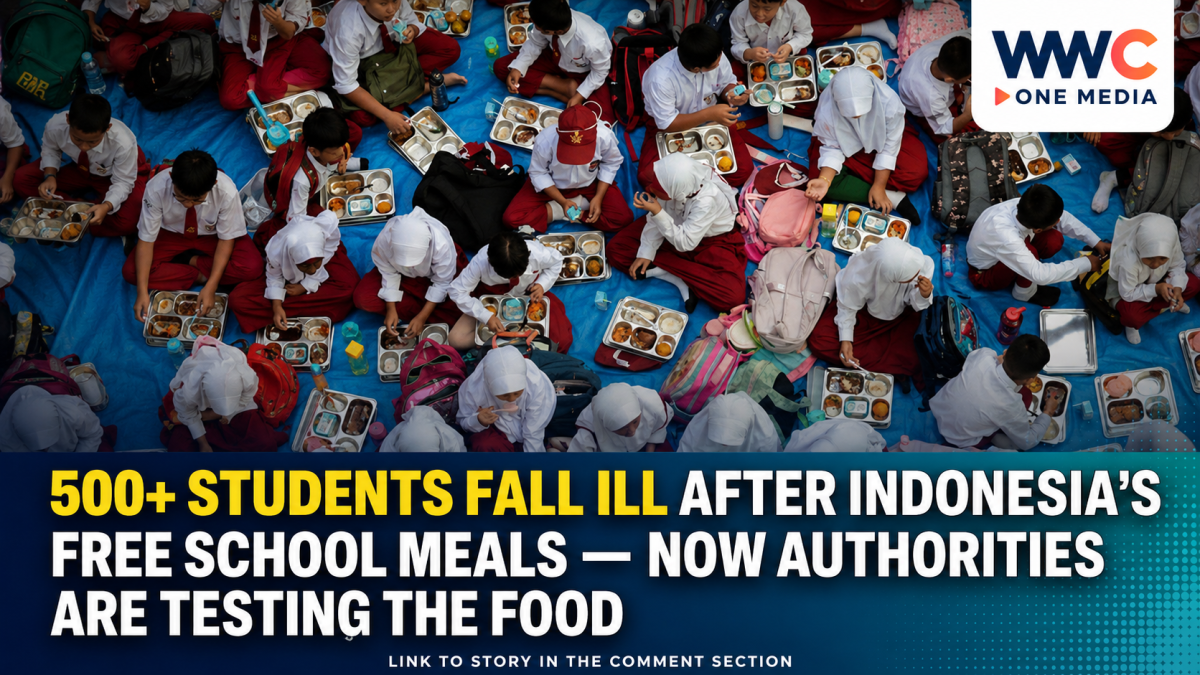
Sidoarjo, Indonesia — More than 500 students in Indonesia’s East Java province have fallen ill and required medical treatment after eating meals supplied through the government’s ambitious free nutritious meals programme, triggering an investigation into whether the food was responsible.
The incident occurred in Sidoarjo, where 516 students were treated at hospitals after developing symptoms consistent with suspected food poisoning, according to local officials cited by CNA and Reuters.
East Java Deputy Governor Emil Dardak said authorities were investigating whether the lunch distributed through the government programme was the source of the illness.
Local government chief Subandi said most of the students treated had already been discharged. Police have also collected samples of the meals for testing as investigators work to determine what caused the outbreak.
FOOD SAFETY QUESTIONS RETURN
The Sidoarjo outbreak has once again placed Indonesia’s Free Nutritious Meals Programme, known locally as Makan Bergizi Gratis or MBG, under intense scrutiny.
President Prabowo Subianto launched the programme in January 2025 as one of his administration’s signature initiatives, with the long-term goal of improving nutrition among Indonesian children and other vulnerable groups.
The programme was designed to eventually reach tens of millions of beneficiaries across the country. But its rapid expansion has repeatedly raised concerns about food safety, logistics, financing and oversight.
Previous outbreaks have already generated thousands of reported cases of suspected food poisoning linked to meals distributed under the programme.
The Network for Education Watch, a non-governmental watchdog, said approximately 37,600 food-poisoning cases had been linked to the programme as of Aug. 8, according to CNA. Authorities have previously cited problems such as improper food storage and delays in delivering cooked meals as potential contributors to food-safety incidents.
A PROGRAM UNDER PRESSURE
The latest incident comes as Indonesia is already attempting to overhaul the programme.
The National Nutrition Agency, which supervises MBG, has been shifting its focus from rapid expansion toward quality, food safety and tighter oversight. The agency has also closed kitchens that failed to meet required standards.
The programme has faced several controversies since its launch, including repeated food-poisoning incidents, allegations of corruption, leadership changes and concerns about its enormous cost.
In June, Indonesia’s government said it was no longer prioritising the original target of reaching 82.9 million beneficiaries as quickly as possible, instead placing greater emphasis on improving implementation and quality.
That change reflects the challenge facing authorities: feeding millions of children every day across an archipelago of more than 17,000 islands requires a huge network of kitchens, suppliers, transporters and food handlers.
WHY THIS MATTERS
The free-meals programme was created to address malnutrition and support children’s development, and Indonesian officials have highlighted potential benefits for students.
Indonesia’s Education Ministry said a national evaluation involving more than 1.2 million student respondents found that schools participating in MBG recorded a greater reduction in learning disruptions caused by hunger compared with schools that had not yet implemented the programme.
But those potential benefits depend heavily on one thing: the meals must be safe.
Earlier reporting by CNA documented other food-safety outbreaks connected to the programme, including incidents in which hundreds or even more than 1,000 students became sick. Some food samples in previous cases were found to contain harmful bacteria, while officials responded by closing kitchens and promising stronger hygiene controls.
THE BIG QUESTION NOW
For families in Sidoarjo, the immediate concern is not the programme’s long-term ambition — it is finding out what made hundreds of students sick.
Authorities are testing food samples and investigating the kitchen and supply chain involved.
Until those tests are completed, officials have not established that the government-provided meals were definitively responsible for the illnesses.
That distinction is important.
The Sidoarjo outbreak is currently being treated as suspected food poisoning, not a confirmed finding that the free-meals programme itself caused the illness.
But with tens of thousands of suspected food-poisoning cases already reported in connection with MBG, the latest incident is likely to intensify pressure on the Prabowo administration to prove that Indonesia can expand one of its biggest social programmes without compromising food safety.
The programme was designed to make sure children do not go hungry. Now, authorities face another urgent test: making sure the food meant to protect them does not put them at risk.
WWC ONE MEDIA MJE

Leave a Reply