
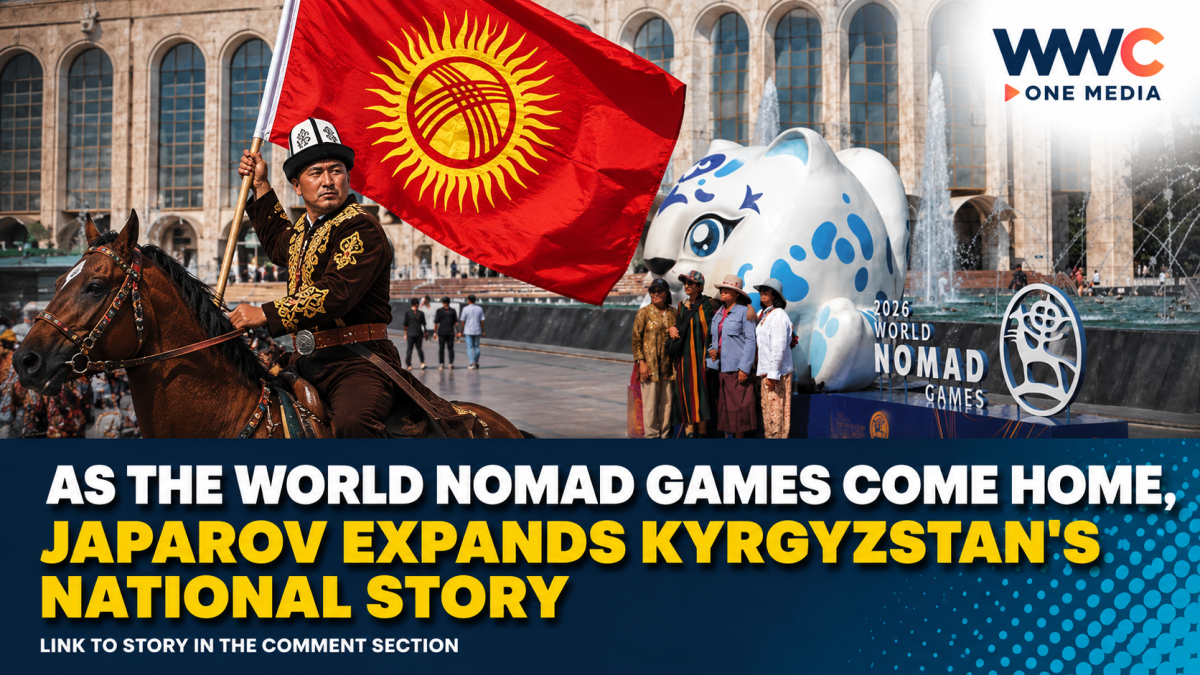
BISHKEK, Kyrgyzstan — Kyrgyzstan is turning the return of the World Nomad Games into far more than a celebration of traditional sports.
As the sixth World Nomad Games opened in Bishkek on August 31, President Sadyr Japarov used the international spectacle to connect Kyrgyzstan’s nomadic heritage with a broader message about national identity, economic development and the country’s place in a rapidly shifting Central Asian landscape.
The timing could hardly have been more significant.
The Games opened on the same day Kyrgyzstan marked the 35th anniversary of its independence, while Bishkek was also hosting a major Shanghai Cooperation Organisation gathering that brought a large group of international leaders to the capital.
More than 100 countries are taking part in this year’s Games, with 104 national teams registered and athletes competing across dozens of traditional sports and cultural disciplines. The competition runs through September 6, with many events centered around the Issyk-Kul region.
A sporting event — and a national statement
The World Nomad Games were created in Kyrgyzstan in 2014 as a showcase for traditional nomadic sports and culture. After the first three editions were held in Kyrgyzstan, the event moved to Turkey in 2022 and Kazakhstan in 2024 before returning to its birthplace this year.
The opening ceremony at Bishkek Arena transformed that heritage into a massive national spectacle.
Thousands of spectators watched performances involving music, dancers, horsemen and visual effects portraying elements of Kyrgyz history and nomadic civilization. About 3,000 performers and hundreds of horsemen were involved in the elaborate presentation, according to reporting from The Diplomat.
The ceremony also brought together prominent international figures, including Russian President Vladimir Putin, Indian Prime Minister Narendra Modi, Turkish President Recep Tayyip Erdogan and Iranian President Masoud Pezeshkian.
That combination of sport, culture and diplomacy has given Kyrgyzstan an unusually large international stage.
Japarov links the past to the future
Japarov’s message went beyond celebrating ancient traditions.
In his address, he presented independence as the foundation of modern Kyrgyzstan while placing nomadic civilization at the heart of the country’s historical identity. He also emphasized international friendship, partnership and the goal of building a stronger and more developed state.
The president also used the occasion to highlight major infrastructure and development projects, including the China-Kyrgyzstan-Uzbekistan railway and the Kambar-Ata-1 hydropower project.
The railway is particularly important because it could strengthen Kyrgyzstan’s role as a transit link between China and Central Asia, potentially reshaping the country’s economic and geopolitical importance.
The Games themselves have also accelerated construction and modernization.
The newly built Bishkek Arena, described by The Diplomat as the largest stadium in Central Asia, became the centerpiece of the opening ceremony. Infrastructure improvements have also included upgrades to the Cholpon-Ata hippodrome, reconstruction at Manas International Airport and road improvements around Issyk-Kul.
From cultural branding to nation-building
The deeper story, however, is about identity.
For years, Kyrgyzstan has sought to strengthen its international image by emphasizing its mountains, nomadic heritage, traditional sports and connection to the wider culture of Central Asia.
Researchers cited by The Diplomat argue that the strategy has also changed how nomadic culture is viewed inside Kyrgyzstan.
What was once sometimes regarded as old-fashioned has increasingly become a source of national pride, influencing fashion, tourism and cultural expression.
The result is a form of nation-building in which cultural heritage is being turned into a modern national brand.
That matters in a country whose post-independence history has included political upheaval and periods of instability.
The World Nomad Games offer an alternative international image: not a country defined by political turmoil, but one presenting itself through history, culture, sport, tourism and regional connectivity.
The political timing is impossible to ignore
There is also a domestic political dimension.
Japarov announced in August that he intends to seek a second presidential term in the election scheduled for January 27, 2027. Reuters reported that the announcement was his first public confirmation of his intention to run again.
That puts the Games, new infrastructure and high-profile international gatherings in an important political context.
Analysts cited by The Diplomat argue that Japarov’s administration can use the events and development projects as evidence of progress ahead of the election.
In other words, the World Nomad Games are simultaneously a cultural celebration, an international diplomatic showcase and an opportunity for the government to demonstrate what it says is a changing Kyrgyzstan.
Why the Games matter beyond Kyrgyzstan
The event is also expanding well beyond its Central Asian roots.
Traditional competitions include horseback sports, archery, wrestling and other forms of ethnosport. This year’s edition has attracted participants from countries outside the traditional nomadic heartland, including Australia, New Zealand, the United Kingdom and several African and Middle Eastern nations.
That expansion is important because it transforms the Games from a regional cultural festival into an increasingly global platform.
The official World Nomad Games organization describes the event as combining three major pillars: ethnosport, ethnoculture and science/traditional knowledge.
For Kyrgyzstan, that creates a rare opportunity to export a national story to an international audience.
The bigger picture
The return of the World Nomad Games is therefore about much more than horses, wrestling or traditional competitions.
Kyrgyzstan is presenting its nomadic past as part of a modern national identity — while simultaneously showcasing new infrastructure, international partnerships and ambitions for greater economic connectivity.
For Japarov, the timing is particularly powerful: the country is celebrating 35 years of independence, global leaders are gathering in Bishkek, the Games have returned to their birthplace, and a presidential election is approaching.
The message is clear: Kyrgyzstan wants the world to see not only where it came from, but where it believes it is going.
And with the World Nomad Games now back on home soil, the question may be whether this cultural showcase becomes something much larger — a lasting transformation in how Kyrgyzstan sees itself, and how the world sees Kyrgyzstan.
WWC ONE MEDIA. G.A



Leave a Reply