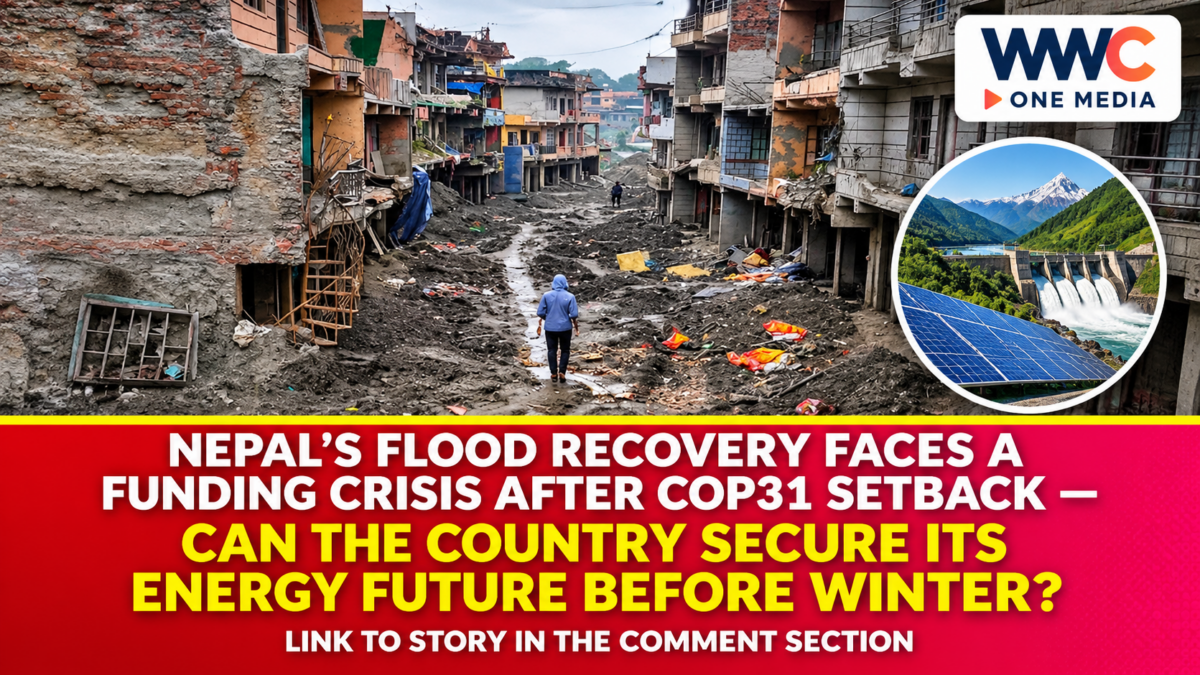
KATHMANDU, NEPAL — Nepal is confronting an enormous reconstruction challenge following the devastating floods of August 26, 2026, as international climate negotiations concluded without their intended major political agreement and the country continues to address disruptions to its hydropower infrastructure.
The Nepal flood recovery effort faces preliminary reconstruction requirements of approximately US$4.8 billion, while economic growth is projected to slow to 3.7% in fiscal year 2027.
With winter approaching, the challenge extends beyond repairing damaged infrastructure. Nepal must secure reliable electricity supplies, mobilise reconstruction financing and strengthen its defences against future climate-related disasters.
India has announced a development assistance package worth NPR 240 billion, providing a potential financing avenue at a critical time for the Himalayan nation.
Nepal Flood Recovery Carries a US$4.8-Billion Price Tag
The August disaster damaged essential infrastructure and disrupted economic activity across multiple sectors.
Preliminary reconstruction estimates place infrastructure at approximately 65.5% of Nepal’s total recovery requirements.
The scale of those requirements illustrates the long-term financial challenge confronting a country that must address immediate humanitarian needs while rebuilding facilities essential to economic development.
The economic consequences are expected to affect energy, transportation, trade and tourism.
Damage to electricity infrastructure can restrict industrial production, while disruptions to transportation networks can complicate the movement of construction materials, commercial goods and emergency supplies.
WWC ONE MEDIA previously examined the scale of the disaster in its coverage of Nepal’s flood recovery requirements and international climate financing.
The reconstruction effort now presents a difficult question: how can Nepal finance its immediate recovery while investing in infrastructure capable of withstanding future disasters?
Nepal’s Electricity Security Faces a Winter Test
Energy security has become an important component of the country’s recovery.
On Sept. 14, 2026, India announced temporary approval for electricity exports to the Nepal Electricity Authority, covering the period from Sept. 13 to Dec. 31, 2026.
The approval established a combined maximum capacity of 654 megawatts across two cross-border transmission connections.
The authorised supply comprises up to 600 MW through the Muzaffarpur–Dhalkebar transmission line and up to 54 MW through the Tanakpur–Mahendranagar connection.
However, the arrangement authorises exports for only 18 hours each day, between midnight and 6 p.m.
The remaining six hours are outside the scope of that particular approval.
Importantly, the approved transmission capacity represents a maximum permitted supply rather than a guarantee that Nepal will receive that quantity continuously.
India indicated that electricity export volumes from January 2027 would be reviewed in December 2026.
The importance of cross-border electricity arrangements was previously explored in WWC ONE MEDIA’s report on Nepal–India power cooperation and its implementation challenges.
COP31 Ends Without Its Main Political Agreement
Nepal’s reconstruction challenge coincides with uncertainty surrounding international climate cooperation.
COP31, the United Nations climate conference in Antalya, Türkiye, concluded on Nov. 22, 2026, without agreement on its principal presidency-led political outcome.
The conference nevertheless achieved progress in several areas, including climate technology, adaptation and the implementation of existing international commitments.
The failure to reach the intended political agreement therefore does not mean that every climate initiative or financing mechanism was abandoned.
However, it highlights the continuing difficulty of establishing international consensus on climate priorities.
For countries confronting extensive disaster-related infrastructure damage, the distinction between negotiations, approved funding and actual financial assistance remains particularly important.
The wider outcome is examined in WWC ONE MEDIA’s coverage of the COP31 climate agreement setback and the measures countries managed to advance.
Nepal Pushes for Greater Recognition of Mountain Climate Risks
Nepal sought to strengthen international attention to the consequences of climate change in mountain regions.
An official submission published on Oct. 30, 2026, proposed adding 1.5°C warming in mountains to the COP31 agenda.
The proposal placed the vulnerability of mountain environments within the wider international adaptation discussion.
For Himalayan countries, climate resilience and infrastructure development are closely connected. Hydropower investments, water management and transportation networks must be considered alongside the natural hazards that can threaten them.
The absence of a comprehensive COP31 political agreement leaves questions about the future direction of international cooperation on these issues.
Separately, the Fund for Responding to Loss and Damage announced on Oct. 22, 2026, that it had provisionally reserved US$21.6 million for Nepal following the catastrophic Bhote Khosi floods.
The allocation is substantially smaller than the country’s estimated overall reconstruction requirements.
It also remains important to distinguish a provisional funding reservation from money that has received final approval and reached implementing institutions or affected communities.
India’s NPR 240-Billion Package Offers Another Financing Avenue
During Nepalese Prime Minister Balendra Shah’s state visit to India on Nov. 22–23, Indian Prime Minister Narendra Modi announced a development assistance package worth INR 150 billion, equivalent to NPR 240 billion.
The package contains two distinct components:
- NPR 56 billion in grants for disaster reconstruction and new infrastructure.
- NPR 184 billion through a rupee-denominated credit facility for energy-sector projects.
The grants represent approximately 23.3% of the total package, while the credit component accounts for approximately 76.7%.
Unlike grants, credit facilities generally create repayment obligations under their agreed financial terms.
The specific projects and implementation arrangements will be determined through consultations between the two governments.
Both countries also reaffirmed their commitment to broader cooperation involving hydropower development, regional electricity trade and infrastructure investment.
Further details of the bilateral assistance programme are covered in WWC ONE MEDIA’s report on India’s development financing package for Nepal.
What Happens Next for Nepal’s Energy and Economic Recovery?
Nepal’s immediate priorities include maintaining electricity availability, securing reconstruction funding and establishing the projects that can benefit from announced international assistance.
December’s scheduled review of Indian electricity export approvals will be an important development for Nepal’s short-term energy planning.
The government must also advance arrangements for the newly announced development assistance package and pursue the implementation of international disaster-related financing.
For the wider Asia-Pacific region, Nepal’s experience illustrates the financial and operational challenges that can arise when climate-related disasters damage essential energy and transportation infrastructure.
The longer-term outcome will depend on how effectively announced commitments are converted into completed projects and dependable public services.
Rebuilding Nepal’s electricity infrastructure is not simply a construction challenge. It is also a question of financing, regional cooperation and the resilience of future economic development.
Frequently Asked Questions
How much does Nepal need for flood recovery?
Preliminary estimates place recovery and reconstruction requirements at approximately US$4.8 billion.
Did COP31 reach a major climate agreement?
COP31 concluded on Nov. 22, 2026, without its intended principal presidency-led political agreement, although progress was achieved in several other areas.
How much climate loss-and-damage funding was provisionally allocated to Nepal?
The Fund for Responding to Loss and Damage provisionally set aside US$21.6 million. This does not establish that the money has already been disbursed.
How much financial assistance has India announced for Nepal?
India announced NPR 240 billion in development assistance, comprising NPR 56 billion in grants and NPR 184 billion in energy-sector credit.
How much electricity can India export to Nepal under its September approval?
The temporary approval permits up to 654 MW through two transmission connections for 18 hours daily until Dec. 31, 2026.